Twelve years old, and Marisol Vega could already hold a penché like the older girls at Lakeshore Ballet Academy — spine long, standing leg trembling just enough that you knew it was real work, not a trick. Her teacher, Miss Okafor, used to say the girl had "unfinished hands," the kind that still needed a few more years to stop looking like a child's and start looking like a dancer's. That was fine. Marisol had time. What she didn't have was six hundred dollars for the spring intensive at the Rockford School of Ballet, the one every serious student in the Milwaukee studio circuit was talking about that April.
Her mother, Priscilla, worked the overnight stocking shift at a grocery distribution center off Highway 41, and her father had been gone since Marisol was four — not dead, just gone, the kind of gone where birthday cards stopped arriving around second grade. It was Priscilla's mother, Marisol's grandmother Ida, who'd raised the girl half the time, picking her up from the Y after school, sitting through three-hour Nutcracker rehearsals on a folding chair with a thermos of coffee going cold.
Ida was the one who found the flyer for the intensive stapled to the studio bulletin board, right under a faded notice for a lost cat. She stood there in her church coat reading the fine print twice, then took a photo of it with her flip phone, which barely worked, and texted the blurry picture to Priscilla with just: "look."
Six hundred dollars for two weeks. Housing not included, though Rockford was close enough to drive. Auditions in three weeks. Ida had eleven hundred dollars in a coffee can in her kitchen cabinet, money she'd been saving toward a headstone for her husband, who'd died the previous winter and was still under a temporary marker at Graceland Cemetery. She didn't tell anyone that's where the money for the intensive came from. She just told Priscilla she'd "found some extra" and handed her four hundred dollars in twenties, folded so tight they looked like they'd been ironed.
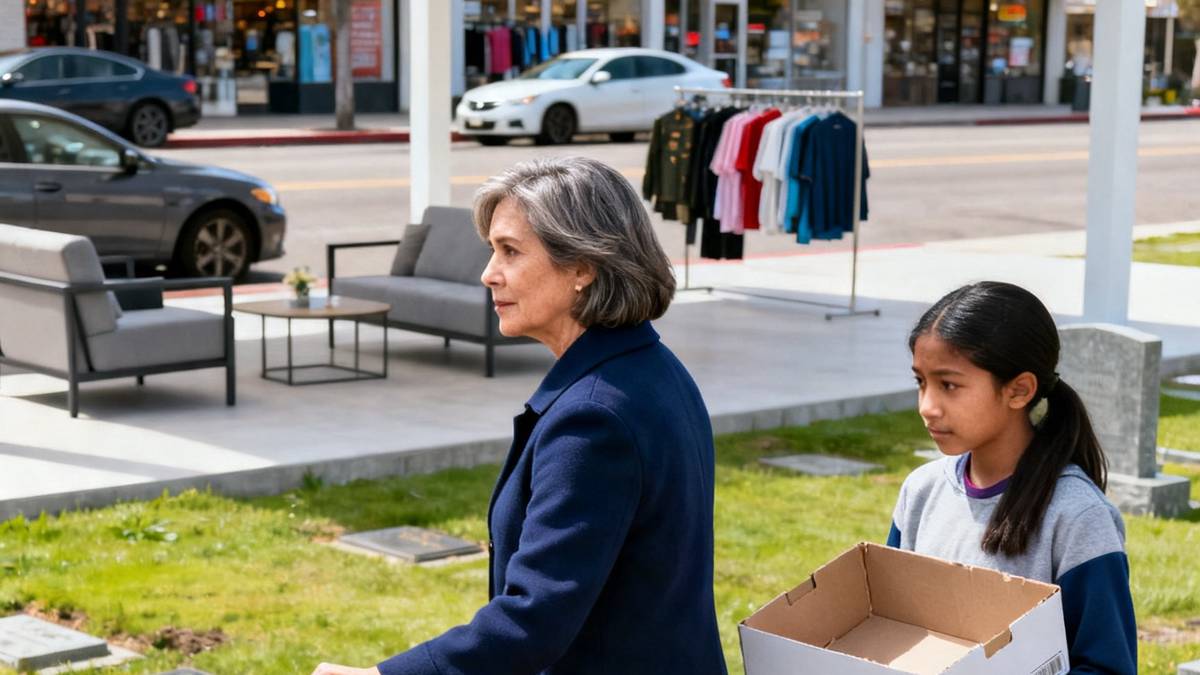
Marisol didn't know any of this. What she knew was that her grandmother showed up to the audition in the same navy coat she wore to Mass, sat in the back row of folding chairs at the Rockford studio, and mouthed the counts along with the pianist like she could somehow will her granddaughter's feet into the right place from thirty feet away.
Marisol got in. Not on scholarship — full price, all six hundred dollars, no financial aid because the school claimed the program was already subsidized as much as it could be. Ida paid it in cash at the front desk in an envelope, and the woman behind the counter counted it twice in front of her, which Ida understood, because it was a lot of crumpled bills for something that was supposed to come from a bank account.
The two weeks were brutal in the way twelve-year-olds don't yet have language for. Six hours a day. A teacher from Chicago named Madame Rosalind who corrected Marisol's turnout so many times the girl cried in the bathroom on day four, quietly, running the sink so no one would hear. Ida drove her every single day, forty minutes each way, waited in the parking lot in the Buick with the heat running because it was still cold enough in April in Wisconsin, and never once said a word about the drive or the gas or the eleven hundred dollars that was now down to almost nothing.
On the last day, there was a showing — not a recital, just an informal demonstration for families, folding chairs again, fluorescent lights instead of stage lights. Marisol danced a variation from Coppélia that she'd learned in ten days flat. Halfway through, her ankle rolled slightly on a pirouette — not a fall, just a wobble, the kind that made her jaw tighten because she knew Madame Rosalind was watching. She finished the combination anyway, landed the final pose a half-beat late, chest heaving.
Ida was the only person in that room standing when it ended. Everyone else clapped politely, phones half-raised for photos of their own kids. Ida stood in her navy coat with her hands pressed together in front of her chest, not clapping exactly, just holding them there like she was praying, and Marisol saw her from the floor and had to look away fast so she wouldn't cry in front of Madame Rosalind.
Afterward, in the parking lot, before Ida even started the car, Marisol said, "I wobbled. Everyone saw."
"I didn't see a wobble," Ida said. "I saw a girl who didn't fall down."
Marisol didn't answer that. She looked out the window at the Rockford strip mall — a Culver's, a nail salon, a vacant storefront with butcher paper over the windows — and picked at a loose thread on her tights.
It was three months later, in July, that Marisol found the folded piece of paper in the bottom of Ida's church purse while looking for a stick of gum. It was a receipt from Kowalski & Sons Monuments, dated the previous November: a deposit of four hundred dollars toward a granite headstone, balance due upon completion, current balance shown as still owed in full. Marisol sat on her grandmother's kitchen floor with the receipt in her lap for a long time before she understood what she was looking at — that the four hundred dollars Ida had given her mother for the intensive was money that should have gone to her grandfather's grave, which still had nothing on it but a small metal marker with a stamped number, the kind the cemetery gives you until the real stone goes up.
She didn't say anything that day. She put the receipt back exactly where she found it, folded the same way, and went home and didn't sleep much.
What Marisol did instead, over the following two weeks, was babysit. She'd been doing odd jobs around the neighborhood already — watching the Hendricks twins down the block on Tuesday afternoons, walking a neighbor's arthritic beagle named Gus for five dollars a walk — but now she added Saturdays, and she stopped spending the money on anything. No smoothies after class, no nail polish from Walgreens. She kept the bills in an old shoebox that used to hold her first pair of pointe shoes.
By late August she had a hundred and ten dollars, which she knew wasn't close to enough, so she did something she'd never done before: she called Kowalski & Sons herself, using the studio's landline because she didn't have a cell phone yet, and asked the man who answered how much the headstone actually cost and whether you could pay in pieces. He told her the total was seven hundred and fifty dollars, the deposit already covered four hundred of it, and yes, they did payment plans, people did it all the time.
She told her mother that night, at the kitchen table, sliding the shoebox across to her like evidence. Priscilla went very still, turned the receipt over in her hands twice, and said, "I didn't know. She told me she found extra money. I didn't ask where."
Two days later, on a Sunday, the three of them — Priscilla, Marisol, and Ida, who still didn't know anything was happening — drove to the monument company together, Ida in the back seat asking why they were going out of their way to run errands in Waukesha. In the small showroom full of granite samples leaned against the wall like library books, Priscilla set a hundred and ten dollars on the counter along with two hundred and forty dollars of her own, money she'd pulled from a cash advance she'd been avoiding taking, and told the clerk to put the rest — the remaining hundred — on a payment plan in her name.
Ida didn't understand what was happening until she saw the paperwork, until she saw her husband's name — Edward Vega, 1951–2025 — typed on the order form for a stone that would finally replace the temporary marker. She put her hand flat on the counter like she needed it to stand up straight, and looked at Marisol, who was holding the empty shoebox against her chest.
"That was your ballet money," Ida said.
"It was your money first," Marisol said. "You just gave it to the wrong thing."
The headstone went up six weeks later, granite, Edward's name and dates and, underneath, the line Ida had chosen years before he died: *Loved without limit.* Ida stood at the grave with both granddaughters — Marisol's younger cousin had come along too — and didn't say much of anything, just reached down and brushed a few stray blades of cut grass off the base of the stone with the side of her hand, the way she used to smooth the front of Marisol's leotard before every rehearsal.
Marisol never did another summer intensive at Rockford. The following spring, Miss Okafor helped her apply for an actual scholarship at a company school in Chicago, the kind with an application fee waived for financial need, the kind that didn't require anyone to empty a coffee can meant for a dead man's grave. She got in. Ida drove her to that audition too, same navy coat, same folding chair in the back row, mouthing the counts.