Everybody in Millbrook, Ohio, knew Ray Costanza as the guy who fixed generators for the volunteer fire department for free. Nobody knew he'd once played a wounded soldier in a movie that made grown men cry in theaters. He never brought it up. If you asked, he'd shrug and say, "That was a long time ago," and change the subject to the weather or the Bengals.
Ray was seventy-one now. He'd started out at nineteen, dropping out of community college to help a handful of friends turn an abandoned Elks Lodge into a scrappy little theater. Nobody had money. Nobody had a plan past the next Saturday's show. But something about that drafty building with the leaky roof kept pulling people back, and twenty years later, one of the plays he did got him cast in a war movie — playing a soldier who lost both legs to a landmine. The film won awards. Ray didn't. But something stranger happened: veterans started stopping him at gas stations, at diners, in the parking lot of the hardware store. They didn't always want a picture. Sometimes they just wanted to say, "That was me. That was my leg."
So Ray started showing up at VA hospitals. Then overseas bases. Then he put together a little band — nothing fancy, a drummer, a bass player, and him on rhythm guitar — and they played free shows for soldiers and their families wherever they'd have them. Over the years that turned into hundreds of shows, some on aircraft carriers, some in places most actors wouldn't fly into for a paycheck. By 2010, Ray had turned it into something with a name and a tax ID: the Costanza Family Foundation, built to help veterans, first responders, and their families — and, more specifically, to build homes. Custom homes. Wheelchair-width doorways, roll-in showers, lowered countertops. Paid off completely before the family ever moved a box inside.
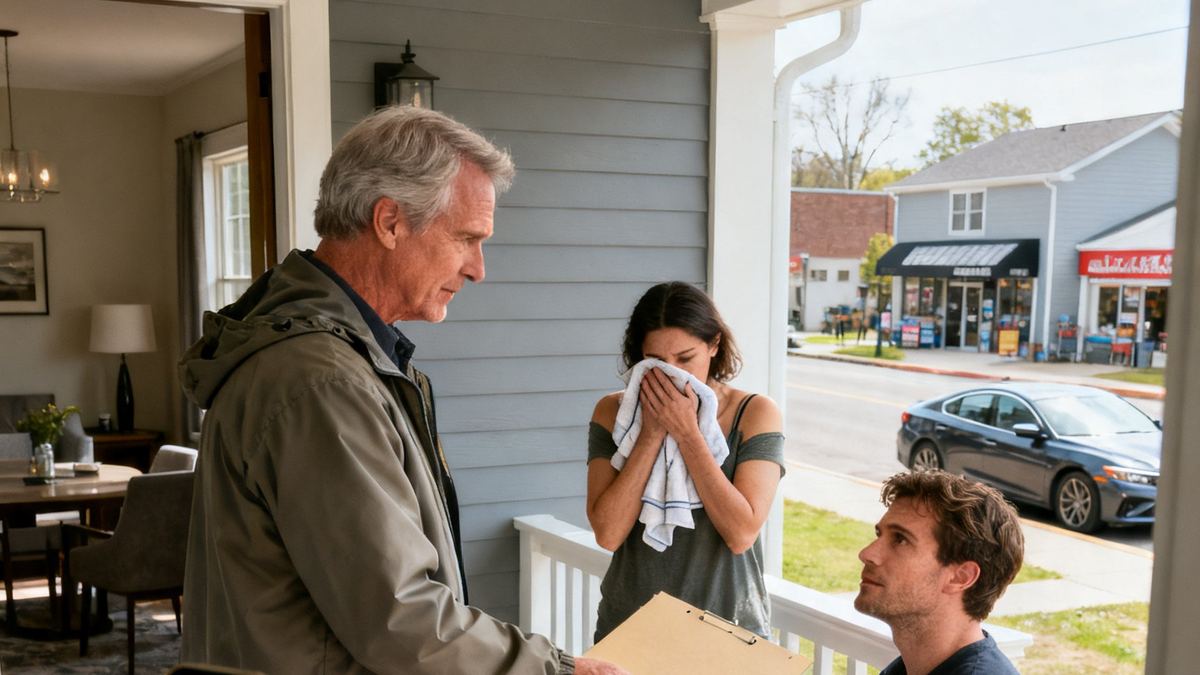
That November, on Larkspur Lane in a subdivision outside Dayton, the foundation handed over its hundredth mortgage-free home to a Marine sergeant who'd lost both legs in Helmand Province. Ray stood on the porch in a windbreaker, holding a manila folder with the deed inside — no bow on it, no ribbon, just a plain folder — and handed it to a twenty-nine-year-old named Danny Ferro. "It's yours," Ray said. "All of it. Nobody's name on this but yours." Danny's mother cried into a dish towel she'd brought from the kitchen for no reason at all.
Nobody in that crowd on Larkspur Lane knew that eight years earlier, Ray had needed a house like that himself — not built, but held together.
In the spring of 2018, Denise Costanza was rinsing shampoo out of her hair when her fingers caught on something the size of a pea, just under her collarbone. She stood there under the water until it ran cold, pressing at it with two fingers to make sure it was real. By Friday a radiologist in Columbus was circling something on a scan with a grease pencil. Stage 3 breast cancer.
Two months into her chemo, Ray was at the kitchen table paying bills when Peter called. Peter was thirty then, a session guitarist who'd inherited Ray's ear for music, and he'd been getting headaches he blamed on cheap studio monitors. "They found something at the base of my spine," he said. "The doctor had to Google it before he told me what it was." Chordoma. Ray wrote the word on the back of an envelope because he didn't trust himself to remember it, then sat with Denise's oncology bills spread out in front of him and Peter's diagnosis on the phone, and didn't say anything for a long moment.
The network calling about the recurring role reached him two days later. Ray stood in the garage with his cell phone and a coffee mug going cold on the workbench. "I can't," he told the casting director. "I've got two people in this house who need me more than your show does." He hung up before she finished apologizing, and went back inside to help Denise into a chair by the window, where she liked to watch Waffles patrol the fence line.
"Home health aides, overnight nursing, the equipment you need when someone can't walk to the bathroom anymore — insurance doesn't cover half of it," Ray told a local reporter once, the only interview he gave that whole stretch. "I was lucky. I'd had a career that let me pay for what she needed without staring at a number on a bill and deciding what we could live without."
Denise responded to treatment. By early 2019 she was in remission, and she started walking Waffles again every morning at six, the beagle straining at the leash toward the mailbox like nothing had happened. Peter's fight went differently. He kept writing songs the whole five years he had left, recording tracks in the spare bedroom on a laptop propped on two phone books, plugged into a secondhand mixer with a cracked fader. Toward the end, Ray would sit in the doorway and listen without going in, because Peter got embarrassed if he caught him crying at a chord change.
On January 4, 2024, Peter asked Ray to bring the laptop over to the hospital bed they'd set up in his old bedroom. His hands weren't steady enough to work the mixer anymore, so he hummed the bridge of a song he'd never finished and had Ray write down the words. He died the next morning. He was thirty-three. The laptop sat open on the nightstand for three days before anyone could bring themselves to close the lid.
Ray never went back to acting full-time. He'll narrate a documentary now and then, show up at a ribbon-cutting, sit for an occasional interview when a journalist tracks him down about the foundation. But the shape of his week isn't built around scripts anymore. It's built around Denise, around his four grandkids, around the foundation's retreats for military families, the vans retrofitted with hand controls, the wheelchair ramps poured one driveway at a time in towns most people couldn't find on a map.
The Elks Lodge theater is still running — different name now, same drafty roof, mostly patched. The foundation is still building. And in a hundred homes scattered across the country, including the one on Larkspur Lane, there's a folder in a kitchen drawer with a deed inside that says nobody owes anybody anything for the roof over their head.
In the house on the street where it started, a different folder sits in a different drawer — Peter's unfinished lyrics, copied onto a legal pad in Ray's handwriting — and every morning at six, Denise clips the leash onto a graying beagle and walks him to the mailbox and back.