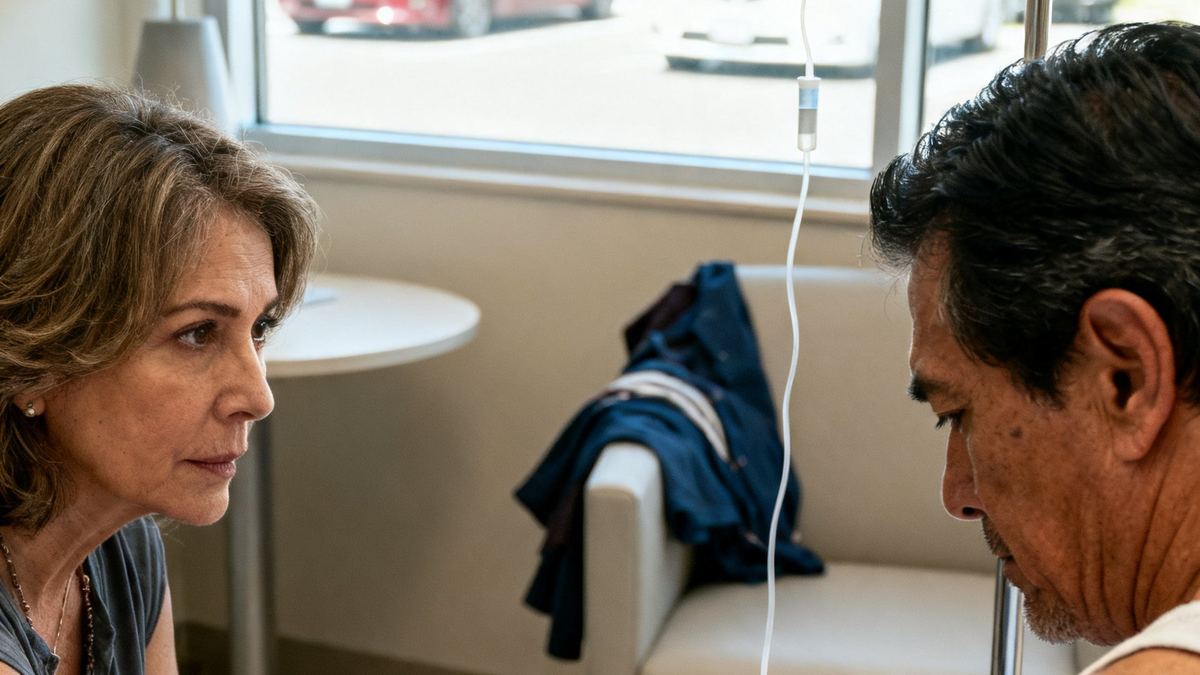
I called Dale my son for the first time in a hospital hallway in Ohio, in March, three years ago. The word came out before I could stop it. Twenty years I'd known that man, and I'd never once called him by his name without gritting my teeth first.
I want to say that clearly, because it still shames me. Twenty years, and I couldn't manage it.
My daughter Renee brought him home the November she turned nineteen. Wet snow on the windows, slush tracked across my kitchen linoleum from a pair of steel-toed boots two sizes too big for my hallway rug. He was twenty-one. A framer, working new builds out past the highway, originally from somewhere in West Virginia, no family to speak of, renting a room above a laundromat on Ash Street.
I raised Renee and her brother Marcus alone after my husband died young. Worked twenty-six years as a claims processor at an insurance office downtown, saved what I could, wanted better for my daughter than a boy who showed up with drywall dust still in his hair. I wanted a son-in-law I could brag about to Carol next door — a dentist, an accountant, somebody with a business card.
Instead there was Dale, perched on the edge of my kitchen chair like it might collapse under him, hiding his hands under the table. When he finally put them on the table to reach for his coffee, I saw the calluses, the split knuckle that never healed right, grout permanently gray in the creases.
"Mom, this is Dale," Renee said, turning red.
He nodded at me. Didn't say a word the whole evening. I decided privately she'd tire of him inside a year. I was wrong. Six months later they got married at the county courthouse, no reception, because neither of them had two nickels to rub together. They moved into his room over the laundromat, then eventually a one-bedroom he'd saved up for himself on the east side, near the rail yard.
My son Marcus was the one I doted on. Tall, quick with a joke, went into welding like his father before him. I forgave him everything — the missed calls, the move three states away for a better paycheck, the holidays he skipped because "shift's crazy, Ma, you understand."
Dale I kept at arm's length for two decades. He reroofed my garage on his own time, hauled the old shingles down on his back over two Saturdays. I handed him a mug of coffee and muttered a thank-you, then went out to weed the tomatoes so I wouldn't have to sit across from him. He never complained. Packed up his tools, caught the bus home because they didn't own a car yet.
He rewired outlets in my house, hauled potatoes by the sackful from some farm stand that sold them cheap, and for my birthday he'd bring practical gifts — a good kettle, a warmer throw blanket — never once meeting my eyes when he handed them over, like he was apologizing for existing.
I took it all as owed to me. My friend Diane finally snapped at me over lunch one Tuesday.
"Ellen, what is wrong with you? That man is a gift and you treat him like garbage. Mine hasn't hung a picture frame in twenty years and yours works around the clock. Leave the poor guy alone."
"You don't understand him, Diane," I said. "He's ordinary. There are a thousand men just like him on any street corner. Renee will get bored. Mark my words — they won't last."
Wrong again. Renee had my granddaughter, Sophie, and they kept living quietly on the east side, no drama, no scandal. I kept waiting for him to slip, to show his true colors. I was so sure of it I nearly missed the winter it all came apart.
Renee got hit by a car on a patch of black ice in January, crossing at the light near the Kroger on Fifth. Groceries scattered across the crosswalk. The driver couldn't stop in time on the ice, though thank God he wasn't going fast.
The hospital called that night and didn't soften it — spinal fracture, pelvic fracture, no guarantee she'd walk again. I slid down the kitchen wall with the phone still in my hand.
Relatives came at first. My cousin drove in from Dayton. Neighbors dropped off casseroles. Diane baked. Everybody wrung their hands and told me to call if I needed anything.
By day four, they'd scattered back to their own lives — gardens, grandkids, blood pressure appointments.
I called Marcus that same first night. He's my son. He should know.
"Ma, I'll drop everything," he said. "Soon as this shift clears I'm driving up, I promise." He wired five hundred dollars once. Called weekly to ask how things were. Never once got in the car.
Dale, meanwhile, seemed to split himself into three people. He took unpaid leave from the framing crew, then picked up nights laying tile on some renovation job just to keep cash coming in. Days, he sat with Renee. Nights, somebody's bathroom floor. In between, he got Sophie ready for school, braided her hair with those enormous hands, checked her homework, made dinner.
I'd come by mornings to relieve him and find the same scene every time: him hunched in a chair by the bed, hadn't slept, eyes red but steady. Spoon-feeding Renee. Adjusting her pillows. Turning her carefully so nothing hurt, murmuring something too low for me to catch.
His bad leg — hurt years back on a job site, never set right — carried her to the bathroom and back without a single complaint. I caught him once, leaned against the hallway wall catching his breath. He straightened up when he saw me, gave a guilty half-smile.
"Go rest, Ellen. I've got this."
He always had it.
Then my own heart gave out on me that February. Ambulance, a shot of something, strict orders to stay flat. Lying in my apartment on Meridian Avenue, I finally understood the hole our family had fallen into. Renee bedridden on the east side. Me bedridden on Meridian. Sophie, eleven years old, shuttling between two houses. Marcus wearing himself thin three states away. And one man — one — crossing the whole city on a bus that never ran on time, back and forth, back and forth.
He started coming to me too. Brought soup in a pot, heated it on my stove. Sorted my pills into a plastic organizer so I wouldn't mix them up. Took my blood pressure with his own cuff, wrote the numbers in a notebook for the doctor — mine and Renee's both.
Sat next to my bed. Didn't ask anything of me.
I lay facing the wall, burning with shame. Twenty years of forced thank-yous, and this man was spoon-feeding me like a child.
"Dale," I said into the dark one night. "You're running yourself into the ground. Go home."
He tucked the blanket around my shoulders and answered plainly, no resentment in it at all.
"Where would I go, Ellen. You're Renee's mother. That makes you mine too."
He walked out. I lay there and cried into my pillow so he wouldn't hear — the first time I'd cried like that in years.
That March, Renee spiked a fever in the middle of the night, started talking out of her head. Dale showed up at my door before sunrise, gray in the face.
"Ellen, come with me. I'm scared something's really wrong."
I dressed and went with him across the city, on foot, through wet March slush, no buses running yet. He held my elbow so I wouldn't slip, limping worse than usual — the winter had worn him down to nothing.
We found Renee thrashing, sheets twisted, forehead burning. My hands shook uselessly. His didn't. He wiped her down, got water, changed the compress, called the doctor's after-hours line, all with those big gentle hands.
By dawn her fever broke. She slept. We sat together by her bed, two wrung-out people, saying nothing.
Then I reached over and took his hand. First time in my life. That calloused hand, scarred, grout worked so deep into the knuckles no soap ever got it out.
"Thank you, son," I said. I felt myself shake saying it. He shook too. Looked up at me — something warm and young in his face — then turned away fast, wiped his palm across his jaw.
"Come on now, Ellen. We're family."
Family. Twenty years a stranger, and he turned out to be the closest thing to blood I had.
I'd spent a lifetime saving my love for Marcus like a hope chest, forgiving him everything, charging Dale double for nothing. I kept waiting for the blood relative to prove himself when it counted. He did — with a shrug and a phone call that never turned into a car in my driveway. The man I never counted as family didn't move an inch.
I couldn't forgive myself for a long stretch after that. I lay in bed running back through every clipped "Dale," every time I'd turned my back on him in the garden, every reluctant cup of coffee. It burned — like I'd been stealing from a good man for twenty years while he kept thanking me for it. I'd spent my whole life watching the wrong person for betrayal.
Renee came back from it. Walker by summer, cane by fall, cane in the closet before Thanksgiving. Her doctor just shook his head — young, strong, and, he said, remarkable care at home. Remarkable. If he only knew whose.
She relearned walking down that hallway with her hand on Dale's shoulder, the same way he'd once walked Sophie to her first day of kindergarten. Both of them laughing at every step like it was a miracle.
Six months after Renee came off the cane, I drove to a lawyer's office on Fourth Street with a folder under my arm — the deed to my house on Meridian, the one Marcus always assumed would be his, the one he used to joke about at Christmas like it was already settled. I sat across from the attorney and had it redrawn: the house goes to Renee and Dale, free and clear, the day I'm gone. Forty-one thousand dollars of equity, paid off in full, no mortgage left on it. I signed my name three times and watched the notary stamp it.
I called Marcus that evening to tell him. He went quiet on the phone for a long stretch, then asked if I was serious, if I understood what I was doing.
"I understand exactly what I'm doing," I told him. "I'm giving it to the one who showed up."
He hasn't called much since. That's all right. I know now which door to knock on when I need somebody, and it isn't the one three states away.
Now I sit in Renee and Dale's kitchen on the east side most Sundays and watch his hands stir a pot of coffee — the same hands I used to flinch away from. They roofed my garage. They fed me from a spoon. They carried my daughter to the bathroom and back for two winters straight. Good hands. I spent twenty years looking past them.
I call him son now. Doesn't take any effort anymore. It just comes.