I set five places at the table every Thanksgiving for eleven years, and every year my father's chair stayed empty. Not because he was dead. Because he chose not to come.
My name is Marisol Duarte. I grew up in a two-bedroom rental on Pine Street in Tucson, Arizona, the kind of house where the swamp cooler rattled all summer and you could hear the neighbor's rooster three lots over. My mother, Elena, worked the early shift at a laundry service on Speedway Boulevard, folding other people's sheets for nine dollars an hour, and my father, Rodrigo, lived across town — close enough to drive over in fifteen minutes, far enough that he never did.
He wasn't gone. That's the part people don't understand when I try to explain it. He had a new apartment, a new girlfriend, eventually a new set of kids. He showed up to my eighth-grade graduation forty minutes late, stood in the back with his sunglasses still on, and left before they called my name for the honor roll certificate. He sent fifty dollars in a birthday card twice — I remember because the second time the card was for the wrong birthday, a "Happy 10th" when I'd just turned twelve.
My mother never badmouthed him. She'd just say, "He's your father, mija, that's not going anywhere," and go back to ironing.
I used to sit on the porch steps on Sunday afternoons because that was supposedly his day. I'd watch cars slow down at the stop sign on the corner and speed back up. By six o'clock I'd go back inside and pretend I hadn't been waiting. My mother knew. She'd have the radio on, some Vicente Fernández record turned up loud enough that neither of us had to talk about it.
Here's the sum of it, if you want a number: over eleven years, he missed thirty-one birthdays and holidays combined. I counted once, in a notebook, the way some kids count stars. Thirty-one.
I got married at twenty-six, in a backyard in Sahuarita with string lights and folding chairs borrowed from the VFW hall. I didn't invite him. My mother asked if I was sure. I was.
The turn came four years later, when I was thirty and had a daughter of my own, Camila, eighteen months old. My mother had a stroke on a Tuesday morning in March — I remember because it was the same week the saguaros were starting to bloom, that thick sweet smell that hangs over the desert for about ten days a year. She survived it, but her left side never came all the way back, and she couldn't keep working the laundry line.
That's when Rodrigo resurfaced. Not for her. For the house.
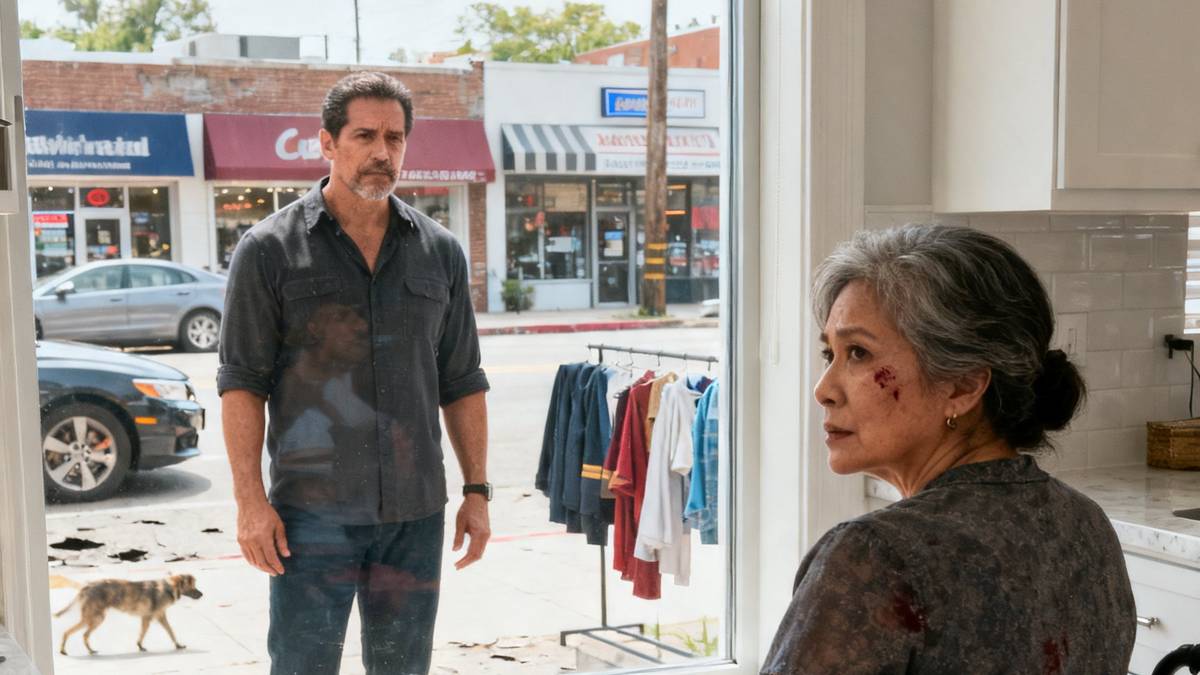
Turns out the little place on Pine Street — the one my mother had paid the mortgage on alone since I was six — still had both their names on the deed from the divorce paperwork nobody had ever bothered to fix. He showed up on a Saturday afternoon in his F-150, walked in without knocking, and told my mother, sitting in her wheelchair by the kitchen window, that he'd found a buyer and needed her signature by the end of the month. Eighty-five thousand dollars, split down the middle. His half would cover, he said, "some debts."
I was there refilling her water glass when he said it. He didn't even look at her while he talked — he was looking at the stove, the cabinets, doing math in his head.
My mother didn't raise her voice. She asked him to leave.
He didn't leave right away, though. He stood in that kitchen for a good five minutes, going on about how the house was "half his by law," how she'd had her chance to buy him out years ago, how he wasn't the villain here — he was just a man who needed money, and family was supposed to help family. Camila started crying in the other room. I went to get her, and when I came back he was gone, his truck already pulling off Pine Street, gravel popping under the tires.
That night my mother asked me to bring her the folder from the top of the hall closet — the one with the property papers, insurance, the original deed. Her hand shook holding the pen, but her signature was steady enough. Not on a sale. On a quitclaim she had a paralegal at the community law center draw up the following week, the one where Rodrigo signed away his interest in the house eleven years earlier as part of an informal separation agreement that had simply never been filed with the county. It had been sitting in that folder the whole time — his signature, notarized, dated the year he moved out.
We drove to the Pima County Recorder's Office ourselves, my mother in the passenger seat with Camila's car seat wedged behind her, and I filed it at the counter. Nineteen dollars. That was the whole cost of ending it.
Rodrigo found out two weeks later, when the buyer's title company ran a search and came back with the recorded quitclaim, no ambiguity left, no half-interest to sell. He called my mother's house eleven times in one evening. She didn't answer. On the twelfth call I picked up.
"You can't just erase me," he said.
"You did that part yourself," I told him. "A long time ago."
He came by once more, about a month after, and stood at the end of the driveway — not walking up, just standing there, hands in his jacket pockets, looking at the porch where I used to sit on Sundays. My mother watched him from the window for a minute, then wheeled herself back toward the kitchen and asked me to help her start dinner.
He was still standing there when I closed the blinds.