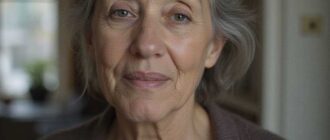
Forty is not old.
But that night, standing in my own kitchen with a birthday candle burning down into untouched frosting, I believed it was.
I had bought a navy dress I’d been too afraid to wear for months. It hugged my waist in a way that reminded me I still had one. I’d curled my hair, put on the small pearl earrings my mother gave me before she passed, and set the dining table for four: me, my husband Mark, and my two closest friends.
Mark had promised he would be home early.
Instead, he walked in at almost eight with no flowers, no card, no kiss on my cheek.
Just a folder in his hand.
I remember the tiny things more clearly than the big ones. The rain tapping against the window. The smell of lemon chicken in the oven. The way one of the candles leaned slightly to the left, melting faster than the others.
“Mark?” I said, trying to smile. “You made it.”
He looked at me the way people look at furniture they’ve already decided to throw away.
Then he placed the folder on the table.
“I’m leaving, Claire.”
At first, I thought I hadn’t heard him right. My mind tried to turn it into something else. A joke. A misunderstanding. A business trip.
But then he said the sentence that cut through me so cleanly I didn’t even bleed at first.
“You’re old now. I have someone younger.”
There are insults you can argue with. There are betrayals you can scream at.
But that sentence emptied the room.
I stood there in my birthday dress, while the woman inside me — the wife, the caretaker, the quiet fixer of everything broken — seemed to sit down somewhere deep in my chest and stop breathing.
My friends arrived fifteen minutes later. I didn’t answer the door.
By then, Mark was gone.
The folder remained.
Inside were papers about the house, the savings, the accounts. He had planned it all. He had chosen my birthday not by accident, I later understood, but because cruelty feels more powerful when it arrives dressed as timing.
For three weeks, I disappeared without leaving the house.
I slept on the couch because the bedroom smelled like his aftershave. I drank coffee for dinner. I reread old text messages until my eyes burned, looking for the exact moment I had become invisible.
And I found it everywhere.
In the way he stopped asking how my day was. In the way he called me “comfortable” like it was a compliment. In the way he praised other women for being “full of life” while I folded his shirts and paid the electric bill.
One morning, I was sorting laundry when I found one of his white dress shirts behind the hamper. I lifted it without thinking, and the smell of him hit me.
Not love.
Habit.
I stood there holding that shirt, staring into the hallway mirror.
My hair was greasy. My shoulders were hunched. My face looked smaller somehow, as if grief had been quietly erasing me with a pencil.
And then, without warning, I laughed.
Not because anything was funny.
Because I suddenly realized the ridiculousness of it. A man had called me old as if he owned time itself. As if he had stamped an expiration date on my forehead and I was supposed to agree.
I dropped the shirt into a trash bag.
Then I filled three more.
By sunset, every trace of him was stacked on the porch in black plastic bags.
That night, I didn’t cry.
I washed my hair. I opened the expensive bottle of bath oil I had been “saving.” I ordered Thai food with extra chili because Mark never liked spicy food. I sat at the table in my birthday dress, three weeks late, and ate until my lips burned.
The next morning, I signed up for a pottery class.
It sounds small, almost silly. But the first time I pressed my hands into wet clay, something in me softened. I didn’t have to be useful. I didn’t have to be pretty. I didn’t have to be chosen.
I only had to be present.
Then came yoga. Then walks before sunrise. Then Saturday mornings at the farmers’ market. I bought flowers for myself every week, not roses — too dramatic — but tulips, wild daisies, sunflowers with ridiculous heavy heads.
I stopped dyeing the silver at my temples.
I cut my hair to my chin.
I painted my front door yellow.
And slowly, very slowly, the woman Mark had left began turning into someone I wanted to meet.
A year later, I opened a small studio downtown.
Not because I was brave. I was terrified. But I had spent nineteen years helping Mark build his insurance office, answering phones when his assistant quit, organizing invoices, calming angry clients, remembering birthdays of people he barely cared about. It turned out I knew more about running a business than he ever admitted.
My studio was part pottery shop, part workshop, part refuge for women who arrived saying, “I’m not creative,” and left with clay under their nails and light in their eyes.
On the wall, I hung a sign my friend Emily made for me:
Nothing broken is useless.
People came for bowls and mugs. They stayed for coffee, music, and the quiet relief of being allowed to begin again.
I was not “young.”
I was better than young.
I was awake.
Mark came back on a cold Friday in November.
I opened the door wearing jeans, a cream sweater, and clay dust on my wrist. Outside, rain slid down the porch steps in silver threads.
He stood there with a bottle of red wine and a bunch of grocery-store flowers still wrapped in plastic.
For a second, neither of us spoke.
He looked thinner. His face had softened in the wrong places and hardened in the others. His hairline had retreated. His eyes moved over me quickly, then slowly, as if trying to understand what didn’t match his memory.
“Claire,” he said.
I didn’t step aside.
“Mark.”
He swallowed. “Can we talk?”
I should have said no.
But there are moments in life when you don’t open the door because someone deserves entry. You open it because you are no longer afraid of what they might say.
So I let him in.
He stood in my living room like a stranger at an exhibition. His eyes caught on the framed photos from my trip to Maine, the shelves of handmade bowls, the yellow curtains, the stack of business magazines on the coffee table.
“You changed everything,” he whispered.
“No,” I said. “I uncovered it.”
He turned toward me. “I made a mistake.”
The words landed softly. Too late to wound me. Too small to impress me.
“She left,” he continued. “Six months ago. It wasn’t what I thought. She was… young. But she wanted a life I couldn’t keep up with. I thought she made me feel alive.”
I waited.
He looked at the floor. “But it was you. You were my life.”
I almost felt sorry for him then. Not because I wanted him back, but because he had mistaken possession for love for so many years that losing both confused him.
He reached into his coat pocket and pulled out a small velvet box.
My stomach tightened.
He opened it.
Inside was my wedding ring.
“I kept it,” he said. “I thought maybe… maybe we could start over.”
The silence that followed was not empty.
It was full of everything I had survived.
The birthday candles. The folder. The weeks of not eating. The first bowl I ruined on the pottery wheel. The first time I laughed alone in the car. The morning I saw my reflection and didn’t flinch.
I took the ring from the box.
Mark’s eyes filled with hope.
Then I walked to the window, opened it, and placed the ring on the ledge outside where rain gathered in a narrow silver line.
“Someone may find it,” I said. “Someone who still believes a ring can save a marriage.”
His face collapsed.
“Claire, please.”
I turned back to him, and my voice did not shake.
“You didn’t leave because I was old, Mark. You left because I stopped shrinking in ways that made you feel tall. And when the younger woman didn’t make you young, you came back looking for the version of me who would forgive anything just to be chosen.”
He stared at me like he had never really seen me before.
Maybe he hadn’t.
At that moment, the studio phone rang from the next room. Then my cell buzzed. A message from Emily flashed across the screen:
The newspaper wants to feature you. Front page of Sunday Lifestyle. Are you sitting down?
I looked at the message and laughed softly.
Mark saw it too.
And that was when he truly froze.
Not because I was beautiful, though I was. Not because I looked younger, though happiness had done what creams never could.
He froze because he finally understood that the door he had slammed behind him had not closed me in.
It had set me free.
I walked him to the hallway.
He stood on the porch with rain spotting his shoulders, holding the cheap flowers like an apology he no longer knew where to put.
“Goodbye, Mark,” I said.
This time, I closed the door gently.
No anger. No drama. No trembling hands.
Just peace.
On my forty-first birthday, the studio was packed. Women from my classes brought cake, candles, soup, wine, flowers, and stories. One woman cried into her napkin because she had filed for divorce that morning. Another raised her mug and said, “To starting over before we’re ready.”
When they sang for me, I didn’t wish to be younger.
I didn’t wish to be loved by a man who had needed to lose me to notice me.
I wished that every woman standing in front of a mirror after someone’s cruelty would hear this clearly:
You are not expired.
You are not too late.
You are not a faded version of who you used to be.
Sometimes the person who throws you away is only removing the last thing blocking your light.