“Call your dirt-road mama!” Patricia trilled, adjusting the heavy diamond pendant that sat like a trophy on her chest. “Let’s give the Charleston ladies a real laugh.”
I stood in her foyer, a cavernous space that smelled of gardenias and old money, clutching a seating chart for the Historical Society Gala. My husband, Whit, buried himself in a text conversation with his golf pro, every ounce of air sucked from the room. Patricia’s eyes, the color of sea glass and just as cold, swept over me from head to toe.
“She’ll be the entertainment,” Patricia went on, smoothing the silk of her gown. “A reminder of what my son rescued you from.”
My fingers bit into the cardstock of the seating chart, the edge digging into my palm. My mama, Della, lived four hundred miles west, in a double-wide outside Waycross, Georgia, on five acres that never stopped giving—collards, tomatoes, a few pecan trees, and a dozen hens. She’d raised me alone after Daddy’s tractor rolled. Her hands were cracked and strong, and her voice carried the rhythm of gospel hymns. I’d been swallowing Patricia’s jabs for three years, but this invitation had a hook in it, and she knew it. If I refused, I’d be the ungrateful daughter-in-law keeping her hillbilly kin hidden. If I agreed, Mama would be the punchline.
I dialed Mama that night on the back porch, swatting at a June bug that had buzzed in from the marsh. A distant train horn sounded across the salt flats.
“Sugar, I got nothing to wear to a place like that,” Mama said, her tone gentle but flat, like she’d already made up her mind. “Your grandmother’s church dress is forty years old. I’ll smell like the smokehouse.”
“Mama, I need you there,” I said. “I can’t breathe in that house. Please.”
A long pause. Through the phone, I heard the screen door of her trailer creak open and the cluck of her old barred rock hen, Petunia, who insisted on roosting right on the doorstep.
“Well, I’ll come,” she said, not quite a sigh. “But I might be selling the back lot soon. Mr. Rafferty up the road wants to expand his soybeans, and he’s been pestering me about it. The old barn sits on that patch, your daddy’s barn. I ain’t made up my mind yet, but it’s been weighing on me.”
The barn. I remembered the smell of hay and motor oil, the way the loft light caught the dust motes. My chest gave a dull squeeze.
“You don’t have to sell, Mama.”
“Let me fret about that. Right now, I’ll fry a mess of chicken. Nobody goes to a party empty-handed. And I got blackberry preserves setting up.”
“Mama, it’s a catered gala.”
“Then they’ll have my chicken to remember what real food tastes like,” she said, and hung up.
The evening of the gala, a sticky June night, the Wentworth mansion blazed with candles. Crystal chandeliers sent fractured light across tables draped in white linen, each one decorated with sprays of jasmine. Guests arrived in a parade of seersucker and pearls, the men’s cologne heavier than the gardenias outside. A string quartet played something by Vivaldi that nobody really listened to.
Patricia fluttered through the crowd, accepting kisses on both cheeks, her laugh a forced, musical sound. I stood near the bar, a flute of champagne chilling my fingers, wishing I were anywhere else.
Then the door opened, and Mama walked in.
She wore a simple butter-yellow dress, lace at the collar, her silver hair pinned up neatly, the same worn leather purse she’d had since I was a girl. But what drew every eye was the enormous wicker laundry basket she carried, covered with a faded patchwork quilt.
Patricia saw her instantly. She swooped over, trailing a couple of society friends. “Della, you made it!” Her voice sliced through the music. “Goodness, did you bring your entire pantry? What’s under there—grits? Squirrel gravy?”
A few titters rose from the group. Mama set the basket down on an empty side table with a solid thump. She folded back the quilt, and the aroma hit the room. Fried chicken, golden and crisp, nestled in butcher paper. A dozen buttermilk biscuits the size of cat-heads, wrapped in a clean dish towel. Two deep-dish peach cobblers, the crust still leaking syrupy juice.
“Just a little something from home,” Mama said, her soft drawl filling the sudden silence.
Patricia’s mouth tightened. “Oh, honey, the caterer is from James Beard. We can’t just put out… picnic food.”
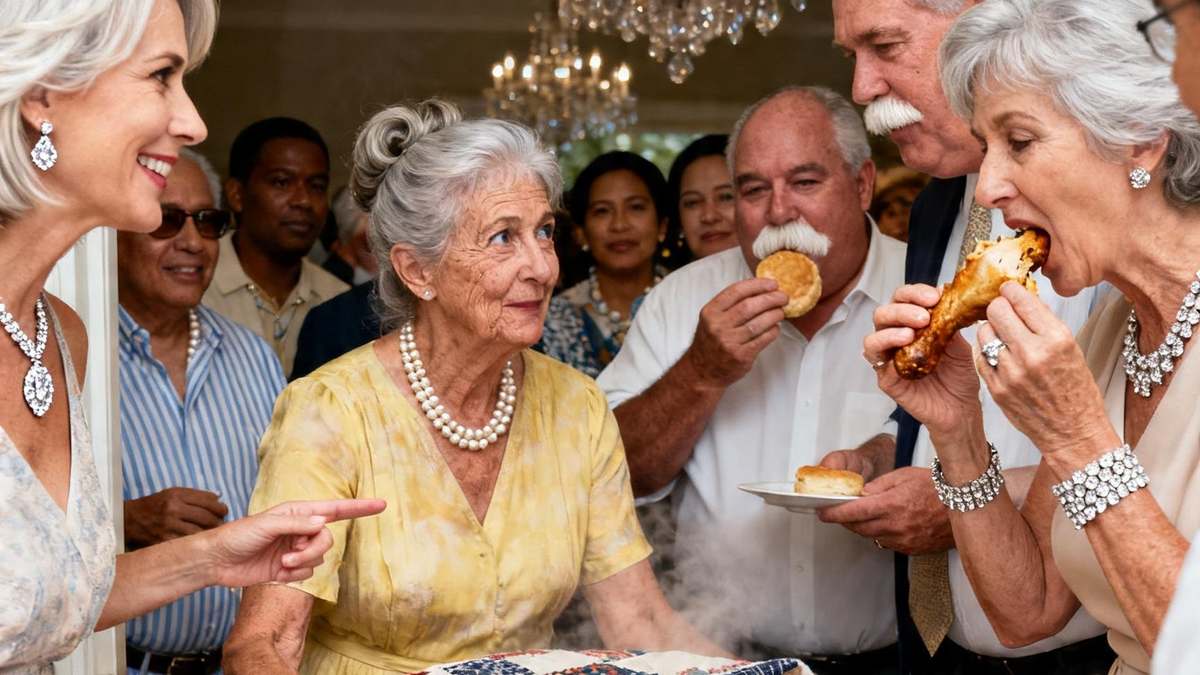
But a retired federal judge, Harold Grimes, a big man who’d been frowning at the hors d’oeuvres table, caught a whiff. He ambled over, plucked a biscuit from the basket, and took a bite. His jaw worked a moment. “Now that,” he said, brushing crumbs from his mustache, “is a biscuit with some sense. Doris, come try this.”
His wife, a tall woman who’d been prodding a single asparagus spear, wandered over, skeptical. She pinched off a corner of biscuit and tasted it. Then she grabbed a whole piece of chicken and started eating it with her hands, her diamond bracelets jangling.
Within minutes, a cluster had formed around Mama’s basket. The caterer’s plates of ahi tuna tartare and fig-drizzled brie sat ignored. Men with monogrammed cufflinks picked chicken legs clean. Women asked Mama about the secret to her cobbler, and she told them it was lard, rendered herself, leaving out the part about the pig’s name.
Patricia stood near the grand staircase, her complexion blotching an uneven pink. She tried to call for a champagne toast, but the string quartet had already shifted into “Georgia on My Mind,” and nobody heard her. She tugged the sleeve of a silver-haired woman nearby, who shook her head without turning around.
At some point, Patricia disappeared. I didn’t notice until a muffled, choked noise leaked from the powder room near the conservatory—a sob, then a harsh nose-blow. I looked at the grandfather clock in the hall; its hands had crept past ten before the door creaked open. Patricia emerged, mascara smeared into gray streaks, her face splotchy and puffy. She slunk to the dessert table, where the last few smears of cobbler clung to a dish.
“Is there… any of that chicken left?” she asked, her voice sandpaper-rough.
Judge Grimes, still wiping his mouth with his handkerchief, looked over. “Gone, Patricia. You missed it.”
Her jaw muscle jumped. Then the main doors swung open, and the caterer himself—a lean man in a crisp white chef’s coat—strode straight to my mama. The room went very still.
Chef Emile was holding a half-eaten biscuit. He set it down with care and offered his hand.
“Ma’am, I’ve worked in kitchens from Charleston to New York, but I have never tasted a biscuit that made me want to call my own mother. I’d like to buy your recipe. Name your price.”
Patricia pushed forward, her composure hastily reassembled with frayed tape. “Well, of course, this is wonderful! I told Della to bring her old-fashioned treats—I knew they’d be a conversation starter!”
Mama looked at Patricia. Just a beat. The kind of look you give a child who’s telling a fib right in front of the whole congregation.
“I don’t sell recipes,” she said to Chef Emile, her voice steady. “They’re for family.”
Then she reached into her worn purse and drew out a folded cashier’s check. She placed it in my hand, her work-roughened fingers closing over mine. I looked down. The amount was more than Whit and I made in a year.
“I sold the back lot, baby girl,” Mama said, low enough that only I could hear. “Where your daddy’s barn stood. Mr. Rafferty closed this morning. It hurt to let it go—I won’t pretend it didn’t—but it’s just dirt, and you’re my blood. You and Whit buy your own place. A house with a kitchen where I can teach you to fry chicken proper, with nobody peering over your shoulder.”
Whit, who’d been leaning against the bar with a bourbon, coughed, a spray of amber hitting his chin. The check shook in my grip. Judge Grimes let out a low whistle.
Patricia’s face drained and then flushed a dark, mottled red. Her mouth opened, but the only sound that came was a thin, strangled wheeze. Her eyes locked on the check, then darted around at her friends, then to the empty cobbler dish.
Mama picked up her empty basket and tucked the quilt under her arm. “Thank you for the nice party, Patricia,” she said, and headed for the door.
I followed her out into the thick night air, the scent of jasmine and fried chicken still tangled together. The valet was pulling up her old Ford F-150, the red paint faded to rust in patches. A possum scurried across the gravel drive, and somewhere, a dog barked twice.
Mama climbed into the truck, and I leaned against the open door. The dome light caught the lines around her eyes. She reached over and patted my hand where the check was still clutched.
“You call me when you get home,” she said. “There’s a biscuit left in my purse if you get hungry later. And don’t let that woman get to you. She ain’t worth the salt in her own kitchen.”
She pulled the door shut, the latch clunking into place. The engine rattled to life. I stood there, the check growing damp in my palm, as the truck rumbled down the drive and the dome light winked out.
Through an open window of the mansion, a fresh, muffled wail drifted from the powder room—the sound of someone whose plans had gone real sideways, but with no one left to perform for.