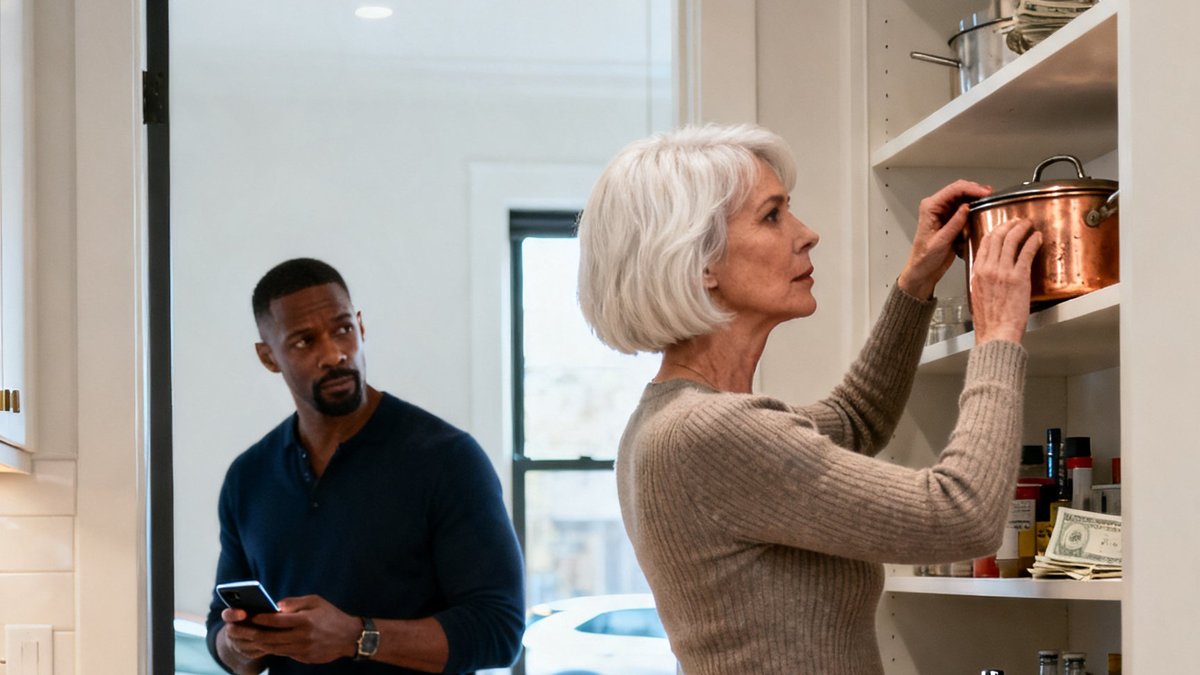
My name's Ryan Kowalski, and I need somebody to explain to me how a set of All-Clad pots ended my nine-year marriage. Because that's the story my mother tells at Thanksgiving now, and it's not even close to true.
Here's what actually happened. My mom, Diane, drove up from Hartford to help my wife Erin pack up the kitchen — we were supposedly "consolidating," which is a nice word for what my brother Tyler and his wife Steph needed after Steph got laid off from the dental office in March. They were renting a two-bedroom in Springfield with a six-month-old and Tyler's hours got cut at the warehouse. My mom saw a problem and she solved it the only way she knows how: by taking things that weren't hers.
I want to be honest about something. I didn't see it as stealing. Not at first. I saw a family that was struggling and a wife who had two Dutch ovens and a drawer full of sheet pans she used maybe twice a month. In my head, that math worked. I know now it didn't work for Erin, and I know why, but let me tell you what it looked like from where I was standing.
I grew up the second son in a house where Tyler always needed something — asthma as a kid, then a car accident at nineteen that wasn't his fault but wrecked his credit anyway, then the layoff. My mom raised us both to believe that family covers for family, no questions, no ledger. I never once thought about whether that was fair to me, because I was the one who'd made it out — steady job doing HVAC estimates, a wife with her own career, a paid-off Honda. I had slack. Tyler didn't. That's just how I saw the scoreboard, and for nine years Erin let me keep score that way without saying much.
So when my mom showed up that Saturday in October with a laundry basket and started going through the cabinets, I didn't stop her right away. I was standing in the doorway in my Patriots hoodie, coffee in hand, half-watching. I remember the sound clearest — the hollow clank of the copper saucepan lid hitting the counter, and underneath it, the radio Erin always kept on low, some classic rock station playing "Landslide," which is a stupid detail to remember but I do.
Erin put the dish towel down like she was setting down a weapon. "Put it back, Diane," she said. Quiet. Not a yell. That should've told me something — Erin never raised her voice, not once in nine years, and that flatness scared me more than shouting would have.
My mom did her whole routine — hands up, eyes to the ceiling, the "Stephanie's got a baby and you two don't even cook" speech. She held up the copper saucier, the one Erin's late grandmother left her, and called it "just sitting here collecting dust." I remember thinking: it's not dust, Mom, it's a wedding gift, it's her Nonna's, but I didn't say it out loud. I said, "Erin, come on, it's just pots." That's the line I keep replaying. Just pots. Like nine years of me not saying anything was just pots too.
Erin looked at me instead of my mother. That's the part I didn't expect — she stopped fighting with Diane and turned the whole thing on me. "Say something, Ryan. Actually say something, for once." And I couldn't. I stood there in my socks on the cold tile and I said, "Don't make this a whole thing," and I watched something close behind her eyes like a shop pulling its gate down for the night.
My mom kept packing. Erin walked over, took the saucier out of the laundry basket, and set it back on the open shelf, gentle, like she was putting a sleeping kid back in a crib. Then she said the sentence that ended my marriage, and I didn't even recognize it as the ending when I heard it: "Nothing leaves this house today. And Ryan — you and your mother can go get lunch, because I need you both gone in the next twenty minutes."
My mother clutched her chest — actual hand to chest, actual gasp — and said her blood pressure couldn't take this kind of stress. Erin didn't even look over. She said, "There's a CVS on Route 9, they do walk-in BP checks, I can drive you if it's real." The color came back into my mother's face awfully fast for a woman having a cardiac event.
I want to tell you I stood up for Erin in that moment. I didn't. I helped my mother carry the basket — now empty — back to her Buick, and I told Erin I'd "let her cool off." I actually used those words. Let her cool off. Like she was an appliance.
Three days later I texted her. Four times. "Can we talk." "Mom feels awful." "You're being dramatic about pots, Erin, come on." "I miss you." She answered none of them. On the fifth day I drove over after my shift and my key didn't turn in the lock. I stood on the porch of a house I'd lived in for six years — her house, actually, she'd bought it before we married, I only ever paid half the utilities — and called her cell from the front step like an idiot while the porch light I used to change bulbs on shone down on me.
She opened the door on the chain, not all the way. "There's a box for you at the Millbrook Self Storage on Depot Street, unit 114, code's 4471. Your clothes, your tools, your dad's old fishing rods. I already talked to a lawyer. You'll get served at the shop." Then she shut the door. I heard the deadbolt — new deadbolt, I could tell by the sound, heavier click than the old one — turn from the inside.
I did what men like me do when we finally understand something too late: I got angry instead of sad, because angry felt more like control. I called her a name through the door I'm not proud of. I told her nobody else would want a woman who counted pots. She didn't answer, and the porch light clicked off on its timer while I was still standing there, which felt like getting hung up on by a house.
The divorce went fast because there wasn't much to fight over — the house was hers before we married, no kids, and Vermont's no-fault statute doesn't leave a lot of room for drama when property's already separate. My lawyer, a guy from Rutland who did this pro bono rate for a buddy of a buddy, told me flat out I had nothing to litigate. I moved into my mother's spare room in December. If you want to know what humility tastes like, it tastes like sleeping under a Precious Moments border wallpaper at thirty-four years old while your mother tells you what you should've said to your wife.
And here's the thing nobody warns you about: living with Tyler and Steph's new arrangement wasn't the reunion my mother imagined either. The baby cried through the walls. Steph got a part-time job at the Rite Aid and needed the car my mom used to drive to her own hair appointments. My mother, who'd fought so hard to redistribute Erin's kitchen, started complaining that nobody in this house respected her space. I watched her realize, in real time, that the math she'd done in Erin's kitchen didn't actually solve anything — it just moved the shortage around and put me in the middle of it.
I saw Erin once more, outside the county courthouse in Bennington, in February. She had on a green wool coat I didn't recognize and looked like she'd been sleeping fine, which stung more than if she'd looked wrecked. I asked her, stupidly, if she was happy she'd blown up nine years over cookware. She looked at me — not cruel, just even — and said, "I didn't blow up nine years over cookware, Ryan. I ended it because you watched your mother go through my grandmother's things and you asked me not to make it a thing. That's the whole marriage in one sentence. I just finally listened to it." Then she got in a Subaru I didn't recognize either and drove off toward Route 7.
I heard through my cousin in October — a year to the month after that Saturday — that Erin's seeing somebody, a chef who runs a small place out toward Manchester, and that she'd had the kitchen at the Millbrook house redone, new range, open shelving, all her grandmother's copper hanging in a row like trophies nobody's allowed to touch. I don't picture that scene to torture myself. I picture it because it's the first time I understood what she actually built in that house while I stood in the doorway drinking coffee and calling it "just pots."
My mother still asks me sometimes, usually after two glasses of the boxed Chardonnay, whether Erin's "gotten over herself yet." I don't answer that one anymore either. Turns out I learned that much, at least — some silences you inherit, and some you finally have to break yourself. I just broke mine about a year late.