On the last Friday in October, David came through the side door, kicked the snow off his boots, and set his wedding ring on the butcher block next to the bread knife. That was the whole announcement. I had my hands inside a turkey, slick down to the wrists, because I was brining it for Sunday dinner like I did every fall. He didn't lean in. He didn't cut a piece of the pumpkin bread cooling on the rack. He just stood there in his Carhartt jacket, looking at me the way he looked at a supplier who'd shipped the wrong grade of lumber.
“I’m leaving, Marissa. Tonight.”
The turkey slipped back into the brine with a sound like a body hitting water. I wiped my hands on my apron and counted the seconds by the drip of the faucet. Seventeen years we’d been married. Seventeen years in this house outside Steamboat Springs, with the window over the sink facing Mount Werner. The first snow had dusted the peak that morning, and I’d thought David would come home early so we could all watch the storm roll in.
“Leaving where? You’ve got a delivery in Craig at seven.”
“I’m leaving you. There’s someone else.” He said it the way he said “invoice” and “backordered” and “net thirty.” His eyes stayed on the cupboard over my head. “Her name is Mikaela. She’s twenty-four. She works in purchasing.”
I picked up the bread knife. I didn’t point it. I just needed something in my hand that wasn’t shaking. “Twenty-four. Cole is fifteen, David. She could be his babysitter.”
He didn’t flinch. “I packed my truck while you were at the dentist. I’ll talk to Cole in the morning. The keys to the house are in the dish by the front door.”
Then he turned, and his boots left wet prints across the floor I’d mopped that afternoon. The side door closed, and the house went so still I could hear the furnace kick on downstairs.
I sat on the kitchen stool with the bread knife still in my hand. I didn’t cry. I counted the thumbprints on the knife handle, every one of them left by David’s hand over the years. The oil from his fingers had darkened the wood. He had carved the first Thanksgiving turkey with that knife, the year we moved here with nothing but a used Subaru and a rented storage unit. The first big snow pushed us inside, and we ate turkey sandwiches for a week because the power went out. He told me then that no matter what we built, it would be ours. Not his. Ours.
The phone rang at eleven forty. I knew before I looked. Virginia Hartley’s name sat on the screen like a summons.
I answered with my whole body braced for the soft, scented voice she used when she wanted something. “David isn’t here, Virginia. He’s gone.”
“I know he’s gone,” she clipped. Her words came sharp as the edge of a county road in the dark. “He sent me a text about finding his ‘true north’ with some girl in purchasing. Absolute nonsense. Is Cole asleep?”
“Yes.”
“Good. Don’t pack anything. Don’t wash anything. Don’t call anyone. Put on coffee. I’ll be there in thirty minutes.” She hung up before I could ask why her car would make it up the mountain road in this weather.
Twenty-eight minutes later, headlights swept across the kitchen window. Virginia stepped out of her Cadillac in the falling snow, wearing a green wool coat and the same strand of pearls she wore to church, to board meetings, and to David’s high school graduation. She came through the front door, set her cane against the wall, and walked into my kitchen like she owned it too.
“Sit down,” she said. “And get out two cups. We’re going to need the whole pot.”
I poured. She took a sip, made a face, and added two fingers of bourbon from the bottle I kept under the sink for the holidays. Then she looked at me over the rim of the mug, and for the first time in seventeen years, I saw that her eyes were David’s eyes — except where his had gone flat, hers were burning.
“Marissa, my son is a fool.” She set the mug down with a click. “He thinks he found a new life because some child in purchasing laughed at his jokes. But he forgot the one thing that matters.”
“Which is?”
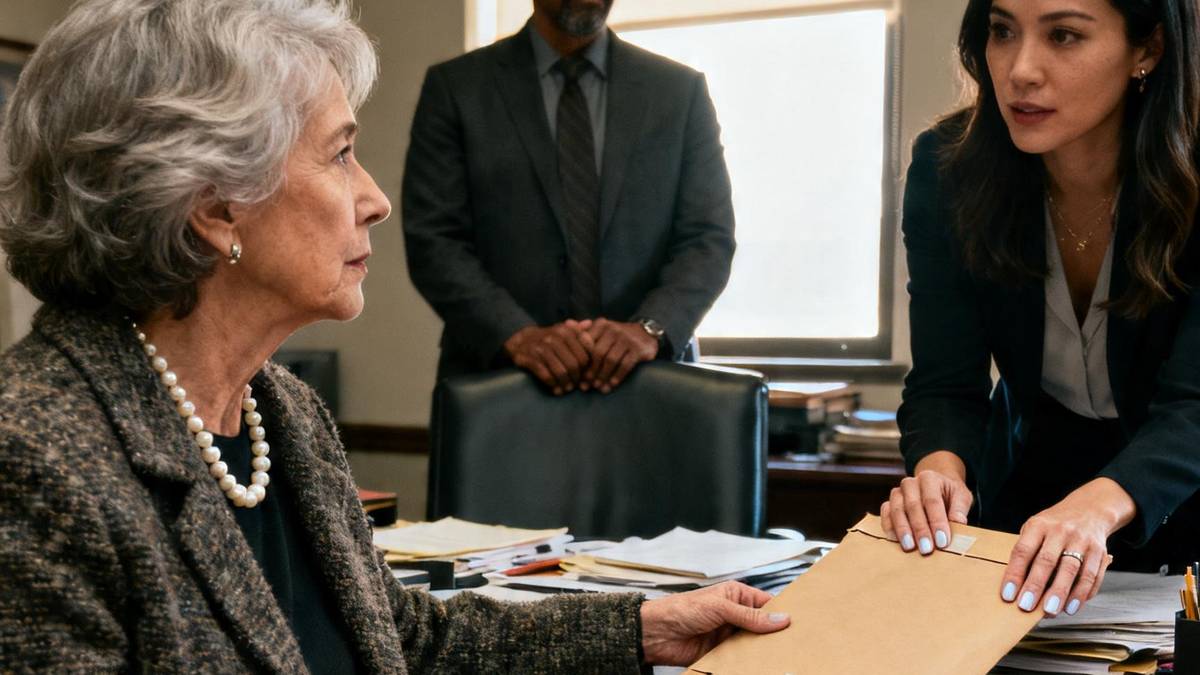
“I don’t forget.” She opened the pocketbook on her lap and pulled out a manila envelope. The flap was sealed with clear packing tape, yellowed at the edges. “Eight years ago, David needed a line of credit to buy out the old hardware distributor in Craig. The bank wouldn’t give him the money without collateral. He didn’t want to risk this house, so he asked me to pledge my condo in Boulder.”
I set my mug down hard. “You never told me.”
“You were busy raising Cole. And David made it very clear that I should keep my mouth shut. But I made him sign something in return.” She slid the envelope across the table. “Open it.”
Inside was a notarized agreement, six pages long. I didn’t understand most of the legal language, but the big words were in bold. *Pledge of Membership Interests.* *Collateral.* *Fifty-five percent.* *Until full repayment of the outstanding debt.*
“He owes the bank one hundred eighty-three thousand four hundred dollars,” Virginia said. “And because he pledged fifty-five percent of the company as security to me personally, I hold the right to claim those units if he doesn’t settle. He never closed the deal. He just kept paying the interest and pretending the agreement didn’t exist.”
I looked up from the paper. “You’re saying you own his company.”
“I’m saying I own the leverage. And leverage is the only thing David respects.” She picked up the envelope, tapped it once against the table, and set it next to the bread knife. “We’re going to visit him at work tomorrow morning. Not to beg. Not to scream. To present him with a choice. He either signs over fifty-one percent of Mountain Supply & Hardware to you, or I foreclose on the entire fifty-five. His bank will get a notice Monday, his line of credit will freeze, and every supplier from here to Grand Junction will hear about it by noon.”
The furnace rumbled. Snow hit the window in fat, soft clumps, the kind that stick to the glass and melt in slow trails.
“Fifty-one percent,” I repeated. “A controlling stake.”
“He forgot that you worked the counter with him for the first four years. You loaded drywall and sweet-talked the county inspector and kept the books by hand while he drove to job sites. You’re not asking for alimony, Marissa. You’re taking back what you helped build.” Virginia stood, smoothed her coat, and picked up her cane. “Finish your coffee. Then go upstairs and sleep in David’s office. Don’t sleep in that room. Not tonight.”
She stayed in the guest room with the door open, and I slept in the leather recliner in David’s home office, across from the wall of framed permits and the first dollar bill we’d taped above the desk. I didn’t sleep. I watched the security light click on and off over the driveway until the sky turned the color of old dishwater.
—
At nine the next morning, the sun came up hard and white, the way it does after a storm in the mountains. The world outside looked like a cake dusted with sugar. Virginia drove us down to the industrial park in her Cadillac, her cane propped between the seats. I carried the envelope.
David’s truck sat in the lot next to his private entrance. A new GMC Sierra, still shiny under the snow. I remembered when he drove a rusted-out F-150 with a cracked windshield and used to call me from the side of the road to bring a can of gas. That truck had no heat. I used to sit in the passenger seat with my hands under my thighs, listening to him talk about the future.
Inside the office, the smell of sawdust and tire rubber hit me like a wall. The receptionist said “Good morning, Mrs. Hartley,” then saw my face and went quiet behind her computer.
Mikaela was at the purchasing desk by the big window. She was young. Not just young — twenty-four with a high ponytail and a cheap silver ring on her thumb. She looked up when I walked past, and her mouth opened, then closed. She didn’t know what to do with her hands, so she picked up a pen and clicked it three times.
Virginia rapped her cane on the doorframe of David’s office. “David. Get out here. Bring your attorney if you have one. You’ll want one.”
He came out of the office in a flannel shirt, jeans, and the same boots he’d worn home last night. He saw me first, then the envelope. His jaw did something I’d never seen before. It was the face of a man who’d just realized he’d missed a stop sign.
“Mom. What are you doing here? This isn’t the time.”
“This is the only time,” Virginia said. She walked past him into the office, sat in the chair across from his desk, and laid her cane across her knees. “Sit down, son.”
I followed her in and closed the door. The office smelled like burnt coffee and old paper. On his desk sat a framed photo of Cole from middle school, the one where he was holding a fish on the riverbank. I sat in the other chair and placed the envelope on my lap.
David didn’t sit. He stood behind his chair, gripping the back. “Whatever you think you’re doing, you can’t just walk in here and —”
“I can,” Virginia cut him off. “Open the envelope, Marissa. Show him.”
I pulled out the agreement and set it on the desk, turned to the last page. His signature was there, small and cramped in the corner, the way he signed things he didn’t read. Under it, Virginia’s neat, looping signature. And a notary stamp from the bank on Lincoln Avenue.
David leaned over. The color washed out of his face. “That was years ago. That was a formality. You promised you’d never use it.”
“I promised nothing,” Virginia said. “And you promised me a lot of things, David. You promised me you wouldn’t embarrass this family. You promised me you’d honor your marriage. You promised Cole you’d teach him to be a man.” She tapped the cane against the floor. “You didn’t read the document. But you signed it. That’s what matters.”
He looked at me. Not at my face — at my hands, still resting on the envelope. “Marissa, come on. You don’t want to do this. This is business. We can work something out.”
I thought about the bread knife, the turkey, the seventeen years. I thought about Cole sleeping upstairs while his father loaded a truck and left the house keys in a ceramic dish by the door.
“I don’t want alimony,” I said. “I don’t want the house. I want my name on the door of this company, David. Fifty-one percent. And I want it in writing today.”
“You can’t just —”
“She can,” Virginia said. She opened her phone and held up the screen. “I have the bank’s foreclosure department on speed dial. One call, and the fifty-five percent goes to me. That’s not a threat. That’s math.”
The office was so still I could hear the snow dripping off the eaves outside. Then David did something I hadn’t seen him do in years. He sat down.
“I don’t have a choice, do I.”
“You always had a choice,” I said. “You just made the same one as every other man who wakes up at forty-six and thinks he can trade in his whole life for a fresh start. So now I’m making mine.”
He called his attorney. The man arrived in twenty minutes, a guy in a puffer coat who smelled like bacon and looked at me like I was the one on trial. Virginia produced a second document from her purse — a transfer of membership interests, already drafted. Fifty-one percent. *Effective immediately.* There was a blank line for David’s signature and a blank line for mine.
David signed first. The pen scratched across the paper like a stick dragged through gravel. Then he pushed the document toward me.
I signed. My hand didn’t shake. I wrote my full legal name — Marissa Ann Hartley — in the same looped handwriting I’d used on the loan application for the first truck, the one that smelled like rust and gasoline.
When I finished, I slid the document across the desk toward Virginia. She opened the folder, pulled out a notary stamp of her own from her bag, and stamped the page with a hard, final thunk.
Then she stood. “We’ll be going now. I’ll have my attorney file this with the county on Monday morning. You’ll want to stay out of the office until the ownership update goes through.”
David didn’t get up. He sat with his hands in his lap, looking at the signed paper like it was a snake he’d been told not to touch.
I walked out of the office first. On my way through the front room, I passed Mikaela’s desk. She was holding her phone in one hand and a half-empty coffee cup in the other, and she was watching me with that same frightened, cornered look a deer gets when it steps onto the highway.
I stopped at her desk. I didn’t raise my voice. I didn’t throw anything. I just set the transfer document on her keyboard, next to the time sheet she’d been filling out.
“You’ll want to read this before you text him,” I said. “You’re not sleeping with the owner anymore.”
Then I pushed open the glass door and stepped into the snow.
Virginia was already behind the wheel of the Cadillac, the engine running, the defroster blasting. I got in and buckled my seat belt. For a long time, neither of us said anything. The windshield wipers swept the snow in slow arcs. The radio played some old George Jones song, faint and tinny, the way it always did in Virginia’s car.
“He’ll call Cole tonight,” she said. “He’ll try to spin it. You need to talk to the boy first.”
I nodded — not because I agreed, but because I was too tired to speak. Virginia pulled onto the main road and headed back toward the mountain. The sun had broken through the clouds, and the whole valley glittered like broken glass.
When we got home, I found Cole in the kitchen making Pop-Tarts. He looked up, saw my face, and said, “Mom? Where’s Dad?”
I set the envelope on the counter next to the bread knife. “Your father moved out last night, sweetheart. But he’s going to be fine. We both are.”
Cole put down the Pop-Tart. He wrapped his arms around me, and I could feel the crumbs on his sleeve press into my back. He smelled like the soap David used to call “too fancy” and the faint, sweet sugar of every teenage boy.
That afternoon, I took the transfer agreement out of the envelope and made two photocopies with the machine in the pantry. I put the original back in the fireproof box on the top shelf of the hall closet, the one where I kept Cole’s birth certificate and the deed to the house. Then I shut the door and locked it.
Down the street, the neighbor’s old yellow Lab was barking at a snowplow. The plow scraped the asphalt with a sound like teeth on a nail file. I stood in the hall with my hand on the doorknob and watched the snow fall past the window, filling the tire tracks David’s GMC had left in the driveway.
By Sunday, the tracks were gone. The plow came again, and the ice melted off the eaves, and the sun came out hard and cold. I cooked the turkey, and Virginia sat at the head of the table like she had every right to, which she did. Cole cut the bread with the same knife his father had used, and the three of us ate in the warm, bright kitchen while the clock over the stove ticked steady as a heartbeat.
David never got the key back from the dish by the front door. He didn’t ask for it, and I didn’t offer.