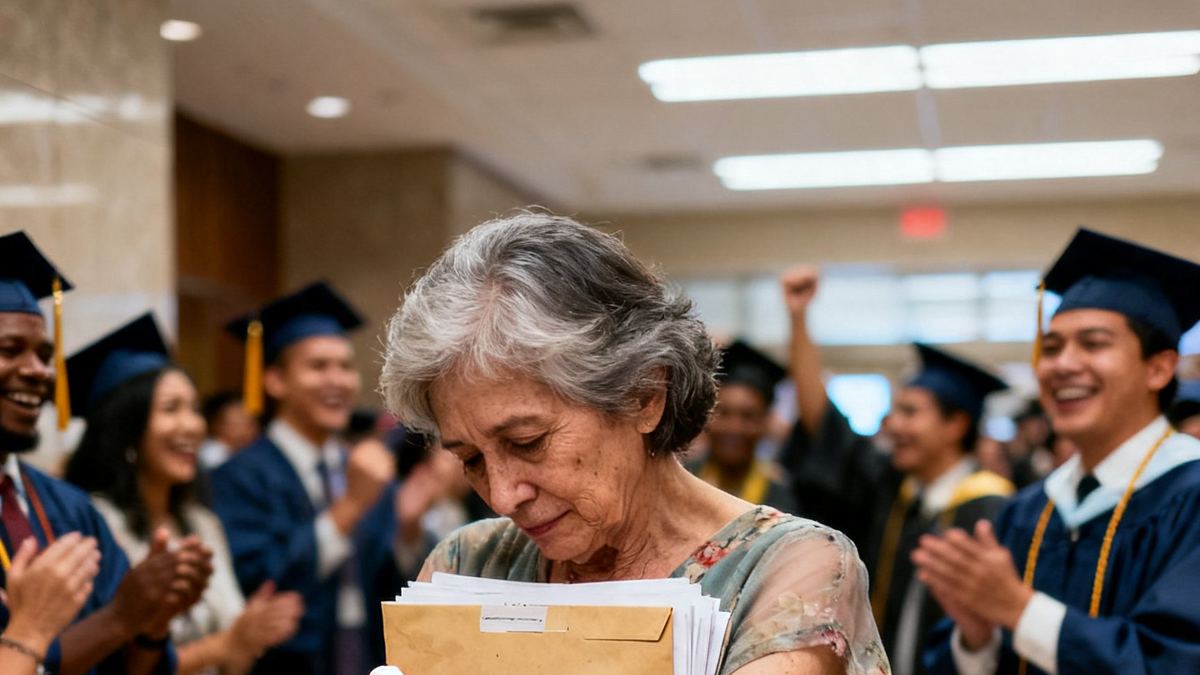
The auditorium smelled like floor wax and nervous sweat, and my hands were going numb from clapping. Nathan was up there on that stage in his cap and gown, and I was down here in the third row, holding a bouquet I'd paid for with the last forty-two dollars in my checking account.
Eight years. Eight years of double shifts at the diner on Clifton and weekend hours at the urgent care front desk. Eight years of pressing his white coat, packing his lunches, and telling myself that the tired in my bones was temporary.
I'd met Nathan in the fall of 2015, first week of pre-med at Ohio State. He was this lanky kid from a trailer park outside of Toledo, couldn't afford the textbooks, kept borrowing mine. Said he was going to be a cardiologist. I believed him. I believed in him so hard that when his parents lost their house sophomore year and the tuition money evaporated, I walked into the registrar's office and signed the form that withdrew me from the only thing I'd ever wanted to do.
"One doctor in the family is enough," I told him.
He grabbed my hands and told me he'd spend the rest of his life making it up to me. And I, fool that I was, pictured a house with a garden and two kids and a framed photo of us at his white coat ceremony.
So I worked. Breakfast shift from five to eleven, front desk from noon to eight. Tuesday nights I took a phlebotomy course at the community college because it paid three dollars more an hour. The apartment had a leak in the bathroom ceiling that the landlord never fixed, and I learned to sleep through the drip. Nathan studied. That was the arrangement.
The day he got his med school acceptance letter, I'd just come off a double and my feet were bleeding through my socks. He wrapped me in a hug and whispered into my hair that this was our win, not just his.
We got married in a courthouse in Lucas County eleven months later. I wore a cream-colored dress from Goodwill. It had a small stain on the hem, but nobody noticed. My mother was dead; his didn't come. The judge's clerk took our photo. I taped it to the refrigerator.
The years after that, I don't remember them as separate days. They blur into steam rising from coffee urns and the gray glow of the waiting room TV and the mechanical click of the time clock. Nathan passed every exam. Each one felt like a step toward something I'd stopped being able to describe.
And then, the graduation.
I took the bus to the convention center because the Corolla needed a new alternator and we couldn't afford it. No—because he couldn't, because every spare dollar went to his tuition and his supplies and his residency application fees. I sat in the third row, right on the aisle, in a dress I'd bought three years earlier for a friend's wedding.
They called his name. He crossed the stage. He shook hands, took the diploma, and scanned the crowd. For a second he found me, and I waved, and I swear I saw something buckle in his expression. But I told myself it was the lights.
After the ceremony, the lobby filled with graduates clutching leather folders and families clutching graduates. I pushed through.
And there he was, with that easy smile I'd married.
"Hey, you," I started. "I'm so proud of—"
He handed me a manila envelope. Thick. Secure.
"What's this?" I said, and I actually laughed a little. I thought maybe it was a card. Maybe he'd made reservations somewhere. For once. For once it could be my turn.
"Open it later," he said.
But I opened it right there. Marriage dissolution. Petition for divorce. Grounds: irreconcilable differences. The papers had been filed two weeks earlier, and I'd been served at my husband's graduation like a tenant getting an eviction notice taped to the door.
I couldn't speak. My fingers were on the edge of the page, and I could feel the paper cutting into my skin, and I held on like the floor was tilting.
Nathan turned. He just turned, and he walked into the crowd, and nobody stopped him.
I don't know how long I stood there. Long enough for my legs to start shaking. I remember a woman with a balloon brushing past me and saying, "Oh, excuse me, hon," like I was in her way.
My feet carried me toward the exit doors. Past the water fountain. Past the sign that said CONGRATULATIONS CLASS OF 2024.
A hand on my elbow.
"Wait," someone said.
I turned. It was a guy I vaguely recognized, one of Nathan's classmates. Indian kid, glasses, kind face. He'd been at our apartment once for a study group. He'd eaten the last of my lasagna and apologized twice.
He looked at me now like I was a car crash he couldn't look away from.
"Ma'am, before you go," he said. "I think you need to know something."
I just stared at him.
"Nathan didn't get his residency in Toledo," the guy said. He shifted his weight. "He got a spot at Johns Hopkins. In Baltimore. Top program in the country. He got the match letter two weeks ago."
The words went in and didn't land. Then they did.
"The day after he got that letter," the guy went on, "he moved his stuff out of the apartment on Bancroft. I know because I helped him carry the boxes."
That was it. Not a scandal, not another woman. Just a clean, computed exit. He'd used me as a ladder. And when he reached the top rung, he stepped off and kicked it behind him.
The man opened his mouth, maybe to say he was sorry, maybe to say he'd thought I knew. I shook my head once, and closed the manila envelope, and walked out into the hot, bright parking lot.
I sat on the bus for forty minutes with the envelope on my lap. The bus smelled like diesel and day-old air freshener. An old man across the aisle held a radio to his ear, tinny baseball crackling through the speaker.
I didn't cry at all. I just kept thinking about the drip in the bathroom ceiling. How I'd never hear it again.
That night I drove to the apartment—my sister picked me up from the bus stop in her minivan, said nothing the whole way, which was the best thing she'd ever done for me. Nathan had already cleaned out his half. The drawers gaped open in the bedroom. The fridge still had his protein shakes. The one at the front, the vanilla-flavored one, was expired six weeks earlier. I checked.
There was a single piece of paper on the kitchen counter. A bill for the electric. Past due. Addressed to both of us.
I sat at the table and did the math.
Eight years. At minimum wage and a bit more, with the raise I got in 2019, and the overtime, and the Christmas shifts I always took because it was time and a half. The tuition I'd paid in cash, semester by semester. The books. The rent. The bus pass, which costs seventy-eight dollars a month now, and that's a number I will never forget.
Just over a hundred and eighty-nine thousand dollars.
I opened my laptop. The screen flickered once, like it was also exhausted.
Nathan had opened a new checking account. I found it because he'd left a pay stub on the table, under the electric bill. He'd started a paid internship at the Cleveland Clinic back in January. His earnings were going into the new account. The old joint account had four hundred sixty-two dollars and eleven cents in it.
That's what eight years of me was worth.
And maybe that's what snapped it, because I stopped being numb and started being angry, and the anger had a very specific shape.
Two days later I walked into the family law office of a woman named Patricia Okonkwo, because I'd googled "divorce lawyer Ohio tough" and her name came up first.
I told her everything. Not the feeling part—just the part that mattered: the years, the payments, the abandonment, the new job in Chicago, actually, because the classmate's info was stale—the match had been for Northwestern, and Nathan had already put down a deposit on a condo in Streeterville.
"Did you happen to keep anything?" Patricia asked.
I reached into my bag and pulled out Number fourteen years of deposit receipts from the savings account I'd used for his tuition. Bank slips. Money orders. A payment plan agreement with the bursar's office that had my signature on the cosigner line. Copies of canceled cashier's checks, kept in a bright orange accordion folder I'd bought at the dollar store for a dollar and nine cents.
And the electric bill, which proved he was still legally tied to the household the month he'd moved out.
Patricia flipped through the file. She didn't smile. She underlined something.
"Mrs. Bennett," she said. "I think we have a case for actual fraud, not just inequitable conduct. Community funds. Misrepresentation. And because you were legally married and he concealed income to limit your share of assets, we can ask for a disproportionate division."
I don't remember much else from that meeting. I signed the retainer. Eleven hundred dollars, charged to the last credit card I had.
The hearing was in late August.
Nathan came in with his lawyer, a man in a pinstripe suit who smelled like expensive cologne. He looked at me once, from across the room, and gave me this tight, courteous nod. Like I was a medical board inquiry. An inconvenience.
We didn't argue in the hallway. There was no screaming match. My lawyer did the talking, and when she was done, the judge asked to see the orange folder.
The decision came back in nine days.
Seventy-two thousand dollars, payable in installments over six years, wage-garnished from every paycheck he receives until the full amount clears. And court costs. Plus attorney's fees.
The judge said something else: permanent relief from any assumption of Nathan's student loan debt, should any portion of it have been accrued under the joint household.
It wasn't everything. It couldn't undo the years, the tired, the faded photograph on the fridge that I'd torn into four pieces at three in the morning on the day after graduation and then taped back together because I couldn't stand the rip going through Nathan's face.
But it was a number with teeth.
The door to that courthouse closed behind me with a heavy thud. I stood on the steps in the heat and I called the community college. I asked them to send me the pre-nursing admissions packet.
"Application deadline for spring start is September fifteenth," the woman on the phone said. Her voice sounded young. Her name, she told me, was Cassie.
"I'll have it in this week," I said.
And I did. I signed the form at my kitchen table. I wrote the check for forty dollars. I taped the orange folder shut and put it in the box in the back of the closet, where the mothballs live.
The bathroom still drips. I haven't fixed it, but I will.
Last Thursday, a letter came from the court. Nathan's first payment, postmarked Chicago. Two thousand, two hundred eighty-one dollars and change.
I took it to the bank and deposited it into an account in my own name. No joint anything. Then I went to the diner and ordered a full stack of pancakes and a side of country ham, and I left the waitress a twenty-dollar tip, because I know exactly what that shift feels like.
She probably needed it.