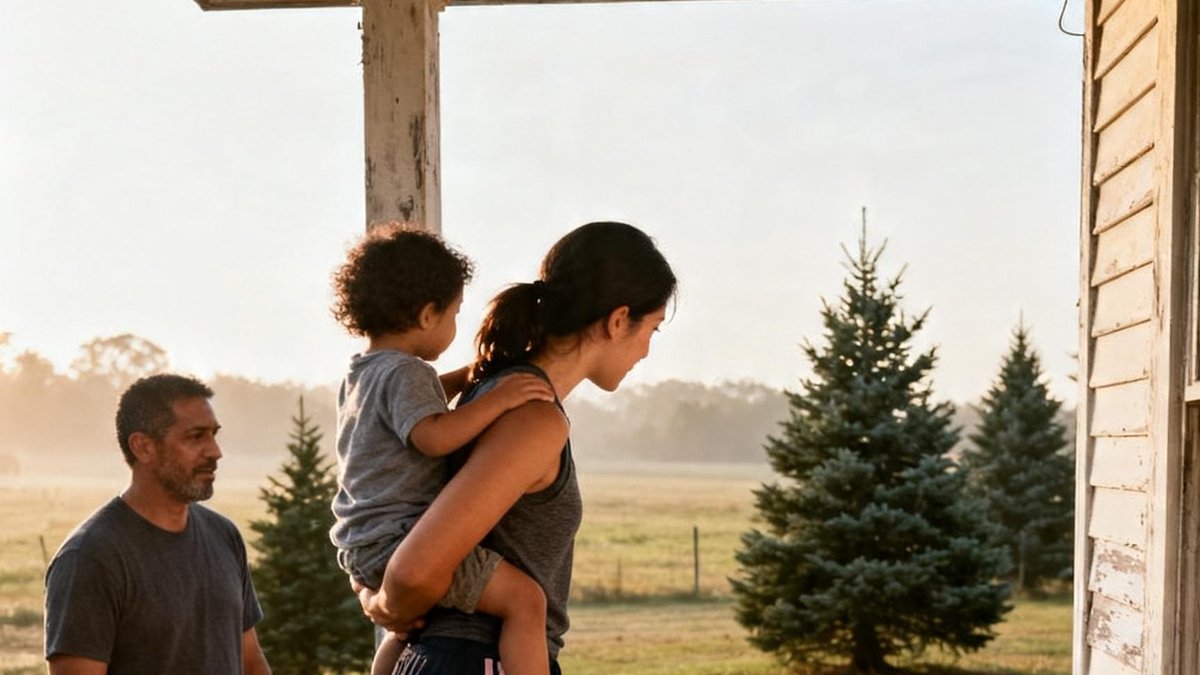
The house itself was worth maybe $310,000, and the land—eleven acres, most of it in pasture and Christmas trees—easily doubled that. I didn't know why I was calculating it. Maybe because Scott had never once, in two years of marriage, mentioned that his father owned land worth over half a million dollars. He'd told me he grew up "renting a place outside Molalla." Another lie, small enough to slide past me the way the big one had.
I found Amber on Instagram in December. Her account was public. Cross country meets, a junior prom picture in blue satin, a photo of a golden retriever mix named Biscuit. In one post, dated the week after our visit, she'd written: *some people show up seventeen years late and still expect a parking spot.* No tags, no names. She didn't need them.
I didn't message her. Not yet. I just watched.
In February, Scott started coming home late. Not dramatically late—forty minutes, an hour—but consistent. He said inventory counts were running long. I checked his paycheck stubs, out of habit more than suspicion, and noticed his hours hadn't changed at all. Same forty a week, same shift differential. No overtime.
I asked him about it over dishes one night, the water running so Leo wouldn't wake up in the next room.
"You're auditing my time card now?" he said.
"I'm asking where you've been."
"Driving. Thinking. You wouldn't get it."
"Try me."
He set down the dish towel. "My dad called. He wants to talk about the property. Estate stuff. In case anything happens to him."
That surprised me enough that I turned off the faucet. "Ray called you?"
"Yeah."
"After Molalla, he called you."
"People change their minds, Jenna."
I didn't believe him, not fully, but I let it sit. A week later I found out why. I was going through the shared Google Drive we used for tax documents, looking for last year's W-2, and I found a folder labeled *Misc* that I hadn't made. Inside was a letter, scanned, dated three weeks after our visit. From an estate attorney in Oregon City. Addressed to Scott. It referenced "your father's expressed intention to divide the Molalla property between his heirs," and requested Scott's current mailing address "for purposes of will preparation."
Heirs. Plural.
I called the attorney's office the next morning while Scott was at work, using the number on the letterhead. I told the receptionist I was Scott Whitfield's wife and needed to confirm an address for correspondence. She put me through to a paralegal, a woman named Denise who talked faster than she should have to someone she didn't know.
"We just need confirmation the letter reached him," Denise said. "Mr. Whitfield Senior wants both children treated equally in the will—the house and acreage split, with a provision that Amber gets right of residence until she's twenty-five since she's still local. Your husband indicated he understood and was fine with the arrangement."
"When did he indicate that?"
"He came in. In person. End of January."
End of January. Two weeks before he started coming home late.
I sat on our bed that afternoon with Leo asleep in the bassinet beside me and did the math again, differently this time. Scott hadn't been avoiding his father. He'd been driving to Molalla once a week to make sure he got his half of eleven acres and a paid-off farmhouse. He hadn't told me because if he told me, he'd have to explain why—and the why was money, plain and ugly, wrapped up in a daughter he'd ignored for seventeen years and was now willing to share an inheritance with, as long as nobody made him actually be her father.
I didn't confront him that night. I wanted to see Amber first.
I drove to Molalla alone on a Saturday in March, timing it around a cross country invitational Amber had posted about. I found the school's practice field from the parking lot, stood by the fence in my coat with my hands jammed in the pockets, and watched a pack of girls in purple singlets come around the far turn. Amber finished fourth. When she jogged back toward the tent, she saw me before I could decide whether to wave.
"You drove an hour to watch practice runs?" she said, hands on her hips, chest still heaving.
"I wanted to talk to you. Not because of your dad. Because of Leo."
She wiped her face with the hem of her shirt. "What about him?"
"He's your brother whether you claim him or not. I'm not asking you to claim him. I'm asking if you'd want to know him someday. That's all. No pressure, no timeline."
She studied me the way Ray had, on the porch—assessing, unhurried. "You know he's splitting Grandpa's place with me. My dad. Suddenly very interested in being fair."
"I found that out three weeks ago."
"You didn't know?"
"No."
Something in her face loosened, just slightly. "Grandpa thinks it's guilt money. I think it's just money. Either way I'm not turning down eleven acres because the timing's ugly." She almost smiled. "Doesn't mean I owe him a phone call."
"I'm not asking you to call him. I'm asking about Leo."
She looked past me toward the parking lot, where Ray's truck was idling, exhaust curling up into the cold air. "Bring him sometime. Not with Scott. Just you." She jogged off toward her team before I could answer, which was its own kind of answer.
I drove home with the heater running too hot and the radio off, and by the time I hit Highway 213 I already knew what I was going to say to Scott, and in what order.
I laid it out for him that night at the kitchen table, after Leo was down: the letter, the call to Denise, the January meeting he'd never mentioned, the four Saturdays of "inventory." I didn't raise my voice. I didn't need to.
He didn't deny any of it. He said, "I was going to tell you once it was finalized."
"Finalized meaning after you had a signed will guaranteeing your half."
"It's my inheritance too, Jenna. I have as much right to that land as she does."
"You have exactly as much right to that land as any father who spent seventeen years pretending his daughter didn't exist. Which is to say, you have a legal right and nothing else."
He didn't have an answer for that. He sat with his hands flat on the table, and for once he wasn't scrolling, wasn't looking away, just sitting there with the truth in the room between us.
I didn't leave him that night. I want to say I did, because it would make a better story, but that's not what happened. What happened was I told him he had until Leo's first birthday—four months out—to either become the kind of father who called his daughter on her birthday, showed up to her meets, and told the truth about where he'd been on Saturdays, or I was done rearranging my life around his omissions.
He tried, in the specific, limited way people try when a deadline is attached. He texted Amber. She didn't respond to the first two. She responded to the third, tersely, about nothing important—a question about her grandfather's blood pressure medication. It wasn't forgiveness. It was a door left open half an inch.
By July, Scott had been to two of her meets, standing at the far end of the fence, not the end where Ray and I stood with Leo in the stroller. Amber never sat with him afterward. But she stopped deleting his texts.
The will was finalized in August. Eleven acres, split down a surveyed line that ran straight through the old hay barn, Amber's half including the farmhouse with right of residence, Scott's half undeveloped pasture and half the Christmas trees. Scott didn't fight the division. I think, by then, he understood he'd already spent the only currency that mattered and this was just the change coming back to him.
We're still married. I won't pretend I know if we'll stay that way in five years. But last month, on a Sunday, we drove out to Molalla together, all three of us, and Amber came out onto the porch before Ray had to tell her who we were. She looked at Leo, fifteen months old now, reaching both arms up toward her the way he did with anyone who'd hold him.
"Hey," she said to Scott. Not warm. Not cold either. A start.
She picked Leo up off my hip without asking, settled him on her hip the way you do when you've held babies before, and walked him over to the porch rail to show him the rooster, crowing at the wrong hour again, same as it had been all along.





