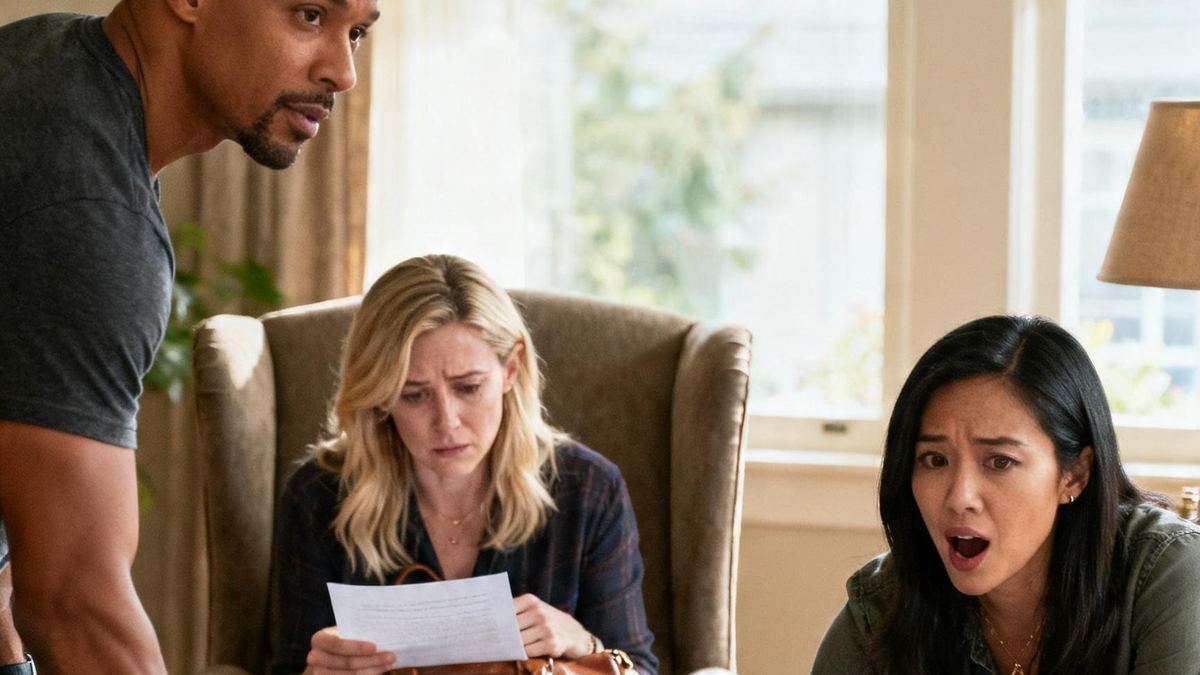
The door swung open, and there she was. Claire.
I had built this moment up for three weeks—rehearsed the words, imagined the look on her face. The shock. The tears. That split second when she’d realize she’d already lost. I had the baby. I had Ryan. I just needed her out of the picture.
She stood in the doorway of that gorgeous old Portland Foursquare, barefoot, wearing a faded Pixies T-shirt, a mug of tea in her hand. The hallway behind her smelled like lemon cleaner and something baking.
“You’re Claire?” I asked, holding my chin up.
“Yeah.” No flinch. “And you are?”
“I’m Harper.” I straightened my spine. “I’m pregnant with Ryan’s child. So you need to step aside.”
I waited for the explosion. Instead, she just blinked, like I’d told her the forecast for rain. Then she stepped backward into the house.
“Come in,” she said. “Let’s talk.”
The house was warm—forced-air heat humming through the vents, afternoon sun coming through the stained-glass sidelights. I’d imagined cheap furniture, maybe an old futon, something temporary. Instead there were hardwood floors that gleamed, a big bay window looking out at a giant maple tree turning scarlet, shelves built into the walls holding paperback mysteries and trail maps. The place had roots.
She walked into the living room and motioned to a wingback chair. I sat, clutching my leather tote on my lap. My heart was pounding so hard I could feel it in my ears.
Ryan had described her as “boring.” “Checked out.” “She just doesn’t get me anymore.” I’d pictured someone mousy, tired, maybe ten pounds heavier than she ought to be. But Claire was square-shouldered and clear-eyed, and the way she set her mug on the coffee table with deliberate precision made my stomach drop.
“You’re about eight weeks along?” she asked, like a doctor.
I blinked. “Nine, actually.”
“And Ryan knows?”
“He’s known since the test,” I said. “He’s thrilled. He wants to be a dad.” I put as much steel into the words as I could. “He just can’t find the right time to tell you. So I figured I’d help him out.”
Claire picked up a thick manila folder from the table—I hadn’t even noticed it—and flipped it open.
“I appreciate that,” she said. “Saved me the trouble of FedExing something.” She slid a stack of papers across the polished wood toward me. The top sheet said *Petition for Dissolution of Marriage* in block letters. Underneath, I could see a dozen printed pages of text messages. Ryan’s texts. The ones where he’d called me *his escape*, said my body made him feel alive again, promised we’d be together by Christmas.
My throat went dry. I recognized the first few lines before I even pulled them toward me. *Last night was incredible. Can’t stop thinking about your hands.*
“He left his phone on the counter while he was in the shower,” Claire said. “About six weeks ago. The night he told me he was going to watch the Blazers game with Andy. I was wiping down the stove.” She said it with no edge, just reportage. “I took screenshots, backed everything up to my cloud, deleted the traces. Then I called a divorce attorney the next morning.”
I felt my face go hot. The wingback chair suddenly felt enormous, like it was swallowing me whole. I’d worn my best heels—red-soled stilettos I’d bought for a birthday dinner Ryan took me to—and they suddenly seemed absurd on her waxed floors.
“You… you already knew?” The words came out half-strangled.
“I knew before you got pregnant,” she said, and the calmness was worse than any slap. “So the pregnancy doesn’t change anything for me. This house? It was my grandmother’s. She left it to me outright, before the marriage. I’ve already got the title docs, the probate paperwork, and a letter from the attorney confirming it’s separate property. Ryan has zero claim to it. Not even if he’d helped pay the property tax, which he didn’t.”
I could feel the script I’d crafted disintegrating. The plan was simple: I’d drop this grenade, Claire would explode, Ryan would get kicked out in a hail of screaming, and he’d land on my doorstep with his duffel bag and his gratitude. I’d be the safe harbor, the woman who gave him a family.
Instead, I was sitting in his wife’s living room, looking at a divorce filing that had been drafted before I’d even cracked open the prenatal vitamins.
“So… you don’t care?” I managed.
She set the folder down and looked at me—I mean, really looked, the way you’d study a pothole before deciding whether to swerve. “Ryan isn’t a prize, Harper. He’s a man who cheated on his wife for months, lied to both of us, and couldn’t even be bothered to delete his evidence. What exactly am I supposed to be fighting for?”
Before I could answer, the front door opened. Keys jingling, heavy footsteps, and then—“Claire? I grabbed burritos from that place on Division. They had the carnitas you like.”
Ryan walked into the living room holding a greasy paper bag, and when he saw me sitting there, his face went the color of old milk. The bag dropped to his side.
“Harper… what the hell?”
“She came to tell me about the baby,” Claire said, in that same unnervingly even tone. “Very thoughtful. Saved me a conversation I wasn’t planning to have anyway.”
Ryan gaped at me, then at the papers on the table, then back at me. “You told her? Without telling *me*?”
“You told me you were stuck!” The words flew out louder than I intended. “You said you just needed more time, that she’d freak out, that the house was complicated! I’m nine weeks pregnant, Ryan. Nine weeks. What was I supposed to do, wait until the kid was in kindergarten?”
He set the burritos on the entryway table—that ridiculous gesture of tidiness—and ran a hand through his hair. “I was handling it.”
“Handling it?” I stood up, my heels wobbling on the floor. “The only thing you were handling was me. You told me you loved me. You said you wanted this baby. Meanwhile, she’s got a fucking divorce file ready and you didn’t even know?”
“I’m not letting you turn this into my fault,” he shot back, and there it was—the flash of annoyance I’d seen before, when I asked about timelines, when I pressed him on when he’d leave. He’d always smooth it over with a kiss or a compliment, but right then, with Claire watching like a spectator at a tennis match, he didn’t bother with the charm.
“Harper, this was insane. You don’t just show up at someone’s house.”
“Your house?” Claire interjected, and both of us turned. She hadn’t moved from her seat. “Actually, Ryan, this is my house. We’ve covered that. And given the circumstances, I’d like you to start packing. You can stay at a hotel, or with Harper—I don’t really care which. But you’re not sleeping here tonight.”
Ryan froze. “Claire, come on. You can’t just throw me out.”
“I can. The title’s in my name. It was inherited before marriage. I’ve already talked to the lawyer about having your things removed if you refuse. So you can leave peacefully now, or you can make this ugly. Your call.”
He stood there, opening and closing his mouth like a fish on a dock. The guy who’d spent months telling me he was trapped by a controlling, cold woman—suddenly he looked like a kid who’d been caught stealing from the register and didn’t have a single lie left.
I grabbed my bag. My heart was slamming against my ribs and I could feel tears building behind my eyes, but I was not going to cry here. Not in front of her.
“I’ll, uh… I’ll call you,” Ryan mumbled at me, but I was already walking toward the door.
“Ryan,” Claire called, not raising her voice, “the keys. Leave them on the table.”
Half a beat of silence. Then the jingle of metal hitting wood.
I walked out into the damp October air, the streetlights just starting to flicker on along the maple-lined block. My car—a ten-year-old Corolla with a crack in the windshield—was parked at the curb. I sat in the driver’s seat for a full minute, gripping the wheel, my gaze fixed on the leaves plastered to the windshield.
He didn’t call that night. Or the next day.
The woman from the county assessor’s office came by two mornings later to post a notice about an abandoned vehicle on the street—an old Ford pickup that had been sitting with a flat tire for weeks—and I saw Claire walking her dog, a lanky greyhound, past my car. She didn’t look over. Just scooped a plastic bag of poop and kept walking, the dog’s tags jingling under the streetlamp.
I spent that week in a fog. Ryan’s text came two days later: *Can we talk? I’m staying at a buddy’s place in Gresham. Things got crazy. I still love you.* I looked at the message for an hour before replying. *We need to talk. In person.*
We met at a Denny’s off I-205, the kind of place with sticky menus and coffee that tastes like burnt water—neutral ground. He looked exhausted, the shadow of a beard coming in patchy, his polo shirt wrinkled. He reached for my hand across the table and I drew back.
“Harper, I swear, I was going to leave her. I just needed to get the finances straight. You know how hard it is to split when there’s a house involved.”
“The house isn’t yours,” I said. “She made that really, really clear.”
He winced. “Yeah, well… I didn’t know all the legal stuff. She was always the one who handled paperwork.”
I let out a laugh that was half-scoff, half-sob. “You told me the house was the main thing tying you there. That you needed time to ‘extract yourself’ without losing everything. But you don’t own a single brick of it, do you?”
He looked at the ceiling, then at the salt shaker. “It’s complicated.”
“No, it’s not.” I leaned forward, lowering my voice. “You lied. To her, to me. You told me she was cold and distant, but she didn’t look cold to me. She looked like a woman who’d already moved on mentally months ago and you were just furniture she needed to put out at the curb.”
“She is cold! You don’t know her. You saw one performance.”
“The performance where she offered me coffee and had a divorce petition ready? That performance?” I shook my head. “Ryan, I’m pregnant. You said you wanted this. I built a whole future in my head because of what you told me. And now I’m looking at the truth and it’s just… you with no plan, no house, and a job that you’re always complaining might downsize.”
He didn’t answer. That was answer enough.
I paid for my own coffee and left him at the booth.
The decision about the pregnancy crept up over the next two weeks, like frost claiming a windowpane. I called the OB-GYN’s office four times and hung up before they answered. I sat in the parking lot of a women’s health clinic in Southeast Portland for over an hour, watching people walk in and out, until a volunteer in a rainbow pin came out and asked if I needed to talk.
I told her everything. Her name was Elena. She didn’t judge. She just listened, and then she said, “You don’t owe him a future just because he promised you one.”
I called Ryan one last time. “I’m ending the pregnancy.”
Silence on the line. Then, “Harper, I… maybe we should think about this together.”
“You’re not part of ‘together’ anymore,” I said. “You don’t have a home, you don’t have a marriage, and you don’t have me.”
I heard him start to say something about how we could still make it work, but I pressed ‘end call’ and blocked his number.
The procedure was a Tuesday morning, rainy and gray, with the kind of wind that turns umbrellas inside out. A friend from work drove me—Megan, who’d never once said “I told you so” about Ryan, even when she could have. She wrapped her fingers around mine in the waiting room, and afterward she brought me back to her apartment in Beaverton, made me a grilled cheese, and sat with me while I sat through a *Great British Bake Off* marathon, eyes glazed.
In the weeks that followed, I cleaned out my apartment—a studio near the Hawthorne Bridge—and threw away every receipt, every ticket stub, every photo with Ryan’s face. The onesie I’d bought on a whim, pale yellow with tiny ducks, went into a donation bag. I cried when I dropped it off, standing in the Goodwill parking lot with rain speckling my windshield again.
But the crying stopped. Not immediately, but it did.
I got a promotion at the marketing firm where I worked—a campaign lead position that came with a window cubicle and better pay. I started running along the waterfront in the mornings, the cold air burning my lungs in a way that felt cleansing. I adopted a rescue cat from the Oregon Humane Society, a one-eyed tuxedo named Ruckus who kneaded my legs while I drank my coffee.
Four months after the clinic visit, I ran into Ryan at a Fred Meyer on a Sunday afternoon. He was in the cereal aisle, holding a box of off-brand Cheerios, and he looked smaller than I remembered—a little paunchier, his hair thinning on top. When he saw me, he almost dropped the box.
“Harper. Hey.”
“Ryan,” I said.
“I, uh… I heard from a guy at work you got promoted. That’s great.”
“It is.” I pushed my cart past his, pausing just long enough to grab a bag of granola I suddenly didn’t need.
“I’m sorry,” he said, and the words came out like he’d been practicing them in the mirror. “For everything. The way it went down. I was a coward.”
I looked at him for a beat. The man who’d once made my heart race now just looked like a stranger in a wrinkled jacket.
“I hope you figure out what you actually want,” I said. “Because three people’s lives got blown up so you could avoid saying the hard thing.”
He didn’t respond. I wheeled my cart away, and the last thing I saw was him standing frozen in the aisle, still holding the cereal.
The cat was waiting on the windowsill when I got home, his tail flicking, the late-afternoon sun catching the dust motes above my couch. I set the groceries down and scratched behind his one ear, and he leaned into it, purring.