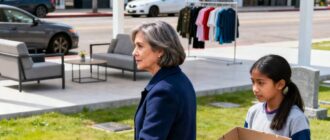
The last thing Elaine brought them was a plate of banana bread. Five months earlier, she’d set it on the hallway console table, the foil still warm. The house smelled of lemon verbena and something sharply chemical underneath, like a hotel bathroom. The woman in the doorway wore dove-gray cashmere lounge pants and an expression of mild, practiced inconvenience.
“I’m the grandma,” Elaine said, her mouth tightening into something that was supposed to be a greeting. “Elaine. I brought the kids a little something.”
The woman’s eyes flicked to the foil. Her name, Elaine had learned from a group text she’d mostly been left off, was Miss Clarissa. Twenty years of early childhood pedagogy. A waiting list eighteen months long.
“Meredith didn’t mention a visit,” Miss Clarissa said, her hand still on the doorframe. “We’re in the middle of a sensory regulation block. And the boys are on an anti-inflammatory protocol. No refined flour, no dairy, no processed sugar.”
Elaine looked at the loaf she’d baked at five-thirty that morning in her Prescott kitchen, mashing the overripe bananas with a fork the way her own grandmother had shown her. “Right. Of course. I just thought—”
“Meredith has asked that all visits be scheduled seventy-two hours in advance so we can prepare the children emotionally for a disruption in their routine,” Miss Clarissa continued, the tone pleasant and immovable. “I’ll let her know you stopped by.”
From somewhere deep in the house, a toy car hit a wall and a small voice—Leo’s—wailed, “But I want Nana!”
Miss Clarissa’s jaw tightened. “Leo. We use our indoor voices. Let’s revisit our calm-down corner.” She shut the door. Elaine stood on the step a moment longer, then carried the plate back to her Subaru. The banana bread stayed on her own counter for days before she threw it away. That was the last time she’d driven to their Scottsdale subdivision with something homemade.
For three years before that, Elaine Cranston had been a woman who let herself be folded up and stored in a hall closet. She’d run the reference desk at the Prescott Public Library for thirty-one years, raised her son Kevin alone after his father took a Gulf oil-rig job and never came back in any way that counted. She had opinions. She had a life. Then Kevin and Meredith had the twins, and that life got packed up.
Meredith was launching Stone + Sky Properties, a boutique real estate firm, and Kevin was grinding ninety-hour weeks at a software startup in Scottsdale. “Just for a few months, Mom,” Kevin had said over the phone, his voice crackling through her Subaru’s Bluetooth. “Daycare for two infants would eat Meredith’s entire first-year profit. And you’re retired now. You’ve got the time.”
Elaine had just bought new Winsor & Newton watercolors. She’d signed up for a birding workshop in the Granite Dells. But these were her grandsons, her only ones. So she’d set her alarm for four in the morning, driven two hours down I-17 in the dark, and put her life on pause.
She was in their house by six forty-five every day, before the desert sun had cleared the roof tiles. She knew which sippy cup was Leo’s (the blue one with the chipped lid) and that Sam would only eat scrambled eggs cut into triangles, never squares. She’d memorized the nap-time, snack-time, and “enrichment activity” schedule laminated on the fridge with a cactus magnet. She tore a meniscus lifting Sam’s car seat out of the Forester and told no one for six weeks, just wrapped it with an Ace bandage and limped through the grocery store.
Meredith called her “Elaine,” never “Mom.” Kevin had stopped pretending to be involved. On the rare evenings he was home, he’d wander through the kitchen while Elaine scrubbed pureed sweet potato off the high chair and say, “You’re a lifesaver, you know that?” already looking at his phone.
And Elaine told herself: This is what you do for family. This is the gig. You show up.
The call that ended it came on a Tuesday in early April. She was in her own bathroom, finally soaking her knee in Epsom salts, when her cell buzzed on the tile. Meredith’s sleek headshot from the company website lit up the screen.
“Meredith, hi. Is everything okay?” Water sloshed.
“Everything’s fantastic!” Meredith’s voice had a new musical lilt, like someone who’d taken a seminar on executive presence. “Elaine, I have wonderful news. The Scottsdale office is officially the top-performing branch in the whole Desert Mountain region. I’ve been promoted to Regional Director.”
Elaine meant it when she said, “That’s incredible. Congratulations.”
“Thank you. So.” Meredith paused; a low voice murmured in the background. “The thing is, with the new role comes a complete recalibration of our household systems. We’ve done a comprehensive time and resource audit.”
Elaine pulled the stopper and the water began to drain. “An audit?”
“We’re bringing on a full-time child development specialist. Live-in. She trained at the Goddard Institute, certified in four pedagogical models. The boys will thrive. We’re transitioning to a professionalized caregiving infrastructure. So we won’t need your daily help anymore.”
The last white swirl of Epsom salts vanished down the drain. “You’re firing me,” Elaine said.
Meredith’s laugh was a bright, shallow peal. “Oh, Elaine, don’t be dramatic. We’re not firing you. We’re restructuring. You should be thrilled. You have your freedom back. Enjoy your retirement.”
Elaine said something agreeable and hung up. She sat on the cold edge of the tub, her knee throbbing. The next day, nobody called. The house went still. A stillness that pressed on her eardrums. Two weeks later, a check for $247.50 arrived from Meredith’s company account—reimbursement for “incidental grocery and fuel expenditures.” Clipped to a tax form. No note.
April blurred into May. Elaine’s Subaru sat in the driveway, its battery draining. She watched the finches at the empty feeder. Her watercolors dried out in their tubes.
Then one Thursday, she woke with a cold, dense anger—like a geode cracked open to reveal something sharp. She drove to the art supply store on Willow Creek Road and bought new paint. She joined a hiking group for women over fifty called the Granite Gals and did a six-mile loop that left her lungs burning. She rescued the sourdough starter from the back of the fridge and named it Dolores. She started saying yes.
By late July, her calendar was her own. Tuesdays, watercolor class in a studio where the light slanted through cottonwoods. Thursdays, book club at a wine bar that actually discussed the book. Weekends, long drives to Jerome or Sedona with Carol, a retired geologist who could identify every rock layer in a canyon wall.
Kevin called twice. “How’s the heat, Mom?” She said, “The AC works.” He didn’t ask more, and she didn’t offer.
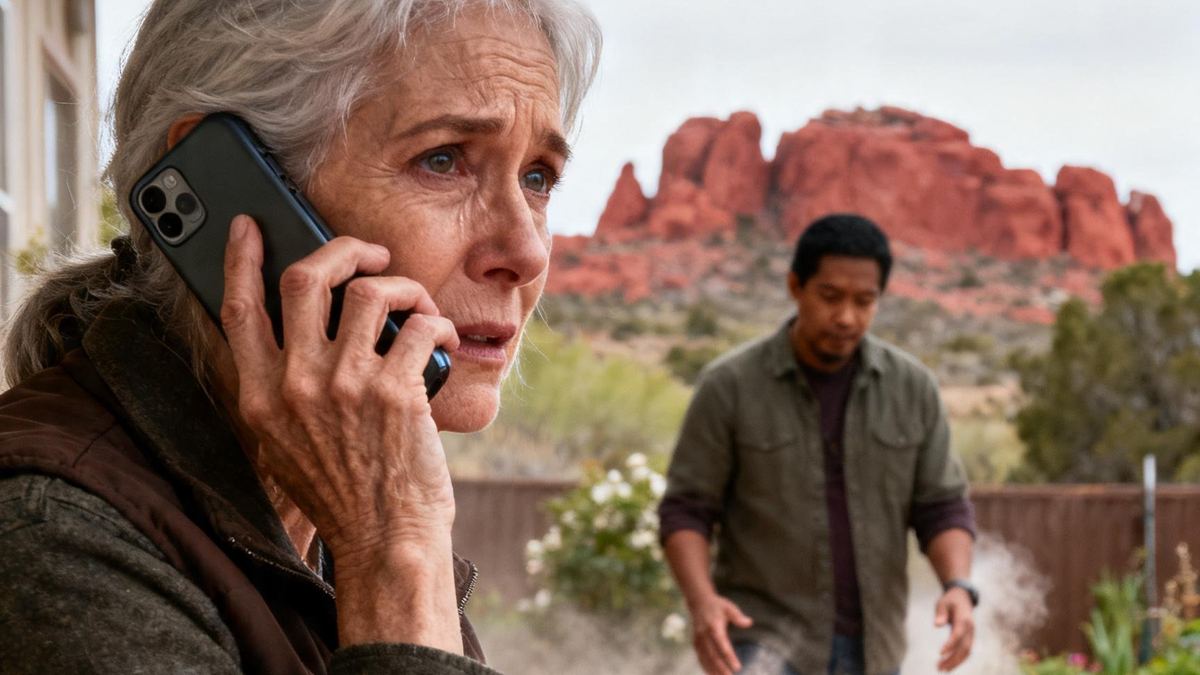
Then, the third Sunday in September, her phone rang at seven in the morning. She was on the back porch with coffee, watching quail skitter through the dry brush. Caller ID read: Meredith, Stone + Sky Properties.
Elaine considered letting it go to voicemail. She picked up anyway.
“Elaine. Oh, thank God.” Meredith’s voice was a wreck, the polish gone. “Okay, so, I know we—look, it doesn’t matter. Miss Clarissa walked out.”
Elaine took a sip of coffee. “Walked out?”
“Last night. Some family in Paradise Valley poached her—doubled her salary and gave her a guest house. Two hours’ notice. We have no childcare. The boys are losing their minds. Leo bit Sam this morning. Kevin has a pitch meeting, and I’m hosting the Scottsdale Luxury Home Tour. We are desperate. I need you to come. Right now.”
Elaine watched a quail peck a seed. She thought about the long, dark pre-dawn drives down I-17 she’d made for three years, her headlights the only thing moving. She thought about Leo’s chubby hand wrapped around her finger at bedtime. She thought about the plate of banana bread she’d thrown in the trash after it had gone stale on her counter.
“Elaine? Are you there? I said I need you to come. Now.”
“I heard you,” Elaine said.
“So you’ll be here by nine? I’ll leave the gate code.”
“No.”
The word hung in the line. Meredith was silent, then: “No? What do you mean, no? You’re not working. You’re just sitting there. The boys need their grandmother.”
Elaine set her mug on the arm of the Adirondack chair. “Here’s the thing, Meredith. Five months ago, you told me you’d audited your resources and decided I was no longer necessary. I accepted that. I restructured. I have a life now. A schedule.”
“A schedule,” Meredith repeated, flat and incredulous. “What could you possibly have on a Sunday that’s more important than your family?”
“Today I’m repotting a fern. After that, Carol and I are driving up to Watson Lake to kayak. And Wednesday, I have watercolor class—we’re working on the shadows saguaros cast at dusk. I find it challenging. My calendar is full.”
“This is insane,” Meredith hissed. “You’re going to let your grandsons suffer because you’re angry about a business decision? You’re punishing them to get back at me.”
Elaine stood and felt the warm flagstone under her bare feet. “I’m not punishing anyone. I’m simply not available. You invested in a world-class professionalized caregiving infrastructure. I’m sure you can find another specialist from the Goddard Institute. I’m not that.”
“Elaine, please.” Meredith’s voice cracked, and for once she sounded not just frantic, but afraid. “We can pay you. The same rate we paid Miss Clarissa. I’m sorry, okay? Is that what you want? I’m sorry. Just get in the car.”
The quail scattered. A hummingbird buzzed past, a tiny emerald blur.
“It’s not about the money, Meredith. It was never about the money. You can’t book a grandmother through an agency. You either have one, or you don’t. You spent three years teaching me I wasn’t needed, and it took me a while, but I learned the lesson. I’m a slow learner, but I get there in the end.”
Meredith started to argue, the shrill words climbing, but Elaine didn’t wait. She ended the call, switched the phone to silent, and slid it into her pocket.
Inside, she found her gardening gloves with the reinforced fingertips and carried her fern—a leggy, sprawling thing named Celeste—out into the morning light. She worked the fresh soil between her fingers, the smell dark and loamy and real. When she was done, she washed her hands, grabbed her car keys, and drove north, the road winding up into the red rocks, the sky a deep, unbroken blue in the rearview mirror.