My brother Mark called me three days before Thanksgiving and told me I was the worst daughter who ever lived. I was standing in the parking lot of the Maple Ridge Memory Care Center, rain soaking through my sneakers, holding a cardboard box with Mom’s knitting supplies and the chipped mug she’d used every morning for forty years.
“You just threw her away,” Mark said. His voice had that tremor he always got when he was performing for his wife. “Dad would be ashamed.”
I didn’t answer. I couldn’t. A siren started up somewhere on Vincennes Avenue, and I let it fill the silence until Mark hung up.
Three weeks earlier, at three in the morning, I woke up to the smoke detector shrieking and the smell of burning margarine. My mother, Gloria, was standing barefoot in the kitchen in her nightgown, a frying pan on the stove with a stick of butter and three unpeeled carrots in it, the pan scorched black, the handle so hot the plastic was blistering. She turned to me with the blankest expression and said, “I think I need new glasses, sweetheart. These ones don’t work.”
That was October. She’d been living with us since Dad died four years ago. My husband, James, and I had converted the den into a bedroom, put in a little bathroom with grab bars, moved the coffee table so she could walk from her room to the sofa without bumping into anything. Our daughter, Chloe, was thirteen when her grandmother moved in. She loved it at first. They watched old movies together. Mom taught her to play gin rummy. But by the time Chloe turned sixteen, she was locking her door at night because Nana sometimes wandered in at 2 a.m. and tried to climb into bed with her, calling her by some long-dead sister’s name.
I gave up my job at the insurance agency. Switched to part-time. Then quit entirely. James picked up extra shifts at the distribution center, and I spent my days managing Mom’s pills, her appointments, her meals, her moods. She forgot who I was maybe once a week by spring. By summer, it was every other day. By September, she looked at me across the dinner table and whispered to James, “That nice lady is here again. Does she need money?”
Mark visited on Christmas Eve last year. Stayed for two hours. Sat on the sofa with a plate of pie and told me, “You’re doing great, Karen. Better you than me — I don’t have the patience.” His wife, Linda, posted a photo on Facebook of Mom and the tree with the caption “Cherishing family moments.” Linda didn’t speak to Mom once the whole visit.
I don’t remember when the anger started. Maybe it was the third time I cleaned feces off the bathroom wall because Mom had tried to “help” by scrubbing it with her hands. Maybe it was the call from the police when a neighbor found her walking down the middle of Western Avenue in her slippers at noon, trying to get to the post office that closed in 2007. Perhaps it was the night I sat on the garage floor and sobbed into a box of Dad’s old tools while James stood in the doorway saying nothing because there was nothing left to say.
The doctor at the memory clinic was a tired man in his fifties who didn’t bother with euphemisms. “Your mother has progressive vascular dementia. She needs round-the-clock supervision. This isn’t a suggestion — it’s a safety minimum.”
Mark came to that appointment. He brought a legal pad and a pen, as if taking notes would make him look responsible. Afterward, he walked me to the parking structure and said, “We could put her in Cedar Hills — that place by the golf course. But it’s six thousand a month. Where’s that money supposed to come from?”
From the house. That’s where. Dad left the house to Mom free and clear — three bedrooms, two bathrooms on Linden Street, painted yellow, big oak tree in the back that dumped leaves every October until the gutter sagged. It was worth maybe three hundred and twenty thousand now. Not a fortune, but enough for a few years of decent care.
Mark almost choked on his coffee. “Sell the house? That’s our inheritance, Karen. You can’t just liquidate it. Mom would never want that.”
I didn’t argue. I just watched a squirrel run along the railing of the parking garage and thought, *You mean* your *inheritance, Mark. I’m not the one who needed a reminder to show up today.*
Mom moved into Maple Ridge on a Tuesday. It’s a single-story building with wide halls and a courtyard where they grow tomatoes in raised beds. The room I chose for her has a window facing north, toward the lake. I hung her curtains, the ones with little blue flowers, and set the chipped mug on her nightstand with a packet of chamomile tea inside because she still remembered — on her good days — that chamomile meant bedtime.
The staff told me not to come for the first week. Standard adjustment period. I spent that week in Mom’s house, going through the closets, the filing cabinet, the shoebox of papers under the bed. I was looking for insurance documents, maybe an old bank statement I’d missed.
What I found was a manila envelope tucked behind a stack of Christmas cards from 1995.
Inside: her will. The original, notarized. It wasn’t what I expected.
The house on Linden Street — the one I’d scrubbed and painted and mowed and paid property tax on for four years — was left entirely to Mark. No provision for me. No mention of a split. A separate page detailed a life insurance policy with a payout of forty-eight thousand dollars, and that, too, named Mark as the sole beneficiary.
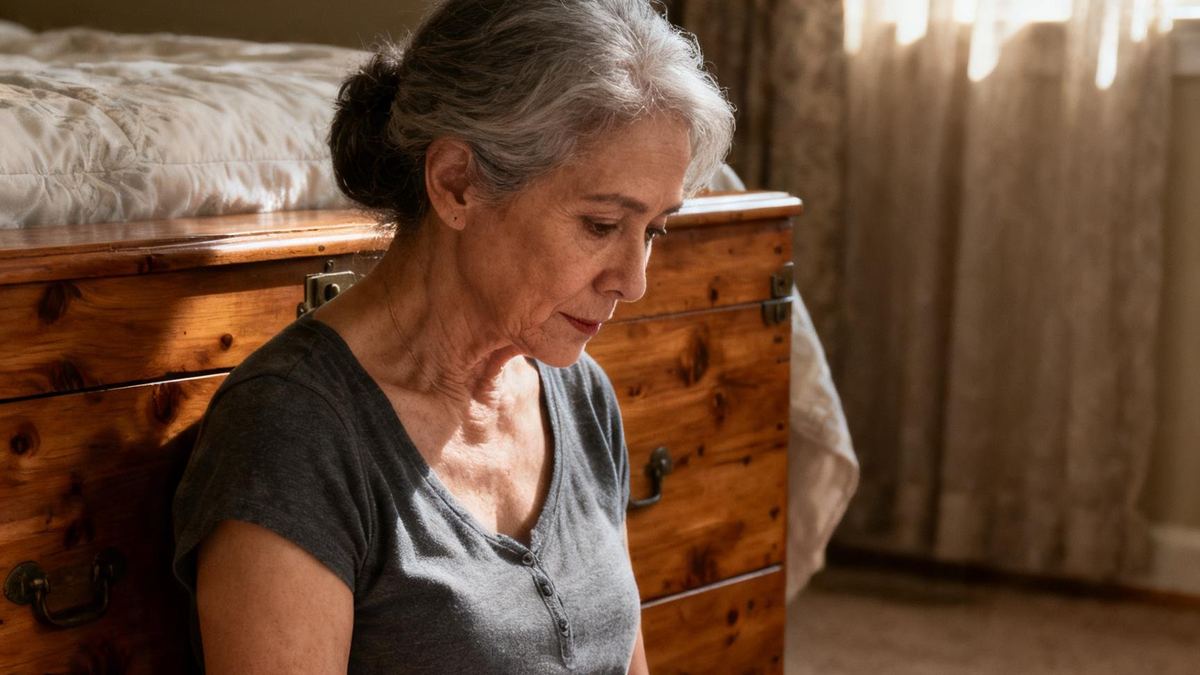
I sat on the floor of her bedroom, my back against the cedar chest she’d had since her wedding, and read the will three times. The signature was Mom’s — shaky, the *G* in Gloria looping too far — but it was hers, and it was dated seven years ago, long before the dementia.
At the bottom, in Dad’s handwriting, a sticky note: *Glory, this is fair. Mark’s got the boys and he’s never been good with money. Karen’s got James and her head on straight. She doesn’t need the help. She’ll understand.*
I didn’t understand. What I understood was that my father — my kind, funny, Sunday-afternoon barbecue father — had sat at this desk and decided that my four years of bathing his wife, fighting with her insurance company, watching her forget my name, and missing my daughter’s volleyball games were worth exactly nothing.
I called Mark from the kitchen, the sunlight slanting through the same window where Mom used to grow basil on the sill.
“I found the will,” I said.
Silence. Then, “What will?”
“The one that gives you everything.”
More silence, but I heard Linda in the background: *Who is that?*
“Karen . . . look.” He sighed, the heavy one he uses when he’s done wrong and knows it. “Dad set that up ages ago. I was going to talk to you about it, but with everything — ”
“Were you, Mark? When?”
“I don’t know. Before you moved her in. After. It got away from me.”
I didn’t yell. I didn’t cry. I hung up and stood there with the phone in my hand until the screen went dark, and then I called my attorney.
The funny thing about power of attorney: my mother signed it over to me a month after Dad died, when she still had most of her mind and a real fear of banks. I was authorized to handle her finances, her property, her medical decisions. Mark knew this. He’d been at the kitchen table that night, half-watching a Bulls game on his phone, telling her, “Yeah, Karen’s better with all that paperwork.”
So I sold the house. Not in a rush; I wasn’t angry in the way that makes you stupid. I found a nice young couple with a baby on the way who wanted the oak tree and the yellow paint. Three hundred and five thousand. I deposited the check into Mom’s account and set up an automatic payment to Maple Ridge — sixty-five hundred a month, every month, for as long as she needed it.
The forty-eight thousand from the life insurance policy, I cashed out and put in a trust for my daughter’s college. Chloe doesn’t know. She just knows Nana is in a place where people play piano in the common room and she doesn’t have to lock her door at night.
Mark found out when the SOLD sign went up on the lawn. He drove straight to my house, almost put his truck over the curb, and banged on the front door with a fist so hard the frame rattled.
James opened it.
I came out of the kitchen holding a folder. I’d put copies inside: the will, the sticky note from Dad, the power of attorney, the closing statement of the sale.
“You sold my house!” Mark’s face was splotchy red, and a vein stood out on his temple that I’d never seen before.
“Mom’s house,” I said. “And yes. For her care.”
“That was mine. Dad — ”
I held the folder out. “Here’s the will. Here’s the note Dad left for Mom. You can keep it. It’s not a legal document anymore, but it’s a nice memory.”
He didn’t take it. He just stared at it, his hands at his sides, his mouth moving without any sound.
“The house is paying for her room now, Mark. She’s safe, she’s warm, she has twenty-four-hour nursing. That’s what Dad wanted, right? That’s what *you* wanted?”
“There’s money left over,” he said finally. “I know there is.”
“There’s about twelve thousand in the account right now. That’s about two more months. Then the money runs out, and then I’ll figure out the next thing, like I always do. The life insurance policy — I liquidated it.”
I said it flat, without apology, without triumph. It was just a fact, like the weather or the price of gas.
Mark took a step back, and I saw something crumple in him. Not guilt — I don’t think he has guilt the way normal people do — but the awareness that the thing he’d counted on was gone. The yellow house, the oak tree, the money that was supposed to float him into retirement. All of it, now, was a bed with a north-facing window and a weekly bingo game and an aide who made sure my mother didn’t wander into traffic.
“Mom would hate this,” he said.
“Mom just asked me if I was the woman who used to do her laundry. She doesn’t know what year it is. She doesn’t know her own address.” I closed the folder calmly. “She’s not worried about the house, Mark. You are.”
Linda was in the truck with the engine running. I saw her craning her neck, trying to hear. She’d been the one, I knew, who’d told their boys not to visit Nana because “it’s too upsetting.” She’d been the one who posted on Facebook about family values while I scrubbed bathroom walls.
I stepped back from the door. “I’ve got Chloe’s parent-teacher conference in twenty minutes. So I’m going to go now.”
Mark stood there on my porch, blinking, as if he expected me to take it back, to apologize, to be the good sister I’d been my whole life.
I didn’t. I shut the door, and I heard his boots on the steps, and then the truck pulling away with a sound like gravel crunching.
The next week, I went to visit Mom. She was in the courtyard, a blanket over her lap even though it was sixty degrees, a nurse’s aide named Tamika sitting beside her.
Mom looked up when I came over. She squinted, and for a second I thought she might say my name.
Instead she said, “You’re the one with the curly hair. I had hair like that once.”
I sat down in the empty chair beside her and took her hand. Her skin was cool and dry, the knuckles knobby.
“I married a man with curly hair,” she said, and she launched into a story I’d heard a hundred times: meeting Dad at a USO dance in 1962, him stepping on her feet, her laughing so hard she snorted. She told the whole thing with the same joy, the same little gasp at the good parts, as though it had just happened.
I listened. When she was done, I gave her the mug from her nightstand, the chipped one, with fresh tea inside.
“Chamomile,” she said. “That’s for bedtime.”
It was four in the afternoon, and the sun was still bright, and her eyes were already drifting shut. I stayed until she fell asleep, and then I walked out past the raised tomato beds and drove home through the late-afternoon Chicago traffic, and at no point did I feel what I was supposed to feel — no guilt, no regret, no hollow ache.
I felt lighter. The house on Linden Street belonged to a young couple now. My brother’s inheritance was a few thousand dollars and the truth he’d have to sit with. And my mother, when she remembered it at all, had her chipped mug and her chamomile and a window where the morning light came in.
That was enough.