The first anniversary of David's death fell on a Tuesday. I'd arranged a memorial service at St. Anne's out on Tillamook Street—nothing big, just the pastor saying a few words, the girls flying in for the day. David wasn't Catholic, but he'd come with me on Christmas and Easter for thirty-four years, holding the hymnal like it might explode, so Pastor Jim knew him well enough.
After the service, people filtered toward the fellowship hall for coffee and those sad little sandwiches you only see at funerals. I stayed in the pew, staring at the program in my lap. Right there, at the bottom:
*In loving memory of David Callahan. From Natalie, with gratitude.*
No last name. Just Natalie. With gratitude.
I didn't know a Natalie. David had never mentioned a Natalie. His sister's name was Ruth, his receptionist was named Michelle, his golf buddies were all men with names like Steve and Ron. We'd been married since I was twenty-six—he was an electrical contractor, I taught eighth-grade science at Grant Middle. Two daughters, Chloe in graduate school at UW and Sarah down in San Jose with a mortgage and a terrier.
I was sixty-one years old and I'd just learned my husband had a Natalie.
Pastor Jim was stacking hymnals when I cornered him. He's around forty, a transplant from Indiana who still says "y'all" even though he's lived in Portland for a decade.
"Pastor, this second dedication—Natalie. Do you know who arranged that?"
He squinted at the program. "Let me check. We take these by phone or through the office, so I don't always meet the person." He pulled out a binder from the podium drawer, ran his finger down a page. "Here. Natalie Reyes. Called last Wednesday, paid over the phone with a credit card. Asked specifically for David's service." He looked up. "You don't know her?"
I shook my head. My mouth had gone dry, the way it does right before you get bad medical news.
"She said she'd attended this church. I assumed she was a family friend."
"We've been members here for thirty years," I said. "I know our friends."
Pastor Jim closed the binder. Something in my voice must have told him not to offer platitudes.
—
I drove home in the rain—that thin February rain that blows sideways across the Fremont Bridge. The girls had already headed out, Chloe to meet an old high school friend, Sarah to catch her flight. I'd told them I was fine. Just tired. Just needed quiet.
The house in Irvington felt too big. David's reading glasses were still on the nightstand, right where he'd left them the morning of the stroke. I hadn't been able to move them. I hadn't been able to move much of anything in the year since.
I made tea. Let it go cold on the kitchen island.
David Callahan. Six-foot-two, hands rough from pulling wire, the kind of man who fixed his neighbor's garbage disposal before fixing his own. He'd built half the shelves in this house. He'd taught both girls to drive in the Costco parking lot on Sunday mornings when it was empty. For our 25th anniversary, he'd rewired the entire basement into a craft room for me, complete with task lighting and a custom table.
He was not a man with secrets. He was not complicated.
Or maybe I'd just never looked.
I'd gone through his things after the funeral—the practical things. Canceled his credit cards, closed his Home Depot account, donated his coats to Goodwill. But I hadn't gone through his desk. The roll-top in the corner of the den had been his territory, a mess of invoices and permit applications and user manuals for tools he no longer owned. I'd shut the roll-top the day he died and hadn't opened it since.
Now I did.
The cubbyholes were stuffed with the usual debris: a box of staples, a receipt for a sump pump, a warranty card for a drill. I emptied each one onto the desk blotter, sifting through expired insurance cards and old business licenses.
In the bottom drawer, under a stack of tax returns from 2017, I found an envelope.
No address. No stamp. Just my husband's name in handwriting I didn't recognize—small, precise, the *D* in David looped with extra care.
Inside was a single sheet of paper, the kind you'd pull from a hotel notepad. *David—I will never be able to repay what you did. You are the only person who knows. Thank you for carrying it. —N*
I read it three times. Then I put it on the desk and stared at it from across the room, like it might do something.
*You are the only person who knows.*
David had carried something. Something that wasn't mine. Something for a woman named Natalie.
—
I called Sarah that night. She's the eldest, the practical one—she works in corporate compliance, she reads contracts for fun.
"Mom, Dad was a contractor for forty years. He probably did free work for someone in a bad spot. You know how he was."
"Sarah, this note says 'you're the only person who knows.' That's not a thank-you for rewiring an outlet."
Silence. Then: "What do you want me to say? Should we hire someone to track her down? I can call an investigator. But Mom—are you sure you want to know?"
Was I sure? I thought about that question for three days.
On Thursday I went back to St. Anne's. The church office manager, a woman named Barbara with a gray bob and reading glasses on a chain, remembered the call. "She had an accent. Not strong, but something. I thought maybe… I don't know. Israeli? Eastern European? I'm bad at accents."
"Natalie Reyes," I said. "Is there an address? You'd have her credit card on file."
Barbara hesitated. "Margaret, you know I can't—"
"I've been coming to this church since before you worked here," I said. My voice came out harder than I meant. "My husband died in my arms in the ambulance on I-5. And a woman I've never heard of is thanking him for carrying her secret. I'm not asking for gossip. I'm asking for the truth."
Barbara looked at me for a long moment. Then she turned to her computer, typed something, and wrote an address on a Post-it note. "She lives in Lake Oswego. I'm probably going to hell for this."
"Get in line," I said.
—
The house was off McVey Avenue—one of those new builds trying to look like an old craftsman, gray with white trim and a porch swing. A Subaru in the driveway with a child seat in the back.
I sat in my car for fifteen minutes, the heater running, rain drumming on the roof. What was I going to do? Knock on the door and say what, exactly? *Hi, I'm the wife. What secret did my husband keep for you?*
I was reaching for the ignition when a woman came out onto the porch. She was around fifty, dark hair pulled back, wearing a fleece jacket and jeans. She wasn't crying now. But when she'd come to our church—I was sure of it—she had been.
She saw my car. Froze.
I got out.
We stood there, twenty feet apart, the rain falling between us. Her face did something complicated—recognition, then dread, then something that looked almost like relief.
"Mrs. Callahan," she said.
"You know who I am."
"I saw you at the service. Sat in the back. I…" She wrapped her arms around herself. "I didn't know if I should come. But I had to. I owed him that."
"What did you owe him?"
She didn't answer right away. A woman in her fifties doesn't cry easily—I know, I'm one of them—but her eyes went bright.
"Can we talk inside?" she said. "This isn't a conversation for a driveway."
—
Her house smelled like cinnamon and laundry detergent. A girl's backpack on the kitchen counter, pink with unicorns. Natalie Reyes—she was an accountant, she told me, a single mother to a nine-year-old named Elena. Divorced. Moved to Portland six years ago from Phoenix, trying to start over.
And eighteen months ago, she'd been diagnosed with breast cancer.
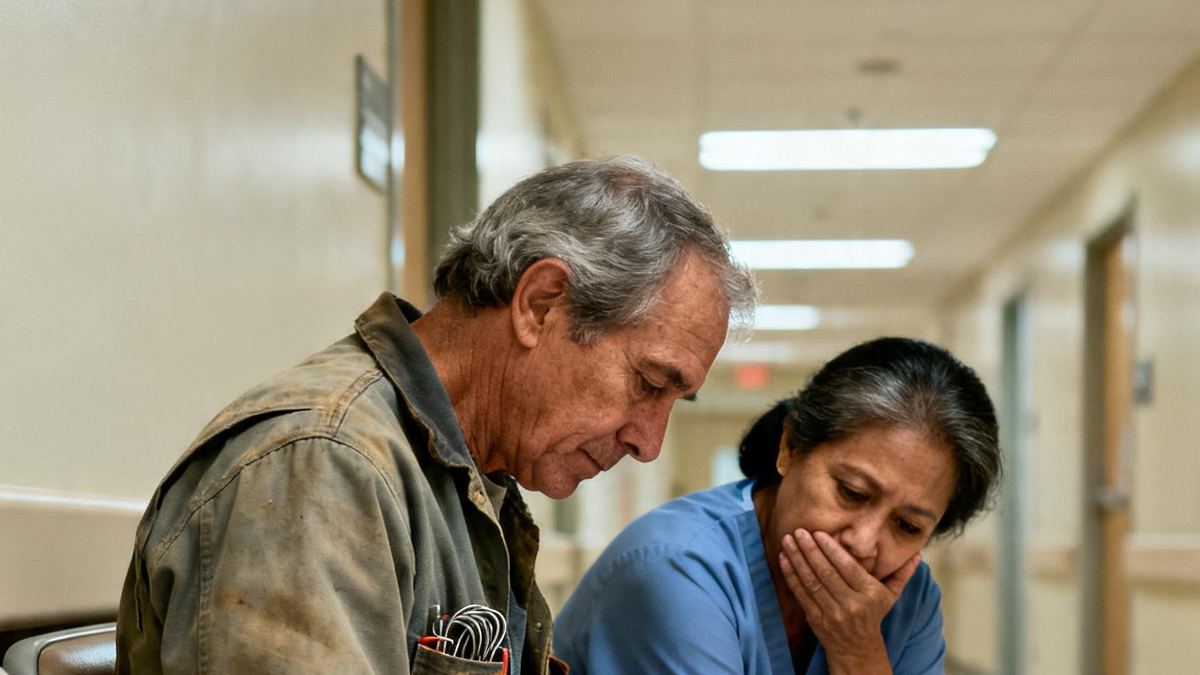
"I had insurance through my firm, but it was terrible. High deductible, out-of-network for the oncologist I needed. I was going to lose everything. I had no family here, nobody to help." She wrapped her hands around a mug of tea that was probably the same temperature as mine at home. Cold. "I was in the waiting room at Providence, crying in front of the billing office, and your husband was there. He'd brought a sandwich to one of his workers who'd gotten hurt on a job site. He saw me."
She stopped. Swallowed.
"He sat down next to me and said, 'Ma'am, I don't know your situation, but you look like you need someone to tell you it's going to be okay.' And then he asked me what was wrong."
*David.* I could see him doing it. I could see him, in his Carhartt jacket with the wire strippers in the pocket, sitting down in a hospital corridor next to a stranger because she was crying.
"I told him everything. I don't know why. I'd never told anyone. I was so ashamed—I'd worked my whole life, and here I was, forty-nine years old, about to be bankrupted by my own body." She took a breath. "And he said, 'What's the number?'"
"What?"
"The number. The out-of-pocket maximum. I told him. And he wrote me a check."
I stared at her. "For how much?"
"Eight thousand, two hundred dollars."
The air left my lungs.
"He told me he'd been putting money aside for years—his 'rainy day fund,' he called it. Said his wife didn't know about it, and she didn't need to. That it was just sitting there, and he'd rather see it do some good than gather dust." Natalie's voice broke. "I said I'd pay him back. He said, 'No. You get better. That's the deal. You get better and you raise your daughter and you don't spend one more second crying in a hospital hallway.'"
I didn't speak. I couldn't.
"He made me promise not to tell anyone. He said if his wife found out, she'd want to meet me, she'd want to bring over casseroles and organize a fundraiser, and he didn't want that. He said, 'Maggie's got a big heart and I love her for it, but sometimes a person just needs to get help without the whole world knowing.'"
Maggie. He called me Maggie.
"That note," I said. "The one in his desk. 'You're the only person who knows.'"
"The money was one thing," she said. "But I meant the other part. He was the only person I'd told. About the fear. About what it felt like to face dying alone, with a child who had nobody else. I couldn't tell my daughter—she was eight. I couldn't tell my ex-husband. Your husband was the only human being on earth who knew how terrified I was." She wiped her eyes with her sleeve. "And he carried it. He called me every week for six months, just to check in. 'How you doing, Natalie?' He never told anyone. Not even you."
—
I thanked her. I don't remember the words, but I remember her face when I left—hopeful, like maybe she'd been carrying guilt for accepting that check and now she'd set it down.
I drove home in the rain.
The rainy day fund. David had one. I'd had one too—my own savings, separate from our joint account. We'd never asked each other about them. Married people keep small mysteries. A birthday present, a surprise dinner, a splurge on something the other wouldn't approve of. These are the harmless secrets that stitch a marriage together instead of tearing it.
But eight thousand dollars to a stranger in a hospital hallway and six months of weekly phone calls? That wasn't a small mystery. That was a whole second self.
I sat at the kitchen island. The tea was still there, from four days ago—I threw it out.
The thing was this: David hadn't cheated. He hadn't betrayed me. He'd done something I would have admired in anyone else. He'd seen a woman drowning and he'd thrown her a rope, and he'd kept it quiet because he knew I would have made it a *project*, would have organized, would have *managed*—and maybe what Natalie needed was exactly the opposite. Someone who asked nothing back.
He knew me. He knew what I would do, and he'd chosen differently.
Did I love him less?
No.
But I loved him *differently*, which was its own kind of grief. I'd spent thirty-four years loving the David I understood. Now I had to love the David who had a rainy day fund and a secret phone call every Wednesday and a woman in Lake Oswego who would never be able to repay him.
—
The following Wednesday, I went back to St. Anne's. Not for a service. I walked into the office with a checkbook.
Barbara looked up. "Margaret. Everything okay?"
"I'd like to make a donation," I said. "To the parish assistance fund. The one that helps people with medical bills."
"That's very generous. Do you have a particular amount in mind?"
I tore the check from the book and slid it across the counter. Barbara looked at it, then looked at me, then looked at it again.
"Eight thousand, two hundred dollars," she said.
"I'll need you to hold it for a couple of days until I move money from savings."
"Margaret, this is… this is a lot."
"It was a rainy day," I said. "And now it's not."
I didn't explain. I walked out into the thin February sun, got in my car, and drove toward the Morrison Bridge. Halfway across, I pulled over at the viewpoint, got out, and stood at the railing looking at the river.
I took my phone from my purse. Called Sarah.
"Mom? You okay?"
"I'm fine." I watched a barge moving downstream. "I'm going to sell the craft table your dad built me. The one in the basement."
"Wait, what? Why?"
"Because I haven't used it in two years and someone else will. I'm listing it on Craigslist for four hundred dollars."
A pause. "Mom, you're being weird. This is about that Natalie thing, isn't it? Did you find her?"
"I found her." I pulled David's reading glasses from my coat pocket—I'd started carrying them, a month after he died, just to have something of his with me. "She's exactly the kind of person your father would have helped."
"Helped how?"
"That's not my story to tell." I put the glasses on the railing, balanced there for a second. Below me, the Willamette ran cold and gray. "But I'm going to start helping too. Not because I have to. Because I can."
"Mom—"
"I'll call you tonight, sweetheart. I've got to go list a table."
I hung up. I picked up the glasses. I didn't throw them in the river—that wasn't the point, that's not what this was about. I put them back in my pocket, got in the car, and drove home.
The basement smelled like sawdust. The craft table sat under the task lights, four hundred dollars' worth of maple and plywood. I took five pictures and wrote a listing: *Custom craftsman table. Built by a man who knew what he was doing. $400. Cash only.*
Before I hit post, I added one more line: *Proceeds will go to someone who needs them more.*
I didn't say who. Natalie Reyes would never see it. David couldn't see it.
But I could.