They pulled up to my gate in a rented SUV with gold balloons and a sheet cake from Costco. My mother-in-law Deborah turned sixty-five, and apparently my house was the venue. My husband Travis was on the Ring camera, his face two inches from the lens, his voice cracking as he begged me to just open the gate and not ruin his mom's birthday.
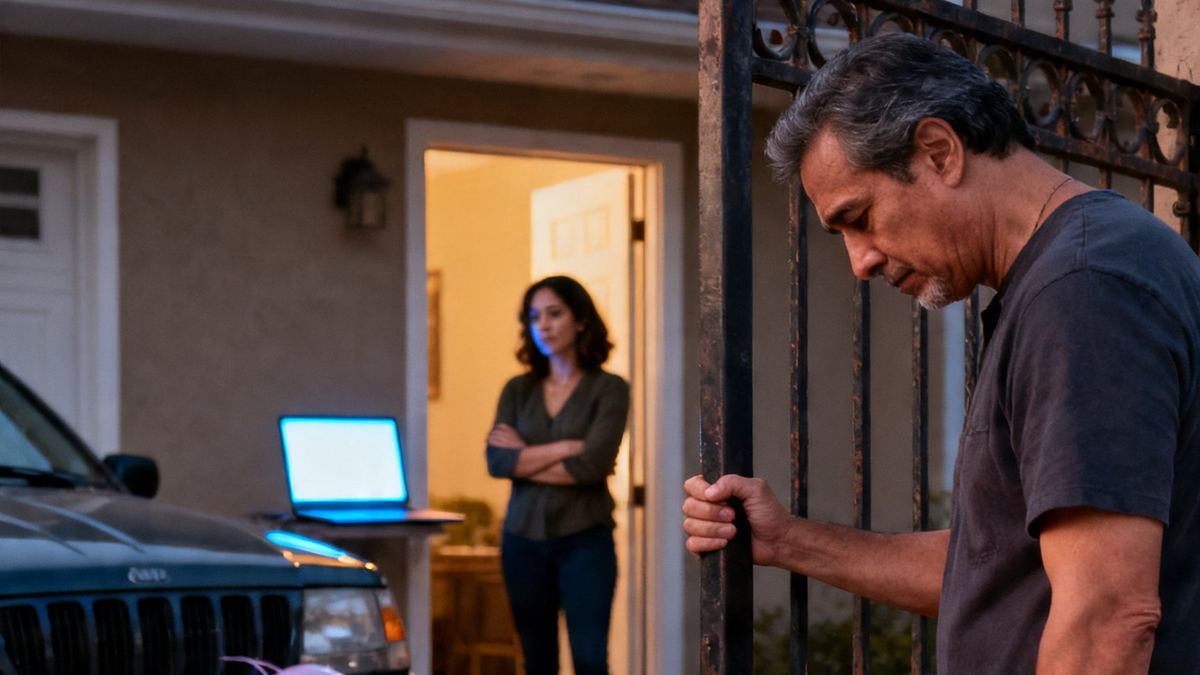
I watched the feed from my kitchen. Deborah was already out of the car, yanking on the wrought iron. Her sisters stood behind her, holding gift bags and looking at the house like I'd committed a crime by locking my own door.
Travis pulled out his phone. I saw my own device light up on the counter.
"Megan," he said when I answered. "Please. She's sixty-five. She's been planning this for weeks."
"Put me on speaker," I said.
"What?"
"Speaker, Travis. They all deserve to hear this."
He hesitated, then I heard the wind from the driveway, the shuffle of shoes on gravel. Deborah's voice cut through: "What is wrong with you? Open the gate! We're standing on the street like strangers!"
"You're not strangers," I said. "You're family. And family should know what you two did."
Behind Deborah, one of the aunts set her gift bag down in the grass. The other pulled her cardigan tighter and said, "What is she talking about?"
Deborah turned to wave them off. "Nothing. She's dramatic. Megan is always dramatic."
I opened my laptop. The folder was already there. Three days of work with my attorney, Renee Okafor, compiled into a tidy PDF. Video files. Eighteen screenshots. A loan application. And a copy of a title transfer document with my name on it — my name, in a signature I never signed.
"Travis," I said, "tell them."
He swallowed. I heard it through the phone, the dry click of his throat. The wind picked up, rattling the balloons. It was early October, the tail end of a heat wave in Columbus, Ohio. The maple tree by the fence was already dropping dry leaves onto the hood of the SUV.
"Megan, we should talk about this alone." Travis said it like he was asking me to lower my voice at a dinner party.
"Alone?" I said. "You and your mother weren't planning to discuss the transfer of my property with me alone. So we can do this your way. In front of everyone."
One of the nieces let her balloon cluster drift toward the ground. The plastic string snagged on the bumper. A cousin looked at Travis, then at Deborah, then back at Travis.
"What property transfer?" the cousin asked.
Deborah snapped, "It's the family home! It's completely normal for a married couple to share ownership. Don't listen to her."
"Except I said no," I said. "Repeatedly. For eleven years."
I pressed play on the first video.
My home office camera, installed two days earlier. The timestamp read 11:14 p.m., the night before they came with the cake. Travis stood at my desk, his back to the window. Deborah was at the file cabinet, flipping through folded documents, muttering about how the mortgage statements weren't organized.
On the video, Travis said, "If Megan signs, it's fine. If she agrees, no problem."
Deborah didn't look up. "She won't agree. You know that. She's been holding that house over your head since your father died."
"So what do you want me to do?"
She turned. In the video, her jaw set into the same line she'd worn at Thanksgiving when the turkey was dry.
"Don't ask her," Deborah said.
By the gate, someone sucked in a breath. The aunt with the cardigan put her hand to her mouth. The niece crouched down and let the rest of the balloons float up toward the power lines.
"Keep watching," I said, and I let the video run.
"Mom, we can't do that," Travis said on the recording. His voice was thin, rehearsed.
"Why not?" Deborah replied. "You're married. If your name is on the deed, at least you'll have security. Then we'll take out a home equity line of credit, pay off my debts, and we'll fix everything later."
"Megan will notice."
Deborah laughed. It wasn't a warm laugh. It was the laugh she gave when a waiter brought the wrong dressing. "By the time she notices, the money will already be in the account."
I stopped the video.
No one at the gate spoke. The only sound was the wind in the dry maple branches and the distant drone of a leaf blower two blocks over. Then one of Deborah's sisters, Kathleen, stepped forward.
"What debts?" Kathleen asked.
Deborah turned. "That's none of your business."
"It is my business," Kathleen said. "In March, you borrowed six thousand dollars from me and said Travis and Megan were refinancing this house. That's what you told me."
The other aunt made a sound like a laugh that didn't come out. "She told me she needed three thousand for a new heating system. Then she asked for two more."
"She borrowed from me too," the cousin said. "Last summer. Said it was for a car."
Deborah's face drained. She grabbed the gate and shook it once, hard. "These are all private matters!"
Travis took a step back from the gate. "Mom, you told me no one else knew."
Deborah whirled on him. "Shut up, Travis. Just shut up."
I let them sit in that for a beat. Then I said, "Travis, do you want to tell them about the loan application you submitted on Tuesday?"
"Megan, that was just a pre-qualification. It wasn't final."
"It was an application," I said, "for a home equity line of credit in the amount of one hundred and eighty thousand dollars. Secured against my property."
The cousin hung his head. Kathleen put her hand on the roof of the SUV and just stood there.
"With my signature," I said.
Nobody spoke. Even the wind seemed to drop, like the street itself was listening.
"Only I didn't sign it," I said.
Travis looked at the ground. Deborah looked at Travis, then at the camera above the gate, then at me — somewhere beyond the lens, beyond the fence.
For twenty-five years, I've signed my name the same way. The small loop on the M. The long tail on the A. When you write your name every day for a quarter of a century, you know when someone else has tried to recreate it. You can see the hesitation in the curve, the pause where there should be none.
My father built this house. He and I poured the foundation together when I was eighteen. He left me the property when he passed. I bought out my brother's share a year before Travis and I got married. The deed has only ever had one name on it: Megan O'Brien.
On Tuesday, a title monitoring service sent me an alert. Renee had convinced me to sign up for it years ago, back when she and I worked together at the county. Someone attempted to file a document changing ownership of the property to include one additional name: Travis William Hartley. Next to mine.
I called Renee that same afternoon. By Thursday, she had begun the legal challenge to the document. The title claims were flagged. The loan application was frozen.
On the driveway, Travis started to speak. "I never wanted to take your house."
His voice cracked, something I hadn't heard from him before. He sounded, for one second, like the man I thought I'd married.
"Then what did you want?" I asked.
"To help my mom."
"With my property."
"She was going to pay it back. All of it."
Kathleen made a sound like a laugh with no air in it. "That's what she told all of us."
Deborah's voice came out sharp as a struck nail. "I am your mother, Travis! I gave you everything! I sacrificed for you!"
"So that makes it okay to practice my signature?" I said.
"No one forged anything!" Deborah shouted at the camera.
I opened the second video.
Deborah sat in my desk chair. She had my old tax documents spread in front of her. Travis held the phone flashlight. On the paper, over and over, Deborah wrote my name.
Megan O'Brien.
Megan O'Brien.
Megan O'Brien.
"There," she said on the recording. "That's close enough."
The video ended.
Kathleen set her gift bag down in the gravel and crossed her arms. She didn't look at Deborah. She looked at the cake through the SUV window, then at the balloons snagged on the bumper.
"Deborah," she said, "you've lost your mind."
"Don't you dare judge me," Deborah shot back.
"I'm not judging," Kathleen said. "I'm finally understanding why you've been working through every person in this family for money."
Travis stepped closer to the gate. "Megan, please. Let's talk. Just you and me."
"I already talked to someone," I said.
"Who?"
"Renee."
His face tightened. "Your attorney?"
"Yes," I said. "This morning, Renee filed for divorce. And a temporary freeze on all our joint accounts."
"Divorce?" Travis said it like I'd told him I'd signed us up for a cruise. "Megan, we've been married eleven years."
"And for eleven years, you've known that when I say no, I mean it."
"It was a mistake," he said.
"A mistake is getting off the highway one exit too early," I said. "This is a decision."
He opened his mouth, but nothing came out. Behind him, the family had gone quiet. No one was trying to defend Deborah now. Even the cousin had stepped back toward the car.
"Here's what I want," I said. I closed the laptop. "I want you to tell me, in front of all of them, whether you helped your mother access my documents."
Travis's jaw worked. He looked at Deborah. She stared at the ground, arms wrapped around herself like a kid caught in a storm.
"I did," he said. His voice was barely audible. On the Ring camera, his hands shook against the metal bars.
"And did you photograph the title documents from my filing cabinet?" I asked.
"Yes."
"And did you send them to your mother?"
A long pause. Then: "Yes."
Deborah snapped her head up. "That doesn't mean anything. He was just trying to protect himself."
"By forging my signature on a loan application?" I said. "By listing my property as joint marital property when it was never his?"
Deborah had no response.
"I've already provided the recordings to the county," I said. "Renee has filed a report with the fraud investigation unit. The loan application has been flagged. The title change has been rejected."
Kathleen set both hands on her hips and turned to Deborah. "You told me the money was for a new roof. You told me this house needed a roof."
Deborah didn't answer.
The next hour passed slowly. They didn't leave right away. Travis sat on the front bumper of the SUV with his head in his hands. The aunts stood in a semicircle, not talking to Deborah, not talking to each other. Someone found the birthday candles in the trunk. They were already bent from the heat.
The cake — a vanilla sheet cake with buttercream roses — stayed in the cargo area. Deborah slammed the trunk shut at some point and locked the keys inside. They had to wait forty minutes for a locksmith.
Here's the detail I remember most: Kathleen walked up to the gate, not screaming, not crying. She just stood there, looking at me through the iron bars. Then she said, "You know, when our mother died, Deborah told me she would take care of everything. She was the oldest. She said she'd handle the estate."
She paused. "I never saw a single paper."
Then she walked back to her car and drove away.
That evening, Travis called me from a motel off I-70. He asked if I'd ever loved him. I told him that was a question for the man I thought he was, not the man standing on my driveway with his mother's lies on his breath.
He started to argue. I set the phone down on the kitchen counter and went outside. The maple leaves were still falling, brown and brittle. The gate was closed, the lock secure.
I didn't go back for the phone.
It took eight months for the divorce to finalize. Travis and his attorney tried to claim I was being "vindictive." His mother called me from three different numbers, leaving voicemails that ranged from rage to tears. I forwarded them all to Renee.
The house remained mine. The title change was invalidated. The loan application was permanently flagged. Travis got his share of the joint savings — $12,740 — and the Honda he drove. He also got two years of probation after the fraud investigation concluded. He cooperated, which helped. But he has a record now. In the line where it says "fraud," his name is there, next to his mother's.
Deborah faced worse. The family discovered she'd borrowed over thirty-eight thousand dollars across five relatives, telling each one a different story. Kathleen filed a civil suit. The other sister blocked her number. The birthday cake, I heard later, stayed in the trunk for three days before it was found. In the October heat, it had melted into something that looked like soup. The supermarket had to detail the whole cargo area.
One year later, I threw a party. Not a birthday. Just a Friday.
Twelve people came. Kathleen, who had sent me a handwritten note apologizing. Renee and her partner. Two of my longtime friends from the county office. My brother and his kids. A few neighbors from up the road.
We strung lights across the back deck. The maple tree was already turning red. I made a lemon tart. Someone had brought a speaker, and we listened to old soul records until the streetlights came on.
Around nine, a car drove past the house. Headlights swept across the front windows. The car didn't stop, but I caught the shape of a woman in the passenger seat, her face turned toward my gate.
It was Deborah.
She didn't get out. She didn't wave. The car turned at the next corner and disappeared.
I watched the road for a moment, then reached into my pocket and closed my fist around the house key — the only key, the one thing I'd never shared.
In the driveway, my brother raised his glass toward the string lights.
"To the house," he said.
I turned back to my guests, and the music kept playing on the deck.