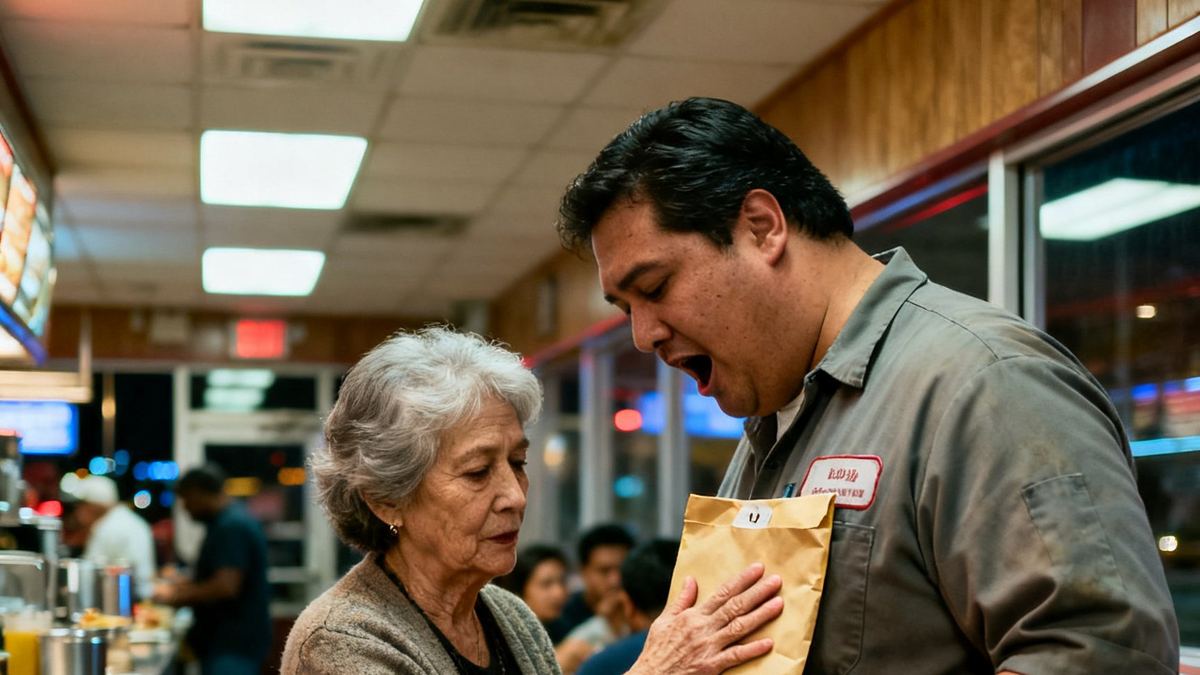
I manage a diner off the I-80 interchange near Truckee. Been doing it eleven years now. You learn to read people by what they order and what they don't finish. That's the whole job, really. The food's just the excuse.
She came in around two-thirty on a Tuesday, which is the dead hour. I'd been restacking the pie case — the lemon meringue was going fast that week, some church group had come through. The bell over the door barely rattles anymore, it's got that soft chime that means someone's coming in slow and tired, not hungry.
She took table nine. Window seat. I noticed because she didn't look at her phone, didn't open a menu, just set her purse down and put both hands flat on the table like she was holding it in place.
Coffee, she said. Black, leave the pot.
I've seen women cry at table nine. I've seen a man eat three slices of apple pie and leave exact change in coins. That's not judgement, that's just what the shift gives you. But this one — she wasn't crying. She was doing something harder than that.
She kept touching a folded letter in her coat pocket. Taking it out halfway, putting it back. Like it was hot through the fabric.
I topped off her cup twice. The second time she looked up and asked if I'd ever had to tell someone something that would destroy their life.
I said I wasn't sure I had.
She nodded. "I hope you never do."
Her name was Elaine. I got that later. Right then she was just the woman at table nine with coffee she wasn't drinking and a letter she couldn't stop reaching for.
—
I want to be clear: this is not my family. I'm just the person who refilled a cup. But the whole thing happened in my diner, over about four hours, and I've turned it over in my head every week since. I can't seem to let it go.
Elaine's daughter-in-law came in around four. Younger woman, maybe thirty-two, thirty-three. She had that look single mothers get — not the tired part, everyone's tired. The *guard* part. Like every room she walks into, she's already doing the math on exits.
Her name was Nicole. I only know that because when she sat down across from Elaine, the first thing she said was, "Nicole, I swear, if you drove three hours to tell me to give him another chance, I will walk out right now."
So there it was. The son. The marriage. The thing I was about to accidentally listen to for the next hour, because you can't not hear table nine from behind the coffee station. Trust me, I've tried.
Elaine pulled the letter out. Finally. Set it down between them, folded, like a white flag neither one wanted to wave.
"I found this in Danny's truck," she said. Her voice was steady, which is the part I keep coming back to. Most people's hands shake when they do what she was about to do. Hers didn't. "Three weeks ago. I've been sitting on it since. I drove out here because I couldn't keep looking at you across Sunday dinner knowing what he's doing."
Nicole opened the letter. I watched her read it. She didn't make a sound. People always think there's going to be screaming. In eleven years of food service, I can tell you the loudest sound in a diner at two-thirty on a Tuesday is somebody's heart breaking quiet.
She read it twice. Her jaw was set. The letter was from a woman in Reno — I won't say more, it's not my business to repeat what was in it. But it made things clear that hadn't been clear before.
After a minute, Nicole's hand went flat on the table too. Just like Elaine's. Two women, same gesture, like they'd practiced it in the mirror. Then Nicole said, "I've known for eight months."
That's the part I didn't expect. And I saw Elaine didn't either — she pulled back, not far, just an inch, like you do when someone lands a punch you thought was a hug.
"Then why are you still there?" Elaine asked.
Nicole picked up the letter. Folded it. Folded it again, smaller. She had this habit, it turned out, of folding things when she was deciding what not to say.
"He's not the man I married," she said finally. "But he's the only father my daughter knows. And I keep thinking, if I leave now, she'll blame me. Not him. He'll make sure of it. That's who he's become."
The daughter's name — I only heard it once. Sierra. Seven, maybe eight. There was a drawing in Nicole's purse that she took out at one point, a crayon thing, a house with a sun that had no rays. Kids draw suns wrong. I saw it for half a second, and it's the thing I remember clearest. That sun with no rays.
—
Then — this is the part I tell over and over, because it's when it stopped being about the letter or the son or the marriage. It became about the whole machine of it.
Elaine reached across the table. Not dramatic, not slow, not any of those words people use when they're writing this down for you. She just put her hand on top of Nicole's. And she said, "Danny and I opened a joint account when his father passed. Ninety thousand for Sierra's college. He moved it last month. Into an account I can't see."
I put down the rag I'd been pretending to use. The register beeped. The cook dropped a skillet in the back. All the normal sounds of a place where nothing's happening kept happening, and Nicole sat there taking in that her husband had already cleaned out his own daughter's future.
Not another woman, not yet at least — money first. He'd started with the money.
Nicole opened her phone. Silent. Her thumb moved a few times. Then she turned it around and showed Elaine something on the screen.
"The truck's in both our names," she said. "But the loan's only in his. I checked last month. If I leave, I owe half on a truck he drives to see her in Reno."
I had to go seat a couple in the corner booth. It was getting on to five, that lull before the dinner rush. When I came back to the station, Elaine was writing something on one of those comment cards we put out by the register. The little white ones. Nobody ever fills them out for anything good.
She finished writing and slid it across the table. Nicole looked at it for a long time.
"You'd do that?" Nicole asked. "They'd hate you. He'd hate you."
"Let them," Elaine said.
I heard it clear as the bell over the door.
—
Here's the part where I stop being just the waitress, because I did something that night I've never done before. After they left — separately, Elaine first, then Nicole about twenty minutes later — I went over to clear table nine. The comment card was still there, tucked under a coffee saucer.
I know I shouldn't have looked. But I'm telling you this story, and you need to know how it ended. So I looked.
It was a name and a phone number. Under it, in handwriting that leaned hard to the left: *Certified fraud examiner. Tell her Margaret sent you. She's expecting your call.*
Margaret. Not Elaine. The name she'd given Nicole was a name for the daughter-in-law to protect. I don't know why that hit me harder than all the rest. But it did.
The next part I got from Nicole, because she came back three days later. It wasn't my shift, but I'd picked up a double. She sat at the counter this time, not table nine. Ordered a hot tea and asked for the day-old pie, the peach, if we still had it.
We did.
She told me, without me asking — people tell counter staff things, that's a thing that happens, you understand — that she'd called the woman on the card. That the woman, Diane, had gone through Danny's accounts like a dog after a buried bone. That there was more than the ninety thousand. There was a second account, and a title, and a safety deposit box.
"He thought I was stupid," Nicole said, quiet over the teacup. "He thought I'd never look because I didn't want to see."
She took a bite of pie. The peach was good, I remember it was holding up. And then she said the thing that stuck.
"He didn't count on his mother loving me more."
—
I saw Danny once, after all this. Just once. He came in looking for Nicole. She'd been eating at the counter two nights running, and I think he'd tracked her there, the way men will. It was a Saturday, maybe seven, full house. I could barely get to the register.
He stood by the host stand, scanning the room. Big guy, heavier than his daughter's sun drawing suggested. He spotted her in the corner, booth this time, with a woman I didn't recognize — mid-forties, briefcase by her feet.
He started that way. I don't know what he planned to say. I never found out, because Nicole moved first. She stood up, said something to the woman with the briefcase, and walked straight to him. Not around the tables, not the long way.
Straight through.
I couldn't hear what she said. The diner was loud with the dinner rush. But I watched his face, and I watched her hands. She didn't fold anything that time. She held one thing: a manila envelope, full enough that the flap didn't lie flat. She put it against his chest and let go.
He caught it. That's what people do — they catch what's put against them, even when they shouldn't. While he was fumbling with it, she walked out. The woman with the briefcase paid in cash and left after her.
Danny opened the envelope right there at the host stand, blocking traffic. I caught a look at what slid out before he shoved it back in.
Divorce petition. And a check, I don't know when he passed them — could've been an hour, could've been five minutes, I don't know. I just know that when I went over, he moved without being asked.
He took the envelope and walked out, and the little bell over the door finally got to make its full sound.
I went back to the pie case. The peach was all gone by then, which was right. Some things don't stay half-eaten forever.
—
Nicole came in one more time, maybe five weeks after that. It was the off hour again, because that's when she moves, I'd learned that. She had Sierra with her. The daughter was taller than I'd pictured, with that sun drawing still yellowing on the fridge? No — that's sentimental, and I don't know it's true. What's true is this:
Sierra ordered hot chocolate, and Nicole ordered coffee, and — I remember this — Nicole took the folded letter out of her coat pocket. The same one, the woman in Reno's letter. She'd kept it all this time. Not out of pain, I don't think. Proof. Insurance. Maybe just because when you finally name a thing, you keep the word.
She set it on the counter, turned it so the creases lined up, and then she tore it.
Not fast. Just once across, then again, then a third time, until it was eight neat squares. She stacked them. And she handed them to Sierra.
"Now you've got paper for the order," she said.
Sierra took the squares and smoothed one out and set it flat on the counter. She reached for the little comment cards we keep by the register, and she started drawing something on the back of the white scrap.
I didn't ask Nicole how the divorce went, or the client, or any of it. You don't ask, not at the counter, not at table nine, not anywhere. What I know is what I saw: she left a tip that was too big and a stack of torn paper on the counter, and the little girl's drawing was still there when the dinner rush started.
It's in a drawer in the back, now. Under the register. A sun with no rays. And I've been here eleven years.





