# The Gray Tom at the End of the Hall
I work the Saturday shift at the Copper Creek County Animal Shelter outside Morgantown, West Virginia. In October the kennel smells like wet cedar chips and the pine cleaner the county buys in five-gallon buckets. That morning I had a cold coffee from Sheetz on the front counter and a sore throat that made me talk like a lawn mower. It was raining just enough to glue leaves to the windows of the staff lot.
A couple came in around 2:15, shaking water off a golf umbrella. The man had a new red leash still in its plastic sleeve sticking out of his jacket. The woman carried a fleece dog bed under one arm and a Food City bag with a collapsible water bowl. She had that look people get when they've been waiting through a landlord's no-pet rule and two job transfers. They wanted a dog who would run with them on the rail trail and sleep next to the wood stove. They walked past the first row of kennels while a hound mix in run 14 kept dropping a tennis ball into his water dish and barking at the splash.
I showed them Biscuit, a yellow lab mix who leaned against the fence and gave them the full tail thump. The man tucked the leash into his pocket, already picturing it clipped to a collar. The woman asked about house-training, about cats, about kids. I answered everything. We were halfway to the front desk to fill out the application when the woman stopped next to the side door.
"What's down there?"
"The cat wing. It's closed for cleaning."
But she had one hand on the glass door. "There's a gray one. Big."
I should have said something about the mop bucket and the wet floor. Instead I said, "That's Clyde."
She didn't move. Her husband came up behind her and looked through the door. The fluorescent light at the end of the cat wing buzzed. Clyde sat in the big glass room at the far end, facing the window. He didn't turn his head. He didn't come to the glass. He didn't do any of the things cats do when people walk past. He just sat there like a piece of furniture nobody had bothered to throw away.
Maybe I made a sound. The woman opened the door before I could stop her.
The cat wing smelled like litter dust and the wet leaves that had blown in under the back door. Clyde was a gray tom with a head the size of a work boot and shoulders like a brick. His intake card, clipped to the door in a plastic sleeve, said eleven years old, owner surrender, moving. Underneath the typed line, someone had added a note in pen — a habit of the woman who used to run intake before she retired, always scribbling extra context in the margins. It said: *left in cracked carrier w/ 10 lb food + vet folder. Relocating to FL condo, no pets allowed. No note for the cat. Owner didn't say goodbye — just signed and left.* I'd read that card so many times over three years I could have recited it in my sleep.
People pass him every Saturday. They look at kittens. They look at dogs. They don't ask about the old gray tom because he looks like he'd take your hand off. He never does. He just doesn't beg.
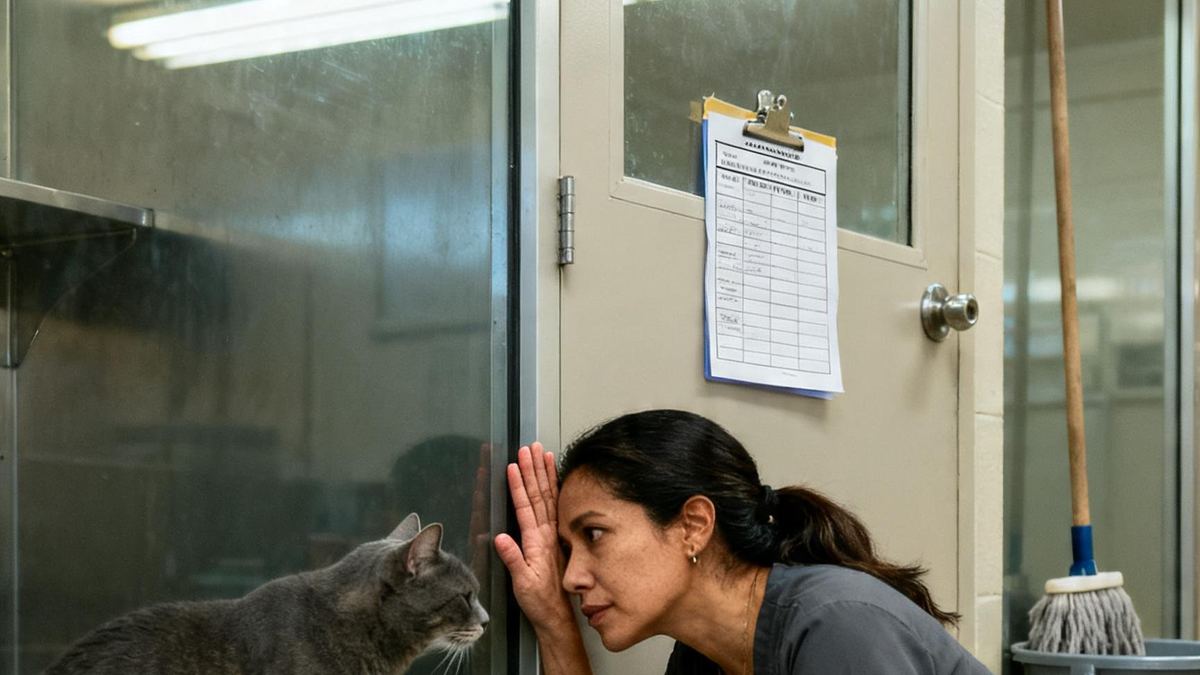
Nora — she told me her name later — knelt on the concrete. Her palm landed on the glass, fingers spread. Clyde didn't react. She stayed there while her jeans soaked up the wet floor.
"Hi, old man," she said.
Clyde's ears moved. Then he stood up, took his time, and walked over. He put his nose on the glass right where her hand was. Not rubbing. Just touching. Like he was checking if she was real.
That was when her husband, Shane, checked his phone. "It's almost three. They close at five, right?" he said to me. I nodded. He looked back at his wife, still on the floor. "We talked about a dog. We drove forty minutes for a dog. Biscuit's going to get scooped up by somebody else — they said he'll probably be gone by Saturday."
"I heard you," Nora said, not moving.
"He's eleven. That's old for a cat. Vet bills, kidneys, all that." Shane crouched next to the intake card and read it himself. "It says here — 'monitor appetite, senior bloodwork recommended.' You know what that means? That means if he stops eating one day, we're driving him to an emergency clinic at midnight and hoping."
"I know what it means."
"And I'm allergic. Not deathly, but I'll be sneezing in my own living room."
Clyde chose that moment to sit down again, slow and deliberate, and press his whole face flat against the glass an inch from her palm, like he was trying to close the last inch between them and couldn't.
Nora didn't answer Shane. She stood up, brushed off her knees, and walked back out into the hallway without a word. Shane followed her. I thought that was it — I'd seen it before, the door swinging shut on an old cat while the couple asked me where the puppies were.
They filled out Biscuit's paperwork instead. Nora wrote her name on the top line, then stopped at "reason for adoption" and just sat there with the pen not moving. Shane was already telling me about a harness he'd seen at the feed store. I started printing the contract.
Nora set the pen down. "I need a minute," she said, and walked back toward the cat wing before I could answer.
Through the office window I watched her go to the glass room alone. She didn't kneel this time. She stood with both hands flat on the door, and Clyde got up without waiting for her palm to land, crossed the room, and butted his head against the glass hard enough that I heard the small thud from the front desk. He did it again. Then he turned sideways and dragged his whole body along the glass, the way a cat does against a person's leg, except there was a pane of glass in the way and he did it anyway, like he'd forgotten it was there or didn't care.
Shane came up behind me at the desk and watched through the window too. Neither of us said anything. Nora didn't cry, exactly, but she pressed her forehead against the glass next to her hands and stayed like that.
"He's had three years of nobody choosing him," I said, because the silence needed something in it. "Longest-held animal we've got."
Shane didn't answer right away. Then he set the harness flyer down on the counter. "Void the other application," he said.
"You sure?"
"No," he said. "But go ahead anyway."
I walked back and told Nora. She didn't say anything either — just kept her hand where it was until Clyde finally sat back down, tucked his paws under himself, and looked at her the way he hadn't looked at anyone in three years.
We went back to the front office. Nora filled out the new application, hand stopping again on "reason for adoption." This time she wrote "companion" and didn't hesitate after that. Shane put a hand on the back of her chair and didn't say anything else about allergies. I printed the contract and she signed it without reading the back page about what to do if Clyde stopped eating or hid under the bed for a month. She paid the seventy-five-dollar fee with a debit card. She asked if she could take the old food bowl from his cage. I said yes. She put it in the bag without washing it.
Then I handed her a folder with his rabies certificate, a coupon for a free first exam at the clinic on High Street, and a paper bag with the brand of food the shelter had been giving him. She wrote their address on the microchip transfer form: Nora and Shane Callahan, 47 Poplar Ridge Road, Fairmont. She pressed hard enough to leave the words on the paper underneath. I stamped his intake card in red ink. ADOPTED.
On my way to the kennel with the empty leash, I passed run 14. The hound mix was still barking at the splash. Biscuit leaned against his fence, tail going, waiting for the next people to walk by. I told myself I'd call the rescue in Clarksburg on Monday, see if they had room to pull him before the shelter got full again. It wasn't a promise I could make him understand.
Clyde went into the carrier without a fight. Shane carried him out to their car — a sedan I hadn't paid attention to walking in, gray with a Marshall University sticker on the back windshield — and set the carrier in the back seat. The rain had stopped by then. The neon from the Arby's across the road showed up in every puddle. Nora buckled the carrier in like it was a child, checking the strap twice. She didn't look back at the shelter. Most people don't.
I walked inside and checked the glass room. The floor was empty except for a single gray hair caught in the seam by the water bowl. I peeled the old tag off the door and wrote a new one with a black marker from the desk drawer. It said "Clyde — ADOPTED" in block letters. I taped it to the glass, over the spot where his face had been.
Then I turned off the heat lamp. The room went still. I locked the front door at 4:55 and stood under the awning for a second. The car was already gone.