The county shelter sat in a fold of the Blue Ridge, fog pressing down on the switchbacks so thick the truck's headlights turned the world into gray wool. October in the high country outside Boone. The leaves had already dropped from the ridge, and the air smelled of wet woodsmoke and diesel from the snowplows idling behind the maintenance shed.
Marcus killed the engine and tapped his thumb on the steering wheel. "Forty dollars for a dog," he said, reading the sign out front. "Twenty-five for a cat."
He looked over at me, and we both knew what we were there for.
We'd bought the cabin the year before. A-frame, gravel driveway with three switchbacks, a woodstove that took forty minutes to heat the front room. And coyotes. Up in the hollow, they'd start yipping around nine o'clock every night, a sound that made the hair on the back of your neck stand up even when you knew what it was.
A dog would make that picture complete. Something that'd hike with us along the ridgeline, warn off the bears that knocked over the trash cans, curl up next to the woodstove when the temperature dropped. We'd talked about it for months. Looked at listing after listing on the county website.
That Tuesday was the day.
A woman named Tessa met us at the door with a clipboard and a limp. She'd worked the shelter eleven years, she told us, and you could tell by the way she moved down the row of kennels — touching one nose, then another, calling each dog by name without checking the cards.
"This is Clyde," she said, stopping in front of a tall red hound who threw himself against the chain link. "Best trail dog we've got. Doesn't chase deer. Good with people."
Marcus crouched down and let Clyde sniff his hand through the fence. "He's solid."
We made our way down the row. A blue-tick hound dropped off by a hunter who'd gotten too old to run him. A shepherd mix who knew sit, stay, and shake. A scruffy terrier with one ear that stood straight up and one that flopped sideways. Each had a story, and Tessa told them the way you'd talk about your own children.
By the time we reached the end of the kennels, Marcus and I had narrowed it down. He liked Clyde. I'd been drawn to the shepherd mix. We were leaning against the fence, quietly making our cases, when Tessa tapped the clipboard against her thigh — the kind of gesture someone makes when they're working up to saying something they already know you won't want to hear.
"Before you make up your minds," she said, "walk with me to the cat building."
I almost said no. We weren't cat people. We'd discussed it plenty: a dog hikes, a dog guards, a dog lives alongside you. A cat just… exists in the same house.
But Tessa was already limping toward a separate cinderblock building connected by a covered walkway, her shoes scuffing the concrete, and something about the set of her shoulders made me follow.
The cat building was warmer than the dog kennels. The air smelled of litter dust and dry food. Cats curled on carpeted shelves, stretched on windowsills, watched us pass with half-lidded eyes. At the very back, Tessa stopped outside a door with a glass panel set into it.
"He's in here," she said.
The cat sat on a shelf by the window with his back to us. He was huge — not overweight, just built, with a wide gray head and fur so thick it looked like it would shed in handfuls. His paws were the size of a bobcat's.
"How old is he?" I asked.
"Ten or eleven. The vet thinks he's a Maine Coon mix."
"How long has he been here?"
Tessa's hand went still on the door handle. "Three years."
The number landed in my chest and stayed there.
Three years in a room with a glass panel.
"His person taught up at Appalachian State," Tessa said, her voice flattening out. "Retired. Got a job at a university in Oregon. Brought him here and said the new apartment didn't allow cats." She stopped, worked her jaw. "Left the county. Left the state. Left him."
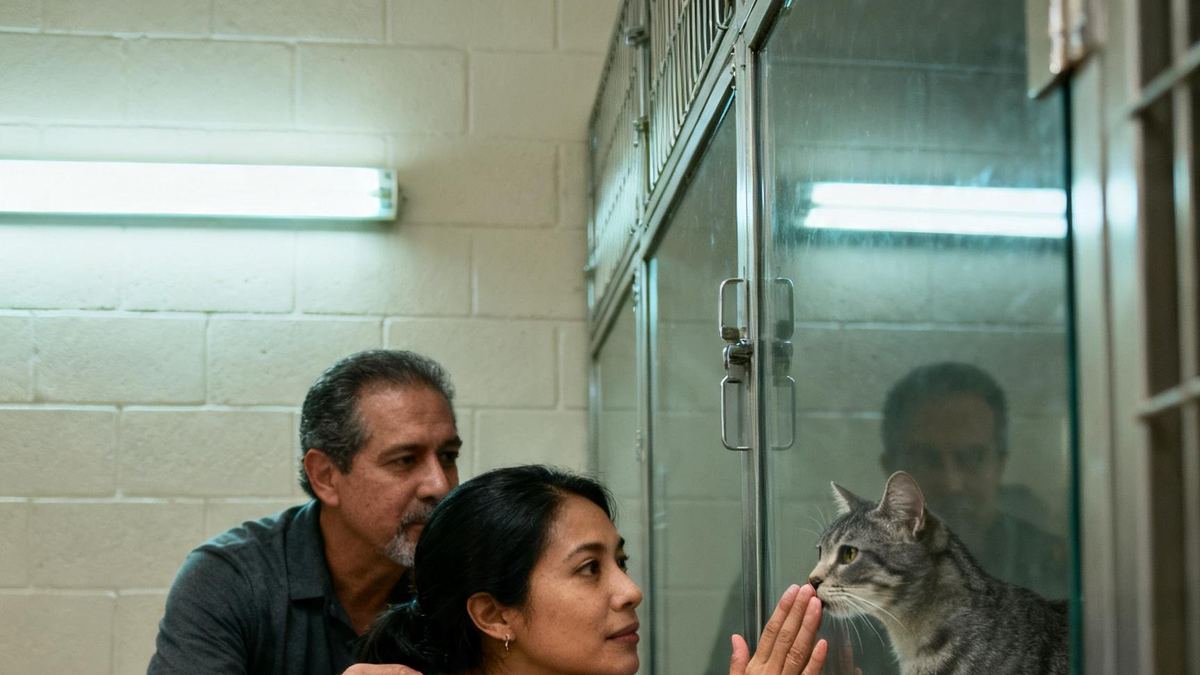
I stepped up to the glass. The cat turned his head then, and I got the full weight of his face: broad and gray, with gold eyes rimmed by age, and a look that wasn't mean, wasn't scared. It was something worse. It was finished. Like whatever he'd been watching for through that window had stopped being real a long time ago.
I crouched down and pressed my palm flat against the glass.
The cat looked at my hand. Then he stood up. Stretched one front leg. And crossed the room to sit directly in front of me, on the other side of the glass. He touched his nose to the exact spot where my palm was pressed.
Marcus's hand came to rest on my shoulder. From behind me, his voice had a rough edge to it.
"Cleo," he said.
"I know."
"Clyde's gonna get adopted. Someone's gonna want Clyde."
I didn't answer. The old gray tom hadn't taken his eyes off mine.
"This one won't," Marcus said.
We stood there for another minute. Nobody spoke. The only sound was the heating system kicking on somewhere overhead, blowing warm air through a vent.
Then I turned to Tessa. She was clutching the clipboard against her chest so tight her knuckles had gone white.
"Does he have a name?" I asked.
She blinked, caught off guard. "Granite. Somebody named him that when he first came in. Nobody's used it since."
"We'll take him," I said.
Tessa's face did something complicated. She turned away with a hand over her mouth, and when she turned back, her eyes were wet.
"I'll get the paperwork."
The adoption room had a metal table and a stack of forms printed on pink paper. Tessa wrote out the cat's intake number, his name — Granite — and the fee: twenty-five dollars. Cash or card.
Marcus handed over a debit card. The receipt printed on a little thermal machine, the kind they use at gas stations. Tessa tore it off and stapled it to the pink form.
"Sign here," she said, pointing to the bottom line.
I signed. Marcus signed. Tessa signed as the shelter representative.
And that was it. The old gray tom belonged to us.
The drive home was strange. The fog had lifted enough to see the valley below, the ridgelines stacked in layers of blue and gray that went on forever. Granite sat in the carrier on my lap, strapped in with the seatbelt. He didn't make a sound the whole way. Every so often I'd peer through the plastic grate, and he'd be watching me with those gold eyes, wary, calculating what this was going to cost.
The gravel road up our ridge was long and rutted from the last rain. The house sat dark at the top. Marcus opened the front door and set the carrier down in the middle of the living room, right on the flat-woven rug I'd bought at a craft fair in Valle Crucis — gray and blue, with a pattern like a river.
He unlatched the carrier door. Granite didn't move.
We sat down on the floor with our backs against the couch and waited. Ten minutes. Twenty. The woodstove ticked as it cooled. Outside, a neighbor's dog barked once, twice, then went silent. Up on the ridge, the wind moved through the bare branches with a sound like running water.
Granite put one paw out. Then the other. Then his whole massive head.
He crossed the floor in three steps. Sniffed the rug. Sniffed the air. Turned once, twice, three times, the way cats do when they're deciding if a place will hold them.
And then he lay down.
Not in a corner. Not under the couch. Right in the middle of the living room, chin resting on his front paws, facing the front door.
Like he was guarding it.
Like he finally had something worth guarding.
I don't know how long we sat there. Long enough that the last daylight drained out of the window and the house got cold enough that Marcus got up to close the flue. Long enough that I heard it — a low, rusty sound, like an engine turning over after a long winter.
Granite was purring.
I stretched out my hand and rested it on his side. Through all that thick fur, I could feel the vibration in his ribs.
He didn't flinch.
He just closed his eyes.
The first snow came that night. Big wet flakes that stuck to the window glass and slid down in streaks. Granite slept on the rug by the front door, and the house filled with the sound of his breathing.
The next morning, I found the adoption folder on the kitchen counter, next to the receipt for twenty-five dollars and the spare key.
Granite was sitting by the front door, watching the snow that had started and then stopped, leaving the ridge white and clean.
He didn't look like a cat who was waiting anymore.
He looked like a cat who was home.