I almost walked out of that shelter before Erin even found the kennel. Four thirty on a Tuesday, rain coming down sideways against the front windows, and I was still in my work boots. I told her we didn't need a dog. Two dogs? That was a whole other conversation I never planned to have.
But Erin had this look she gets when she's already decided something and just wants me to catch up. She took my hand and pulled me past the front desk, past the barking, past the little cages where puppies clawed at the glass.
Then we saw them.
A big gray dog, maybe eighty pounds, lying flat on his side. His face was white around the muzzle, his back legs sprawled like he'd given up trying to hold them under him. Next to him, a smaller rust-colored girl, her chin resting on his shoulder. Neither one stood up. The gray one lifted his head three inches, looked at us, and let it drop back down.
The kennel card said "Ollie" and "Juniper." Two names on one card.
The shelter worker, a woman named Denise who smelled like bleach and wet wool, said, "They came in together. Owner passed, no family. They've been here four months. If they go, they go together. We will not separate them."
I remember looking at the card and seeing the ages. Twelve and thirteen. Two senior dogs. Two sets of vet bills. Two bowls of food every day. Two bodies to bury whenever that day came.
And I said, out loud, "We can't afford two dogs right now, Erin."
She didn't answer. She crouched down next to the kennel bars. The little rust-colored one, Juniper, lifted her head off Ollie's back. She didn't come to the front. She just watched Erin's hands, which were empty, open, resting on her knees.
The big gray one's tail swished once against the concrete floor. One thump. Like he was making a decision, too.
—
On the drive home, we fought. Well, Erin didn't fight. She just sat in the passenger seat of the Subaru, windshield wipers going, and said, "I took an extra shift at the clinic. That covers the adoption fee."
"One fee," I said. "There are two dogs."
They wanted $125 each, which Denise said was a special because the two had to go as one. I kept doing the math in my head like a receipt I couldn't fold away.
"I can pick up another shift," she said. "That's two-fifty total. That's not nothing, Dan. But look at them."
I looked out the window at the strip mall across from the shelter. The old Albertsons, the nail place, the dry cleaner. Rain collected in the empty shopping carts in the parking lot like little silver bowls. I'd lost a dog once, a chocolate Lab named Duke, when I was sixteen. My dad put him down while I was at school because the cancer had spread to his spine. I never said goodbye. I told Erin about it on our third date, and she'd squeezed my hand so hard her fingernails left little half-moons.
"I don't want to sign up to lose two more," I said.
Erin looked at me. Her hair was wet from the run to the car. She reached into the glovebox, pulled out the adoption folder Denise had given us, and set it on the console between us.
"Then you go home," she said. "I'll call a truck and bring them myself. But I'm not leaving them in that place another night."
Something about the way she said it — not angry, just tired — got me. I put the car in drive. The traffic light at 19th turned yellow, then red. We sat there, heater blowing, and I saw my own reflection in the rearview mirror.
I said, "Okay."
—
We went back the next morning. The rain had stopped, leaving that cold, wet-dirt smell in the air that Bozeman gets right before Thanksgiving. Denise walked us to the kennel. Ollie was in the same spot, his back to the door. Juniper had wedged herself between him and the wall, her nose buried in the fur behind his ear.
"Are they always like this?" Erin asked.
"Since day one," Denise said. "They don't play. They don't bark. They just wait."
I asked how they'd do in a house with stairs. Denise handed me a sheet of paper showing Ollie had a thyroid issue, and Juniper was mostly deaf. I read it twice, then folded it into my back pocket. The thyroid medication was $38 a month. The deafness meant no sudden movements. We had a split-level, so the stairs were a real question. I started thinking about blankets on the living-room floor, a water bowl by the back door, maybe a ramp.
I was already making a place for them before I even signed anything. That should have told me something, but I was too busy being right about the cost to notice.
In the end, they brought us into a small room with a laminate table and a plastic plant in the corner. Denise laid out the form. The top line said: "Both animals must be adopted together. Under no circumstances are they to be separated." She handed Erin the pen. Erin wrote her full name, Erin Marie Callahan, in her neat nurse handwriting. Then she slid the pen to me.
I didn't sign right away. I read the line again. "No circumstances." I thought about the old fenced yard behind our house, the metal gate that never latched right. I thought about what would happen if one of them got sick and the vet said to keep them apart. I thought about the day, years from now, when one of them would go first and the other would be left behind.
Then I clicked the pen and signed my name in the same blue ink. Daniel J. Callahan. The "J" came out a little crooked because my hand was shaking.
—
The adoption fee was $250 for the pair. I wrote a check from the account we used for groceries. Erin carried Juniper in her arms like a sack of flour, all four legs hanging. Ollie walked next to me on a leash but didn't pull. He stopped at the door to the parking lot, looked back at the shelter, and then stepped outside.
We drove home with the radio off. Ollie sat in the cargo area of the Subaru, his face pressed to the back window. Juniper rode in Erin's lap like a trembling little heater. At a red light on North 7th, I looked in the rearview mirror and saw Ollie watching the shelter disappear behind us. He didn't make a sound. He just watched.
—
The first night, they didn't eat. I opened a can of wet food — chicken and liver, because that's what the shelter used — and set two bowls down on a towel by the kitchen island. Neither dog moved from the corner by the back door. Ollie lay in front of Juniper, his body a barrier between her and the rest of the house. Juniper's eyes were half open, but she didn't seem to see us.
Erin said, "Give them time." She'd set an alarm on her phone to go off every three hours, in case one of them needed to go out. At two in the morning, she woke me. I'd fallen asleep on the couch with my boots still on. The house was so still I could hear the water heater in the garage ticking. I sat up and saw the two of them, still in the corner, but now they'd pressed themselves into a single shape, like one animal with two heads.
I got down on my hands and knees and held a small bowl of water out to them. Ollie turned his head toward me. A long string of drool hung from his jaw. Then he looked away. I set the bowl on the floor, backed up, and sat down against the wall with my head on my knees.
Erin came over and sat next to me. Neither of us said anything for a long time. I could hear the rain starting again, soft against the windows, and I thought about Duke's collar in a shoebox in the basement, the little brass tag with his name on it, and I thought I might cry.
Then I felt something warm on my ankle. I looked down. Juniper had crawled out from behind Ollie. She wasn't looking at me. She was just resting her muzzle on the toe of my boot, her eyes closed. Her ribs moved up and down in a rhythm I could barely see.
Ollie hadn't moved, but his tail swished against the floor again. Twice.
—
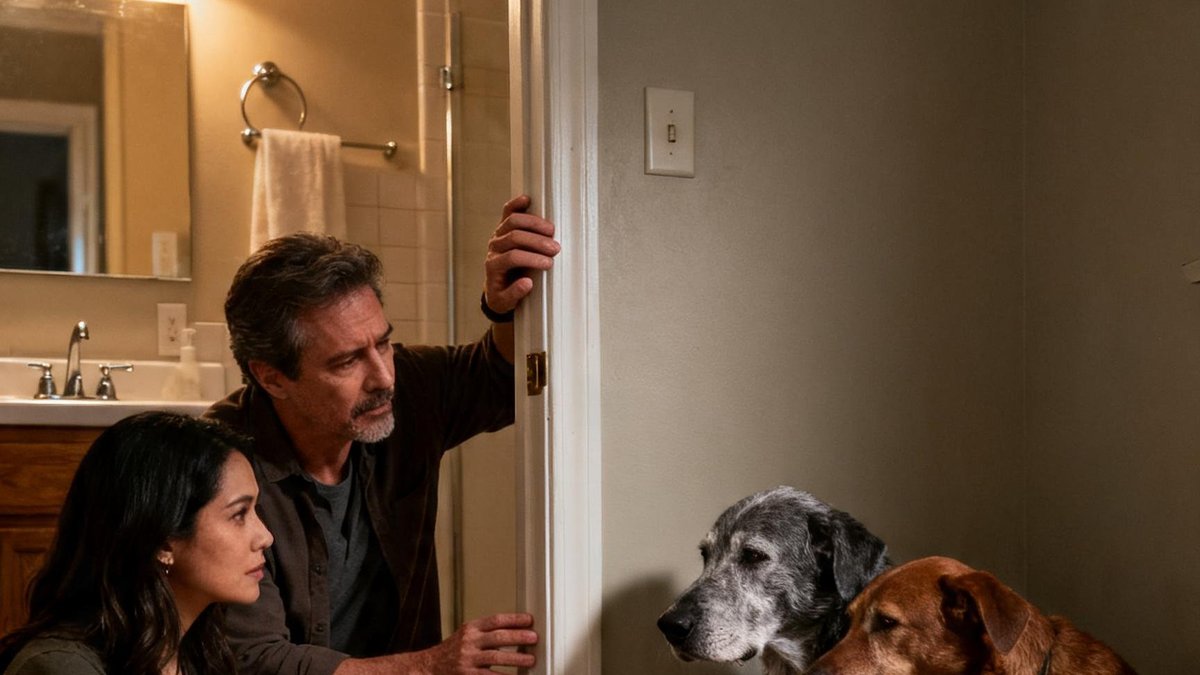
Day three, I almost separated them. Juniper got spooked by a delivery truck backfiring on the street. She bolted from the living room into the half-bath off the hallway and wedged herself behind the toilet. I tried to call her out with a treat, but she just pressed further into the corner, her paws skittering on the tile. Ollie stood in the hallway, whining low in his chest.
I thought, She can't stay in there. I'd have to shut the door and leave Ollie outside to keep him from following. But the second I put my hand on the doorknob, Juniper's whole body went still. She looked at me, and her eyes were so wide I could see the white all the way around.
I didn't close the door. I sat down on the bathroom floor with my back against the tub. I didn't reach for her. I just sat there, on the cold tile, and listened to the toilet tank gurgle. Ollie came and lay down in the doorway, his front paws just inside the room. After about twenty minutes, Juniper crawled out. She walked over to Ollie, put her head under his chin, and the two of them went back to the living room together.
That night, they ate.
—
Two weeks later, I came home from work to find Erin on the couch with a fleece blanket over her lap. The TV was on HGTV, some couple in Waco tearing out a load-bearing wall. The dogs were on the big orthopedic bed we'd ordered from Chewy, the one that cost more than my first car. Ollie was on his side. Juniper had arranged herself beside him, her head on his ribs.
I stood in the doorway to the living room, my jacket still on, my keys in my hand. I didn't move. I watched them breathe: Ollie's chest rising slow, Juniper's tiny ear twitch like she was dreaming. Then, without opening her eyes, Juniper shifted her head higher onto Ollie's shoulder. Ollie let out this long, low breath. His whole body relaxed. His eyes were closed, but his face did something I'd never seen before. It was the face of a dog who had stopped waiting to be taken somewhere else.
I pulled out my phone. I took a picture. Then I took another one. Then I walked to the kitchen, still in my jacket, and pulled the adoption folder out of the drawer where we kept the bills and the stamps. I opened it and looked at the form we'd signed. The line about no circumstances. The blue ink. The pretty handwriting.
I took a clean sheet of paper, the kind Erin uses for grocery lists, and I wrote in pencil, across the top: "For Ollie and Juniper. No one separates you. Ever."
I taped it to the front of the dog food bin. The bin had a snap lid, the kind that clamps down over the kibble. I put the paper on top, pressed the tape down hard with my thumb, then shut the drawer and went back to the doorway.
Erin looked up at me. "You're letting the cold in," she said.
I didn't answer. I just stood there, watching the two gray muzzles in the corner of the room, and I didn't close the door until Ollie opened his eyes, looked straight at me, and blinked once.