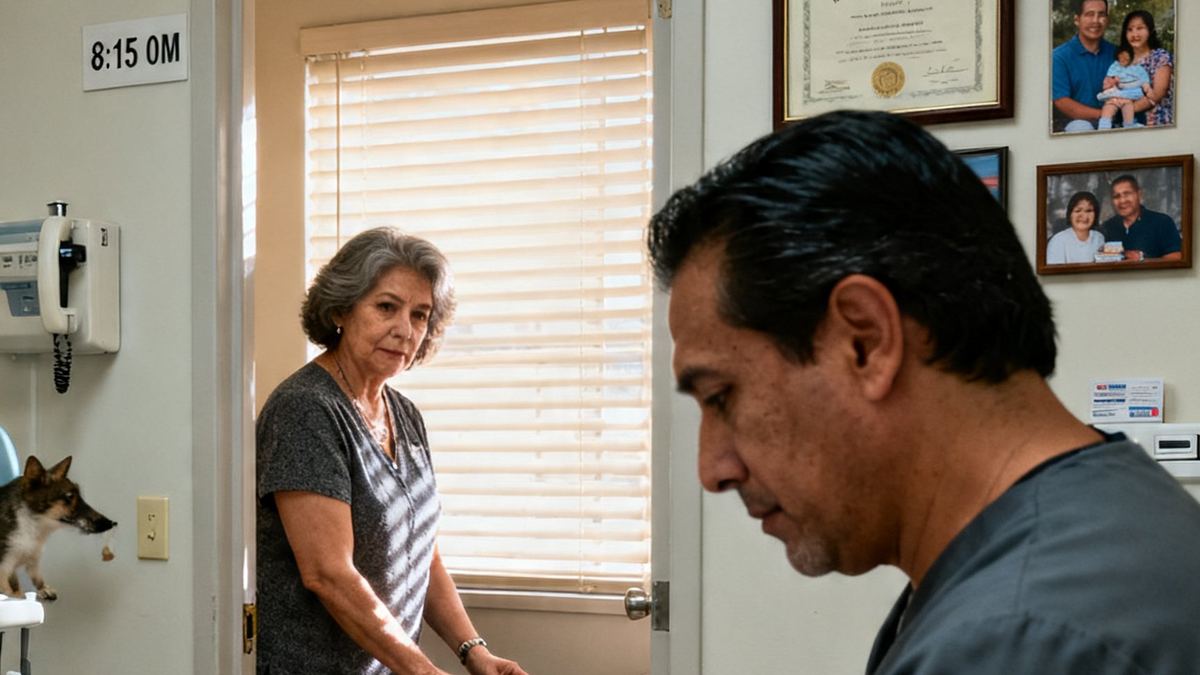
Marnie Talbot had worked the front desk at Redbrook Family Dental for six years before she understood what her boss actually thought of her.
It happened on a Tuesday in March, the kind of gray afternoon in Akron, Ohio, where the slush on Waterloo Road never quite melted and every patient tracked road salt across the waiting room carpet. Marnie was refilling the coffee station — the good stuff, the hazelnut pods Dr. Reyes kept for himself — when she overheard him on the phone in his office, door cracked open maybe four inches.
"No, I don't need to replace her yet," he was saying. "She does the job of a scheduler for the pay of a receptionist. Why would I fix that?"
She stood there with a pod in each hand. The office smelled like fluoride varnish and the lavender diffuser the hygienist ran on repeat. Somewhere in the back, a patient's toddler was watching cartoons on a tablet with the volume up too loud, and nobody moved to turn it down.
Marnie had started at Redbrook when she was twenty-six, newly divorced, needing something steady while she figured out the rest of her life. Dr. Aaron Reyes had hired her himself — told her she had "a calming presence," which she later realized meant she didn't push back. Over the years her job had metastasized. She confirmed appointments, yes, but she also managed the insurance claims, trained three different hygienists on the scheduling software, covered the billing when the part-time bookkeeper quit and was never replaced, and fielded every angry phone call from every patient who thought their crown cost too much. She did this for nineteen dollars an hour.
She'd asked for a raise twice. The first time, Dr. Reyes said the practice was "in a tight spot" — this was the same month he traded in his Tahoe for a new one. The second time, he said he'd "think about it" and then scheduled her for a performance review three weeks later, as if her asking for money required her to first prove she deserved to keep the job she already had.
What broke her wasn't the phone call, exactly. It was the fact that she went home that night, made dinner for her daughter Ivy, helped with a fractions worksheet at the kitchen table, and somewhere around problem six she noticed her hands had started shaking and wouldn't stop. She sat there holding a mechanical pencil, watching her own knuckles tremble, and thought: this is what a bad job does to a body.
She didn't quit the next day. She's not impulsive — never has been. What she did instead was open a folder on her laptop labeled "Tax Documents 2023," because she knew nobody in her house would ever click on that voluntarily, and she started keeping a record. Every task outside her job description, dated. Every unpaid overtime hour, logged against the clock-out times from the office software, which she could still access. Every insurance claim she'd personally untangled after Dr. Reyes' billing service had botched it — twelve of them in four months, worth an estimated $34,000 in reimbursements the practice would otherwise have eaten.
She also called her sister Denise, a payroll manager two towns over in Canton, and asked her a plain question: what would a practice this size actually pay a full-time office manager who also handled billing? Denise didn't hesitate. "Fifty-five, sixty, easy. Probably with benefits on top."
Marnie made nineteen dollars an hour with no benefits beyond a dental plan she was, ironically, too busy to ever use for herself.
The Friday before Easter, Dr. Reyes called her into his office to talk about the schedule for the holiday weekend. Family photos of his kids' Little League games lined the wall behind him, next to a wallcert from his implant certification course. He didn't offer her a seat.
"I need you here Saturday," he said. "Denise called in — sorry, I mean Priya, the hygienist. I keep mixing up names when I'm stressed."
"I have my daughter's dance recital Saturday," Marnie said.
"Can someone else take her?"
"Her father's in Charlotte this month."
He exhaled through his nose, the sound he made when a patient asked about payment plans. "I really need this from you, Marnie. You're the only one who can run billing without me holding your hand."
She looked at him — really looked, the way you look at someone once you've stopped needing their approval — and said, "I know. That's actually something I want to talk about."
She laid it out plainly. Not with anger, because anger would let him make it about her tone instead of the numbers. She told him what Denise had said about market rate for the work she was doing. She told him about the $34,000 in claims she'd recovered. She asked for a title change to office manager, a raise to fifty-two thousand a year, and health benefits that started in thirty days instead of the current ninety.
Dr. Reyes laughed — not cruelly, just reflexively, the laugh of a man who has never once had to ask anyone for anything. "Marnie, that's almost triple what you're making. This isn't a corporate law firm."
"It's not," she agreed. "But I'm doing the job of three people, and I have the printouts to prove it."
"I'll think about it," he said, which by now she understood was a door closing gently enough that he didn't have to hear it click.
She didn't wait for his answer. Two weeks later — the second Monday in April — Marnie walked into Dr. Reyes' office at 8:15 a.m., before the first patient arrived, and set a manila folder on his desk. Inside was her resignation letter, effective in two weeks per her contract, and a second document: a bulleted breakdown, in plain black ink, of every duty she'd absorbed over six years and every dollar she'd personally recovered for the practice, with a note that a placement agency in downtown Akron had already floated her three interviews at practices offering forty-eight to fifty-four thousand a year, benefits included, for exactly the job title she'd asked him for.
"You're serious," he said, flipping through the pages.
"I already accepted one of them," she said. "Northside Dental Group, off West Market Street. I start the fifth."
For a second he just sat there with the folder open, the fluorescent light humming overhead, and she watched something shift in his face — not sadness exactly, more like a man doing math he should have done a year ago.
"What am I supposed to do for scheduling coverage?" he asked, and it wasn't really a question to her, it was a question to the room.
"You'll need to hire an office manager," Marnie said. "I'd suggest paying market rate this time."
She worked her two weeks. She trained the temp agency hire who came in behind her, a nice kid named Josh who kept asking why nothing in the software matched the binder Marnie had built by hand. On her last day, Priya the hygienist hugged her by the sterilization room and said, "I don't know how this place runs without you," and Marnie said, honestly, "It's going to run worse for a while. That's not my problem anymore."
Six months later, Ivy's fractions worksheets had turned into long division, and Marnie's hands didn't shake at the kitchen table anymore. She kept the manila folder — the original, not a copy — in the bottom drawer of her new desk at Northside, not out of spite, but because some part of her wanted proof, on paper, that she had once done the math on her own worth and believed the number enough to walk toward it instead of waiting to be offered it.