I was down on my knees behind the rhododendron, fingers buried in cool dirt, when I heard the number. A man’s voice—Todd, the son—boomed right through the Hendersons’ screen door like somebody had cranked the volume on a bad sermon.
“Four hundred and fifty thousand dollars! That’s our inheritance, Dad. And you’re throwing it away on a cruise?”
My hands stopped moving. Their house sits maybe thirty feet from mine, just across a strip of frosted grass and a sagging wire fence that my late husband, Arnold, always meant to fix. In forty years, I’d never heard more than a muffled television drifting from that kitchen. Now this.
Todd again, higher, tighter: “Sharon and I have been planning around that money for ten years. Ten years! Sharon’s got a second mortgage, and I was going to pay off the Ram. You can’t just—”
A woman cut him off. Sharon. I’d seen her Honda pull up behind the Ram five minutes earlier, both of them slamming doors in the August heat. She was crying, but the words came out crisp and hard, like she’d been waiting to deliver them. “Mama, we love you, but you don’t understand how the world works anymore. That money is supposed to come to us. It’s what parents do.”
I found myself staring at a beetle crawling over a peony leaf, not moving. I’m a retired school librarian from Asheville, North Carolina, seventy-three years old, and I’d spent that whole morning trying to decide whether to pull up the blighted boxwoods or give them one more season. The last thing I wanted was to be a spy. But the window was open, the screen door hardly muffled a thing, and my knees weren’t cooperating enough to stand up without sounding like a marching band.
Harold Henderson answered. His voice had a new, flat quality that I recognized from the week I drove his wife Betty to Mission Hospital after he collapsed in the backyard. That was April. The doctors called it a “widowmaker” that didn’t quite finish the job.
“Sharon,” he said, “the cruise costs eight thousand dollars. Eight. Your mother has been cutting coupons for thirty-eight years. You’re going to stand on my porch and tell her she can’t see a glacier before she dies because your truck payment is four times that?”
No one answered. A chair scraped linoleum. My cat, Jasper, jumped onto the fence post and blinked at me, which is about as much judgment as that animal ever offers.
I went inside without shutting the French door properly and turned on the tap so I could stop listening. But I’d heard enough. They were all doing math. The grown children had reduced their parents to a countdown, and the number four hundred and fifty thousand just hung in the air like the smell of the paper mill on a wet Wednesday.
Two days later, a Lincoln Navigator with a Hendersonville law decal pulled into their driveway. A woman in a seersucker suit got out carrying a thick folder. I was on the porch shelling butterbeans, and Betty saw me and gave a small wave—not her usual, but one that said *I’ll explain later*.
She did, that evening, over the fence. Her hands were gripping a watering can she wasn’t using.
“Mabel, we went and redid the whole thing. The trust. Harold called Stan Fillmore—remember him, did Arnold’s will?—and we spent three hours signing papers. The bulk of it, sixty percent, goes to the American Heart Association. Cardiac research. The rest… well, they’ll each get a base amount, but they have to meet conditions. Financial counseling. A budget we approve. And no guarantee it goes up.”
She tipped the watering can, finally, into the marigolds. “Harold told them, ‘You want an ATM, go to the bank. We’re not it.’”
I said that sounded like something Arnold would’ve said, if we’d had children to disappoint. We never did. Arnold passed six years ago, and his pension covers the taxes and the cat food. I didn’t have a number that anybody was chasing.
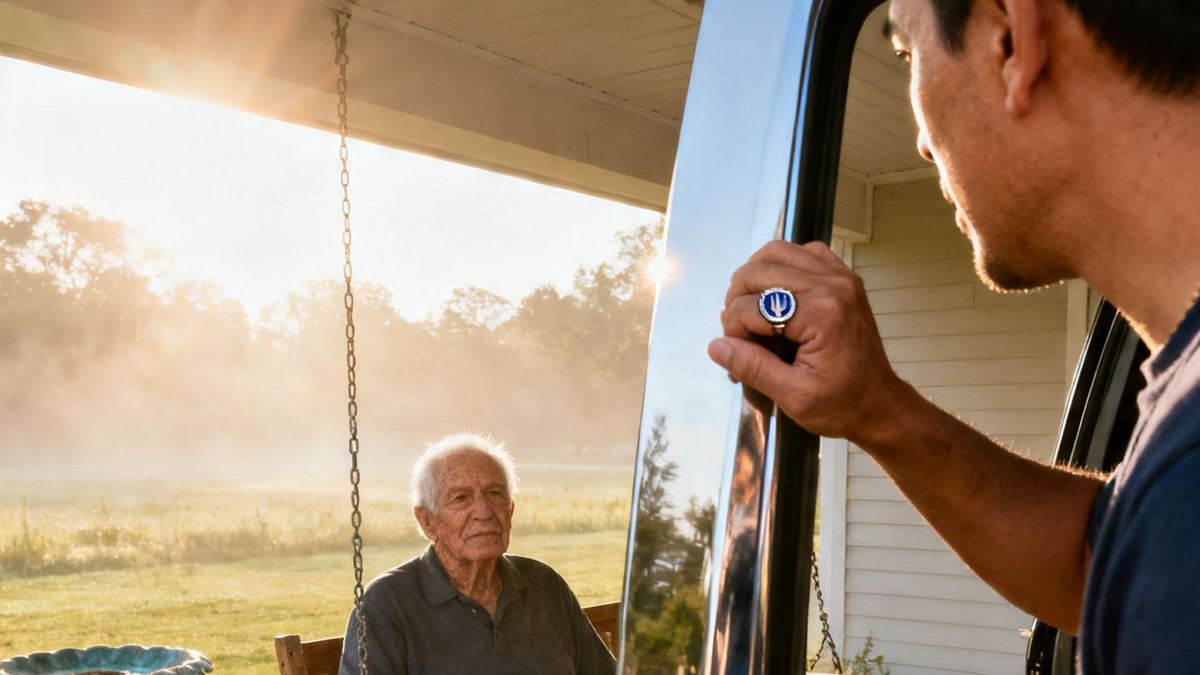
The real confrontation came the following Saturday, and I wasn’t behind a rhododendron this time—I was right out in the open, deadheading the roses that climb our shared fence. Todd’s Ram rolled up at ten in the morning. The truck had chrome wheels that caught the sun and a magnetic sign on the side: *Newbilt Construction*. Sharon was already in the yard, pacing by the birdbath, her phone pressed to her ear.
Betty and Harold came out and sat on the porch swing, which creaked once and then went silent. Nobody offered anybody sweet tea.
Todd pointed a finger with a college ring big as a hubcap. “I talked to a lawyer. You can’t just cut us out because you’ve got some bucket-list fever. We’re your children.”
Harold didn’t stand up. He just waited a beat and said, “That watch on your wrist. I saw the receipt on your kitchen counter last Christmas. Four thousand six hundred dollars. A cruise for your mother is two of those watches, Todd. You’re not losing an inheritance. You’re losing control of somebody else’s checkbook.”
Sharon’s phone slipped into the grass. “Daddy, I’m sorry, okay? I’m scared about the mortgage. I didn’t mean the things I said.”
Betty answered before Harold could. “Honey, you meant them. We heard you. But we’re not angry—we’re tired. The trust is set. If you can show us you can manage money and stop counting the years until we’re gone, there’s still something for you. If not, the cardiac ward at Mission Hospital gets a very nice addition.”
I kept snipping the spent blooms, the pruners clicking. I was a prop in their drama, a neighbor who might as well have been a fence post. But I saw Todd’s jaw work sideways, and I saw his knuckles go white on the porch rail, and I saw him swallow whatever he wanted to yell. He stalked back to the Ram without a word. Sharon bent to pick up her phone, smeared grass on her slacks, and drove away two minutes later.
Betty lifted the watering can and filled the birdbath. Harold went inside and came out with a brochure for the Alaskan Inside Passage, which they’d stuck on the refrigerator with a magnet from Myrtle Beach. He smoothed the crease and set it on the arm of the swing.
They left on a Tuesday in early September. I collected their mail and watered the geraniums. The cruise was eleven days. A postcard arrived with a glacier on the front and Betty’s handwriting on the back: *Mabel—the blue up here doesn’t match any crayon. We’re already planning the next one. —B&H.*
Winter came. I saw Sharon’s Honda more often. She’d bring a store-bought pie or a pot of chili and stay an hour, not shouting. One Sunday, Todd showed up in a different truck, an older Chevy without the chrome, and he and Harold walked down the driveway and stood talking for twenty minutes. I couldn’t hear the words from my kitchen window, but I saw Harold put a hand on his son’s shoulder once, then drop it. Todd nodded. He didn’t come inside, but he didn’t slam the door either.
The trust didn’t change back. Harold told me at the mailbox, February, when a thin sheet of ice had frozen the latch, that the conditions were still in place. “Sharon’s working with a financial coach,” he said. “Todd sold the Ram and his boat. They’re not there yet, but they’re trying.”
I said that sounded like something, and he said, “Something’s more than nothing.”
This morning I was on my knees again, same spot behind the bush, digging out a clump of chickweed. The Hendersons’ screen door was shut, but from inside I heard a woman’s laugh—Betty’s real laugh, the one that always made Arnold turn his head. A kitchen cabinet opened and closed, and Harold said, “I’m making waffles, not asking for a bank loan.”
Jasper meowed on the fence. I dumped the weeds in the bucket and went in to make my own coffee, thinking about the number four hundred and fifty thousand, and how it had been replaced by the sound of a waffle iron clicking shut.