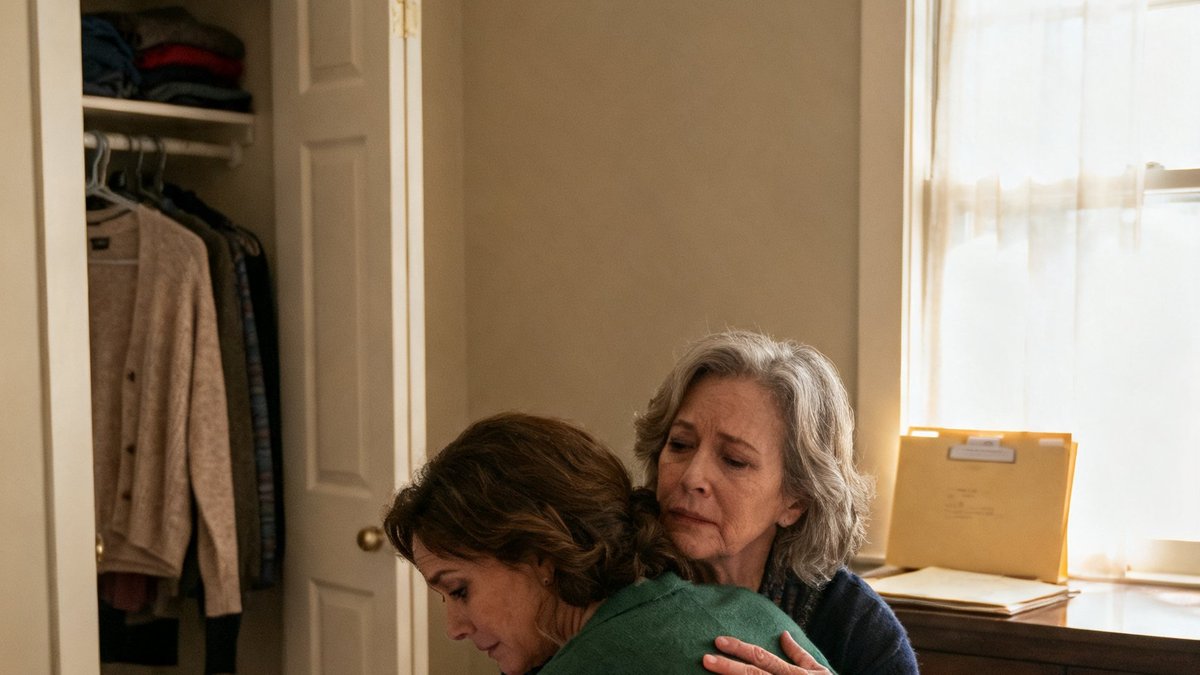
The house on Maple Court still smelled like her mother's cedar closets, and that was the problem. Dana Whitfield stood in the doorway of the room she'd shared with her sister for eighteen years and realized she couldn't remember the last time they'd spoken without one of them raising her voice.
"Are you close, or does everyone just live their own life?" That was the question her therapist had asked her three weeks earlier, and Dana still didn't have an answer. She had a sister. Renee. Two years older, one state away in Ohio, and as far as Dana could tell, perfectly content to let their mother's funeral be the first time they'd stood in the same room in fourteen months.
Dana set her suitcase on the bed and looked at the closet, still full of their mother's cardigans. Someone was going to have to sort through all of it, decide what went to Goodwill and what got kept, and she already knew that someone would be her, because Renee had a flight back to Columbus booked for Sunday morning, two days after the funeral, like she'd already decided how much of this she was willing to carry.
They hadn't always been like this. Dana could still picture the two of them at ages nine and eleven, building a blanket fort in this exact room while their father grilled burgers in the backyard, back before the divorce, back before their mother started working double shifts at the hospital just to keep the lights on. Back before Renee left for college and never really came home again, not even for holidays, not even when their mother got sick the first time and the doctors used words like "manageable" that turned out to mean nothing at all.
Dana heard the front door open downstairs and her sister's voice, thin and careful, calling up the stairwell. "Dana? You here?"
She didn't answer right away. She sat down on the edge of the bed, ran her hand along the quilt their grandmother had sewn, and thought about all the versions of this conversation she'd rehearsed in the shower for the past two years — the ones where she told Renee exactly how it felt to be the only daughter who showed up, who signed the hospice paperwork alone at a plastic folding table, who held their mother's hand through the last four nights while Renee sent flowers with a card that just said *Thinking of you both*.
Footsteps on the stairs. Renee appeared in the doorway wearing the black blazer she probably kept for exactly these occasions, a suitcase of her own rolling behind her, and for a moment neither of them said anything.
"I brought the paperwork from the lawyer," Renee said finally, holding up a manila folder like a peace offering. "Figured we could go through it tonight, get it done before I have to head back."
"Get it done." Dana stood up. Her hands found the edge of a cardigan on the closet rod — the green one, the one their mother wore every Thanksgiving — and she gripped the wool sleeve so hard her knuckles went white. "That's what this is to you. Something to get done."
"That's not what I meant."
"Isn't it? You booked a flight before the funeral even happened, Renee. Before we buried her, you already knew exactly how many hours you were willing to spend here."
Renee's jaw tightened, and she set the folder down on the dresser like it had suddenly gotten heavy. "You think I wanted to leave that fast? I have a job, Dana. I have kids who need me back in Ohio. Not everybody gets to just — be here. Be the good one. Some of us had to build a life somewhere else because staying here was killing me."
"Killing you?" Dana let go of the cardigan and turned. "She was dying, Renee. For real. Not some metaphor. And I was the one who drove her to chemo. I was the one who learned how to change the dressing on her port. I was the one who sat in that hospice room at three in the morning because she was scared of the dark, and you were three hundred miles away sending flowers."
"You think I don't know that?" Renee's voice cracked, and for the first time since she'd walked in, something in her face slipped — not composure exactly, but the effort of holding composure. "You think I don't replay every single one of those nights I wasn't there? I called. Every week, I called, and every week she told me not to bother coming because you had it handled, because she didn't want to be a burden on both of us, because — God, Dana, do you know what she told me the last time I called her?"
Dana said nothing. She hadn't known their mother was still taking calls in those final weeks; she'd assumed the phone stayed off, that everything ran through her.
"She told me to stay away," Renee said. "She said watching you exhaust yourself was hard enough, and she couldn't stand the thought of both her daughters wrecking their lives over her. She made me promise not to come more than twice, so that you'd have someone to lean on when it was over instead of two burned-out daughters who couldn't function."
The cedar-and-lavender smell of the closet suddenly felt suffocating. Dana sat back down on the bed, the green cardigan still balled in her fist. "She never told me that."
"Because she knew you'd never let her get away with it. She knew you'd call me every night and insist I fly in. So she made me promise, and then she made *me* the reason you'd resent me, because that was easier for her than watching us both fall apart in the same room." Renee wiped at her eyes with the back of her wrist, quick and rough, like she was angry at her own face for betraying her. "I have eleven voicemails from her on my phone that I haven't been able to listen to. Eleven. I can't even open my phone in the car because sometimes it plays through the last one automatically, and I have to pull over."
Dana looked down at the cardigan in her hands. She thought about the folding table in the hospice office, the hours alone signing forms no eleven-year-old should ever have to understand at any age, the specific loneliness of being the one who stayed. She had built an entire narrative in that solitude, brick by brick, and it had never once included the possibility that her mother had constructed the wall between them on purpose, as her last act of protection.
"I'm not saying it wasn't hard for you," Renee said quietly, sitting down on the opposite end of the bed, the manila folder forgotten on the dresser. "It was hard. It was the hardest thing either of us has ever done, just in different rooms. I just — I need you to know I wasn't hiding from her. I was hiding because she told me to, and I hated every single day of it."
The two of them sat there for a long moment, the space between them narrower than it had been in fourteen months, though neither of them closed it entirely. Outside, a neighbor's dog barked twice and went quiet. Dana finally set the cardigan down on the bed between them, not folded, just laid flat, like something offered rather than surrendered.
"There's eleven voicemails," Dana said. "Play the first one. I'll sit here with you."
Renee's hand shook as she pulled her phone from her blazer pocket, and Dana reached over — not to take the phone, but to rest her palm flat against her sister's back, the way she used to when they were kids and one of them had a nightmare. The screen lit up between them, their mother's name still saved under a photo from some Thanksgiving neither of them could quite date anymore, and Renee pressed play.
They didn't get through all eleven that night. They only made it through three before Renee's shoulders gave out and Dana pulled her sister into the kind of hug that had been years overdue, the green cardigan crushed between them, smelling like cedar and like their mother and, faintly, like the both of them.