At fifty-one, I moved into David’s house believing I’d earned some softness. Two years later, I was standing in my own bathroom at three in the morning, turning a box of hair dye over in my hands—a box I’d bought and hidden behind the bleach—trying to figure out when I’d started needing permission to be the color I already was.
Before David, I’d spent almost a decade building a life that fit me. The divorce had been clean, the kids were launched, and I’d turned my leatherworking hobby into an actual business—custom bags, mostly, sold on Etsy and at a couple of boutiques in Santa Fe. My duplex in Albuquerque had a workshop in the garage, a coffee maker I’d paid too much for, and nobody in it who needed me to be quieter or smaller or different. I dated here and there. Nothing stuck. I wasn’t lonely. I was just… mine.
We met at a trade show in Denver. He ran a high-end furniture company out of Boulder, and he’d stopped at my booth because the stitching on my messenger bags reminded him of something his grandfather owned. He was fifty-seven, sharp in that casual Colorado way—good fleece, good teeth, stories about climbing fourteeners that he told without making them sound like boasts. He bought me a drink that night. Then dinner the next week. Then a flight to see me. The distance made it feel like an event every time. By month three, he was already saying it: *I’ve been waiting for someone like you.*
He had the Boulder house—big windows, views of the Flatirons, a kitchen island the size of a coffin. When he asked me to move in, he framed it as the obvious next step. *Why pay two mortgages when we can have one great life?* he said. My duplex felt cramped next to his space. My workshop was a converted garage with bad heating. His place had a finished basement he kept calling “your future studio.” So I rented out the duplex instead of selling it—a compromise I made for myself, a tiny emergency brake I didn’t think I’d need. He hated that I kept it. Called it a lack of commitment. *You’re still thinking like a single woman,* he’d say, and it sounded like concern, so I swallowed it.
By the end of the first year, the rental income had been redirected into “our” joint account, the lease was in both our names, and I’d let him talk me into selling the place because the market was hot and we could use the equity for his showroom expansion. I remember signing the closing documents at the title company on Pearl Street and feeling the pen shake a little. I told myself it was caffeine.
The shrinking happened in inches. I didn’t notice the inches.
He started with my work. Not directly—he never said *quit*. He just questioned the margins every month. *You’re killing yourself for fifteen bucks an hour after materials,* he’d say, standing in the doorway of my studio while I was cutting leather. *You know I make more than that just breathing.* And then: *If you’re going to be here, maybe contribute more to the house. I handle the big stuff. You could pick up groceries, the cleaner, the little things.* So I did. The business became a side project. Then a hobby. Then something I did on Saturday mornings while he was out cycling.
He started with my friends. Tina, my best friend from college, came to visit for a weekend. David was charming for the first four hours. By dinner on Saturday, he’d gone tight, his answers clipped to single syllables. After she left, he said: *She’s a little much, don’t you think? Very… loud.* I defended her. He shrugged. *I’m just saying, we have different tastes in people.* Tina got a text the next week canceling our planned trip to Taos. The week after, I ghosted book club. I told myself I was just busy.
He started with my daughter. Harper was twenty-six and living in Denver, an hour away, working at a nonprofit and dating a guy David called “that kid.” David was never rude to her face. He’d pour her wine, ask about grant cycles, compliment her shoes. Then, the second her car left the driveway, he’d find the flaw: she stayed too late, she left dishes in the sink, she talked about politics at dinner, she borrowed my jacket without asking. *She treats this place like a hotel,* he’d say, and I’d want to scream *she treats it like her mother’s home,* but I didn’t. I just started meeting Harper at a diner off I-25 instead, and I told myself I was saving her the drive.
He started with my body. My hair had been a deep auburn since I was thirty-six—the color of wet brick, Harper called it—and it was the one vain thing I refused to apologize for. One morning David passed me in the hallway and said, without breaking stride: *You know, natural gray is actually really elegant at your age.* He didn’t say *ugly.* He didn’t say *change it.* He said *elegant,* and he said it with such casual warmth, like he was giving me a compliment I hadn’t earned yet. I let it sit for a month. Then I bought the box dye—medium ash brown, nothing flashy, something a sensible Boulder wife would wear—and hid it behind the bleach. I didn’t use it. Not yet. But I bought it. And that purchase was when I admitted to myself that I was altering who I was to keep the air in the house breathable.
The money was the thing I can’t talk about without tasting something sour. I still earned—$42,000 a year from the business, even in its diminished state—but it all bled into the household account. Groceries, toilet paper, gifts for his business partners, the Audi’s detailing. David handled the mortgage and the investments because he “had the head for it.” I stopped checking balances. I stopped asking. One afternoon I walked into a boutique on Broadway and saw a pair of boots—dark green leather, hand-stitched, $300. I stood in the aisle with one boot in my hands for seven minutes. I had the money in my personal account. I had earned it. I put the boot down and walked out because I could already hear his voice: *Three hundred dollars? You sure that’s the best use right now?* I didn’t need him to say it. I’d learned to say it for him.
The last inch was a plant.
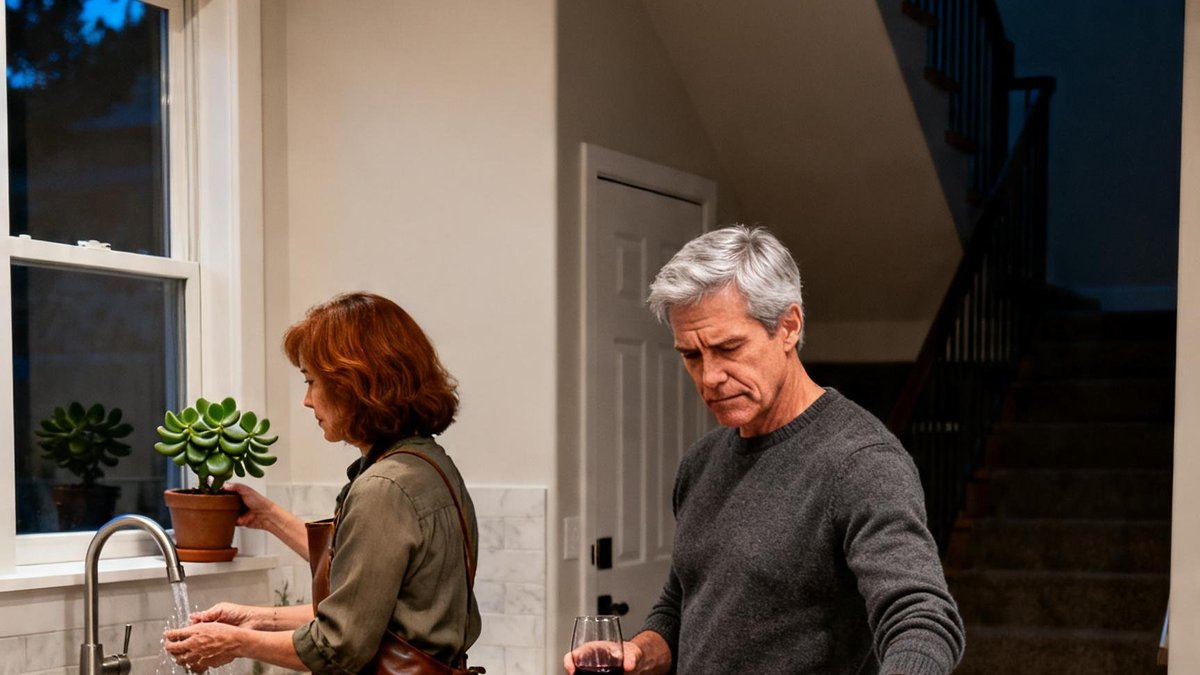
My mother, before she died, had a jade plant in her kitchen window in Santa Fe—the same plant for thirty years, thick and glossy and stubborn. I found one at a nursery on Arapahoe, a small one in a terra cotta pot, and brought it home and set it on the kitchen windowsill above the sink. I didn’t think about it. It was a plant. A $14 plant.
David came home at six. He poured a glass of wine. He saw the pot. He tilted his head. *What’s that?*
*Jade plant. Reminded me of my mom’s.*
He took a sip. *It’s just—we have a certain aesthetic going in here. The clean lines. The minimalism. It kind of breaks the flow, don’t you think? Maybe put it in your studio.*
My studio. The basement room he’d stopped entering months ago. The space for things that didn’t match his *aesthetic.*
I didn’t argue. I picked up the pot and carried it downstairs and set it on my cutting table, next to a half-finished tote bag and a roll of waxed thread. I sat down in my chair and looked at it for a long time. A jade plant in a basement with no windows. That’s where my mother went. That’s where my color went. That’s where my money and my friends and my daughter and my voice had been going, one inch at a time, and I’d been the one carrying them down the stairs.
I called Harper that night from my car, which I’d parked down the street under a streetlight, my voice low even though David was two floors away. “I need a rental. And a storage unit. And I need to be out of here in two weeks.”
“Mom,” she said, and her voice cracked on the single syllable. “I’ve been waiting for you to say that.”
The move was a Tuesday. David was at a supplier meeting in Denver, and I’d timed it so every trace of me was gone by the time his Audi returned to the driveway. Harper’s boyfriend—the one David dismissed as “that kid”—drove the U-Haul. My studio equipment came first. Then my clothes. Then the jade plant, riding shotgun in the passenger seat of my Subaru.
David called me twelve times that evening. When I answered his call, his voice wasn’t angry—it was baffled, which was somehow worse.
*What are you doing? What did I do?*
I closed my eyes. The landlord had given me the keys to a small house in Longmont that morning. Ranch style. Ugly carpet. A kitchen window facing east.
“You didn’t do anything, David. That’s the problem. You made me do it all to myself.”
He was quiet. Then: *That doesn’t even make sense.*
“I know,” I said. “It really doesn’t.”
I hung up. The next morning, I threw the box of ash brown hair dye into the dumpster behind the house. I drove to a salon on Main Street, sat in the chair, and told the stylist to take me back to auburn—the exact shade, the wet brick, the one I’d worn for twenty years. She mixed the bowl while I drank bad coffee and watched the foothills catch the sunrise through the front window.
A year later, my kitchen windowsill has four plants on it: the jade, a lavender that won’t bloom, an aloe from Harper, and a leggy basil I keep forgetting to water. The boots are on my feet as I write this. I bought them two weeks after the hair appointment, standing in the same boutique, the left boot in my hands for maybe ten seconds before I walked it to the register.
Tina and I have a standing lunch every other Thursday at a taco place in Lyons that makes its own tortillas. Harper helps me run the Etsy shop now—we’ve rebranded, added wallets and belts, and the last time I checked my account, the number didn’t make me flinch.
David still texts occasionally. *Let’s talk about what happened. I never understood.* The last time he wrote, I set the phone down, watered the jade plant, and watched the water bead up on the thick green leaves. It’s thriving in the light.