Dr. Langley asked how I was feeling, and I got about four words out before Sam cut in from behind his shoulder. “Just put it in the chart for me, Doctor. My mom won’t remember half of this by the time she gets to the parking lot.”
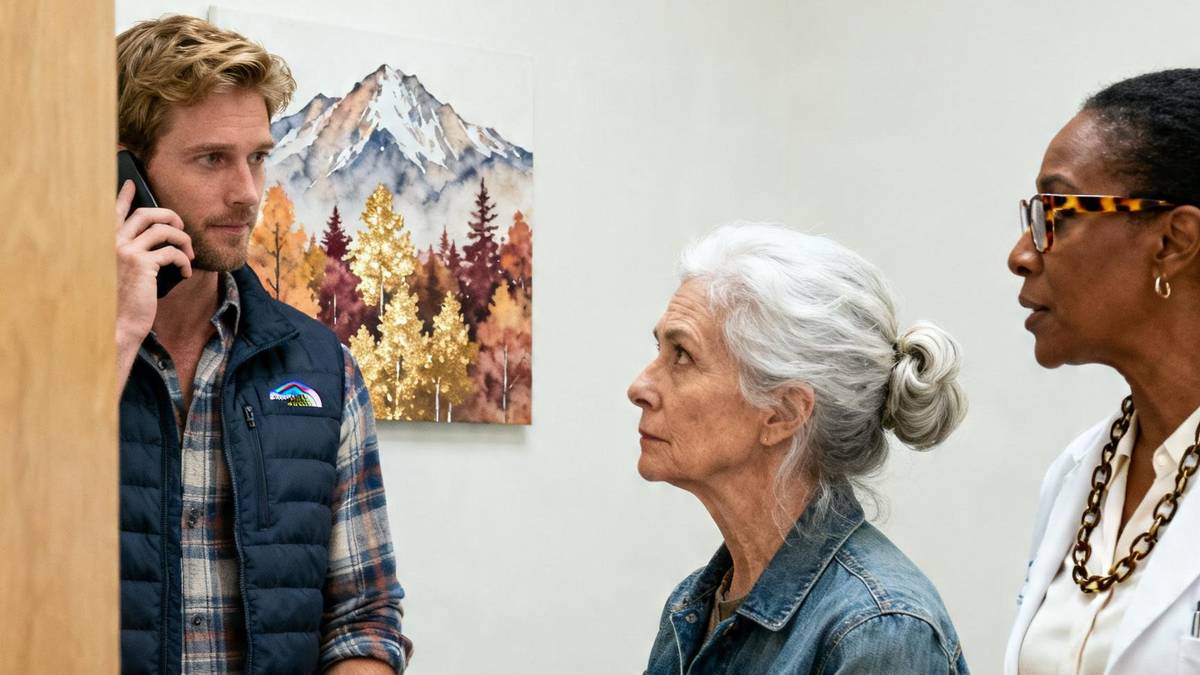
I sat there with my mouth half open, the sentence I’d been building scattered like spilled pills. Dr. Langley’s pen stopped mid-air. She was a lean woman in her fifties, tortoiseshell glasses on a chain, and she looked from Sam to me with the kind of pause you give a car before you decide whether to merge. I didn’t look back at either of them. I fixed my eyes on the poster above the exam table—a watercolor of the Blue Ridge in October, the words “Know Your Numbers” stamped over a backdrop of gold and russet trees. The artist had painted a hawk riding a thermal, wings locked, going nowhere.
Sam stood by the door in his Patagonia vest, phone clutched in one hand, keys in the other, a thirty-eight-year-old man who’d inherited his father’s habit of filling a room before he’d finished entering it. Jim used to do the same thing—breezing into the kitchen, shedding opinions like loose change, the whole house recalibrating around whatever he’d decided was the problem of the day. Jim died six years ago from a staph infection after a routine knee replacement, the kind of thing that doesn’t even make a good story. One week he was complaining about physical therapy, the next I was signing forms in a hallway at Mission Hospital.
I’m sixty-three. I spent thirty-three years keeping books for a family-run orchard up in Hendersonville—ledgers, payroll, the unglamorous math of bushel pricing and equipment depreciation. If you want to talk about remembering things, ask me the 2008 Honeycrisp yield per acre. Ask me about the tax code changes in 2012. Sam thinks forgetting a dentist appointment is the same thing as forgetting yourself.
In the exam room, Sam was already running through my medication list—metoprolol, lisinopril, the baby aspirin—along with dosages and refill dates and a neat little speech about my salt intake. He had it all in an app on his phone, the same app that syncs to the blood pressure cuff he bought me for Christmas, the one that sends my readings straight to his lock screen. I never asked for that feature. He set it up while I was making coffee.
Dr. Langley turned to me and said, “Mrs. Callahan, are the morning doses still on schedule?” and Sam and I answered “Yes” at the same instant. He blinked, as if my voice had come from a chair he’d already decided was empty.
Later, in the car, we took I-240 toward West Asheville. Sam lives in Biltmore Park, one of those new developments where every driveway looks pressure-washed, and I’m in the same house on Pearson Drive I’ve been in since 1994, the one with the creaky porch and the dogwood that drops petals all over my neighbor’s Honda every April. The drive’s not on his way—he has to cut across the river and double back—but he’s insisted on taking me to every cardiology appointment since the stress test in January. He says it’s no trouble. I say about as much as a root canal.
The silence between us stretched until we hit the Patton Avenue exit. “Sam,” I said, “why did you say that? That I wouldn’t remember.”
“Say what?”
“You know what. In the doctor’s office.”
He ran a hand over the top of the steering wheel. The Subaru’s dashboard was scattered with the usual debris—a crumpled receipt from Ingles, a half-empty bottle of Highland spring water, a faded parking sticker from Tweetsie Railroad. “Mom, you forgot about the eye doctor last fall. And that water bill sat on the counter for six weeks.”
“I got the month wrong on the eye appointment. One time. And the water bill—I thought they’d switched to paperless. They changed the system without telling anybody.”
“Exactly.” He said it the way a teacher marks a quiz, a little sad, a little final. That “exactly” landed harder than anything he’d said in front of Dr. Langley. The first one had been impulse—a man trying to save time. This one was a verdict he’d been rehearsing.
That night I made tea in the kitchen and stood at the window watching the light drain out of the mountains. The same teakettle I’ve had since 1987. The same ceramic mug with a chip in the handle from the time Jim knocked it off the counter trying to reach the toaster. Down on the street, the neighbor’s collie was barking at the mail truck, and I could hear the low hum of the AM radio on the shelf, still dialed to the station that plays bluegrass from five to six. Jim used to listen to the Braves games on that radio, the volume cranked so high you could hear the static in the floorboards.
But I wasn’t thinking about Jim. I was thinking about the phrase “when you get older.” As if I’m not already. As if there’s some clean border you cross, and suddenly your own son starts making plans for you like you’re a winter coat that needs dry cleaning.
Sam’s takeover didn’t happen all at once. It came on by increments, the way mold spreads on the back of a bathroom cabinet—you don’t see it until you’re pulling everything out. First it was the grocery runs: “Don’t bother with the heavy stuff, just text me a list.” Then it was the retirement account—he wanted to “streamline” my 401(k) because the new interface was “impossible to navigate.” Then the medication app with its three daily alarms, a robot marimba tone that makes me jump every time. Then the nine p.m. phone call, which is less a check-in than a pulse check. If I don’t pick up by the fourth ring, he calls my next-door neighbor, Ellen, whose landline number he got from the church directory. Ellen told me about it over lemon bars a few weeks ago, her voice full of the kind of admiration you’d give a seeing-eye dog. “Your Sam—he’s so devoted. My Kevin only calls when he needs a babysitter.”
I didn’t correct her. I didn’t know how to say that devotion can feel a whole lot like being erased, small paragraph by small paragraph.
Two Sundays after the cardiologist, Sam showed up with my granddaughter Chloe—eight years old, all knees and curiosity—and four Pyrex containers stacked inside a reusable bag from Trader Joe’s. Chicken tortilla soup, black bean enchiladas, a quinoa salad, and lasagna. Each lid was labeled in black Sharpie: *MOM—MON*, *MOM—WED*, *THAW NIGHT BEFORE*. He arrayed them in my freezer like evidence bags.
“Sam,” I said, “I know how to make a pot of soup.”
“Of course you do,” he said, not looking at me. “But why stand at the stove for an hour when you could be resting?”
Chloe was at the kitchen table, drawing a horse with a blue mane. She looked up and said, “Grandma, Daddy says when you get really old, we’re going to fix up the guest room for you so you don’t have to do stairs anymore.”
Sam’s face went the color of a sunburn. “Chloe, finish your horse.”
But I’d already heard it. The blueprint had been drawn: Phase One, medications and meal prep. Phase Two, the guest room at the end of the hall in Biltmore Park, with its view of the retention pond and its proximity to the bathroom with the grab bars Sam would install without asking.
I didn’t sleep that night. At five a.m., before the sun had cleared the ridge, I was at the kitchen table with Jim’s old laptop, the one that still runs Windows 7 and takes fourteen minutes to boot. I wasn’t even sure what I was hunting for—some kind of proof that I hadn’t already been boxed up and labeled for storage. Part-time bookkeeping? A bridge club? A plane ticket to somewhere I’ve never been? My fingers went where they always used to go when I felt cornered: researching. Sorting. Flipping through possibilities the way I used to reconcile a messy ledger.
What I found was the Osher Lifelong Learning Institute at UNC Asheville. Summer catalog. Classes on Appalachian ecology, watercolor for beginners, the archaeology of the Cherokee, digital photography. A Tuesday-morning group that hikes different sections of the Mountains-to-Sea Trail and stops to sketch wildflowers. I read the course description three times, the screen buzzing faintly against my thumb. Registration was open. $85 for the whole term.
I filled out the form. Name: Dorothy Callahan. Date of birth: 06/12/1963. Emergency contact: blank. Hands shaking, I clicked “Submit,” and the shaking wasn’t from the metoprolol. The confirmation email landed in my inbox before the kettle boiled. A materials list, a room number, a date.
The Friday before class, I drove to the Michael’s on Tunnel Road. Two synthetic brushes, a tin of Winsor & Newton half-pans, a 9×12 pad of Arches cold-press paper. Forty-two dollars and fifty cents. I stood in the aisle for a long minute, studying the labels that read CADMIUM YELLOW, ALIZARIN CRIMSON, ULTRAMARINE BLUE, before I chose a beginner set. At home I spread the supplies on the kitchen table. Bright little pills of color in their metal tray—I hadn’t held a paintbrush since high school. The receipt and the OLLI confirmation printout sat next to them, a small army of evidence I should have hidden. I told myself I’d put everything away before Sam’s next pop-in.
He came Saturday morning, earlier than he usually did, no call. The front door swung open on his voice, the bagels forgotten in his hand as soon as he stepped into the kitchen doorway. I was sorting the brushes by size, still trying to remember what a “round” versus a “flat” did. The receipt lay faceup on the table. The OLLI printout with its blue UNC Asheville logo was right beside it. Sam’s eyes swept the table, and his whole body slowed, the way a runner does when a cramp hits.
“What,” he said, not really a question, “is all this?”
I set the brushes down. “I signed up for a watercolor class.”
He crossed to the table, lifted the confirmation sheet. The bagels—sesame, my favorite—landed next to the paint tin. “UNC Asheville. That’s a twenty-minute drive each way. You haven’t driven more than five miles alone in months.”
“I’m aware of the distance, Sam. I drove it for thirty years before you got your license.”
He put the paper down and stood with one hand braced on the back of a chair. “Mom, think about this. You get tired in the afternoons. The metoprolol drops your pressure when you stand too fast. What happens if you get dizzy on the road, or halfway across the parking lot?”
“What happens is I sit down, same as I’ve done for three decades of blood pressure medication.” I’d kept my voice steady, but it wasn’t easy. I’d spent the last six years letting my son believe he was the sole captain of the ship, and now I was yanking the wheel. “I picked a morning class. I’m bringing a water bottle. I’ve got the Honda gassed up. I’m not asking for permission, Sam. I’m telling you so you won’t worry.”
His mouth opened, closed, and I saw the exact moment he chose the safer path. “I’ll come with you the first day. Just to be sure you’re okay. I can take a half day.”
“No.”
The word hung between us, small and hard as a pebble hitting a window. Sam’s shoulders set. “Mom, I’m trying to keep you safe.”
And that was when the question I’d been turning over for weeks finally left my mouth. “Are you protecting me, or are you just taking over?”
For a second he looked like Chloe had just drawn a horse with six legs. “That’s not fair.”
“Really? Because the guest room in Biltmore Park is already being measured for grab bars, and nobody asked me how I felt about any of it.”
He was quiet, the kind of quiet that isn’t an agreement. “I don’t want another call in the middle of the night. I don’t want another hallway at Mission Hospital.”
“Neither do I,” I said. “But there’s no guarantee in the world that staying inside my house and letting you manage every minute of my life will keep me out of one. And I am not going to sit in a little closet and be grateful it’s safe until that clock runs out.”
Sam picked up the receipt. He looked at the date, the total, and set it back down with the careful fingers of a man handling something fragile that didn’t belong to him. “What time is the class?”
“Tuesdays, ten to noon.”
He nodded, the way you nod at a schedule you don’t like but can’t rewrite. Then he turned and walked toward the front door. I followed him onto the porch. He paused with one hand on the rail, facing the dogwood that had dropped its last petals onto my neighbor’s Civic. “When you get dizzy and your pressure tanks,” he said to the tree, “just remember I offered to drive.”
“I’ll remember.” I didn’t add *I always remember*. I didn’t have to. He was halfway down the steps when I shut the door.
Tuesday morning broke cool for July, the kind of morning where the mist sits on the French Broad and the mountains look like they’ve been brushed in charcoal. I packed the tote bag myself: brushes, paint tin, paper pad, a clean jar for water, a granola bar, and my cell phone set to vibrate. At eight-fifteen I backed the Honda out of the driveway. The garage door stayed closed behind me.
The drive to campus took thirty-one minutes. I parked in the lot by the Sherrill Center, under a maple that had dropped a dozen helicopter seeds onto the asphalt. Two students in shorts and flip-flops walked past my bumper, laughing at something on a phone. I lifted the tote bag from the passenger seat and shut the car door.
The classroom had tall windows and long tables that smelled faintly of turpentine, even though it was a watercolor room. I chose a spot at the table by the window. A woman about my age—silver bob, dark-rimmed glasses, a flannel shirt over a Hendrix College T-shirt—was already squeezing a curl of cobalt blue onto her palette. She caught my eye and pointed at my supplies with the tip of her brush. “First time?”
“Mine too,” I said. “Name’s Carol. You’re going to love it—or at least that’s what my daughter told me fifty times before I signed up.”
I sat and set my brushes out in a neat row. The instructor walked in carrying a vase of daisies, which she placed on the front table with a thump that made the water slosh. I took the lid off my water jar, dipped a brush, and watched the bristles darken.