I’ve lived in this building on Clifton Boulevard going on forty-one years. Three floors, twelve units, and a laundry room where the dryers eat quarters. I know who’s fighting, who’s cheating, who got a new hip. I’m Marion, apartment 2A, retired eighth-grade English. My cat, Walter, sits on the windowsill and judges everyone who walks past. I’m the same, just without the fur.
The whole business with Laura from 3B started on a Tuesday in April. I was coming back from the West Side Market with a bag of pirogi when I saw the U-Haul double-parked out front. Dan, her husband, was wrestling a black duffel bag down the front steps. He’d been the kind of guy who waved at you in the hall but never remembered your name after ten years. A construction foreman, always in Timberlands and a Browns hoodie, kept a photo of himself holding a walleye taped to his locker down in the garage. He’d nod and say “ma’am” like I was ninety.
Laura stood in the doorway of their unit, barefoot on the cold tile. She wasn’t crying. She wasn’t screaming. She just watched him load the truck. I slowed down by the row of mailboxes, pretending to sort junk mail, and caught the tail end of what Dan was saying: “…not your fault, I just need to grab this last chance. You’ll be fine, you’ve got the place. She’s pregnant, Laura. I’m fifty-four, I want a real family.”
I dropped my key. The sound made him glance over, and his face went through this complicated little shuffle — embarrassed, annoyed, then blank. He threw the duffel into the passenger seat, slammed the door, and drove off down Clifton toward the Shoreway. Laura stayed in the doorway for maybe two minutes, then turned and shut the door without a sound. I waited. Nothing. So I took my pirogi upstairs, gave Walter the corner of a napkin to bat around, and thought: well, that’ll be a mess.
For a solid three months Laura became a ghost. I’d hear her leave at six a.m. and not come back until after ten. On weekends she’d blast vacuum at seven in the morning like she was scrubbing every memory out of the baseboards. Twice I saw her schlepping black garbage bags to the dumpster — Dan’s stuff, I figured. Old fishing rods, a cracked cooler, stacks of *Field & Stream*. She didn’t talk to anyone. Mrs. Kowalski in 1C said she looked like a paper cutout, pale and flat and barely there.
Then came the night the ambulance showed up. No sirens, just a big white box silently backing into the lot at eleven p.m. Two paramedics went up with a gurney and came down with Laura on it. She was awake, blinking at the lobby ceiling like she couldn’t figure out how she got horizontal. I held the door for them. The younger one, a redhead with a ponytail, caught my eye and said, “Exhaustion and a blood pressure spike. She collapsed at the Dave’s Market on West 117th.” I nodded and watched the ambulance pull away toward Cleveland Clinic. Walter meowed from the window. I told him, “Some people run themselves into the ground so they don’t have to feel the quake.”
She came back a week later. I knew because I saw a light on in 3B and heard the clink of a spoon against a mug at six in the morning. A couple days later, I was coming up from the laundry room with a basket of towels and nearly bumped into her on the stairs. Her hair was different — she’d chopped it off. Not a trim, a whole restart, short and blunt above her ears, like she’d told the stylist “I want to look like I don’t take anyone’s advice.” She was wearing running shoes and a Cleveland Metroparks tank top, and she smelled like Lake Erie wind.
“Laura, hey,” I said. “You’re looking…” I didn’t have the word.
She gave a little shrug. “Alive, I hope.” Then she smiled, and it was an odd thing — she used to smile like a receipt: proof of transaction. This one had some actual light in it.
Over the next few months I’d spot her on my own early-morning walks at Edgewater Park, loping along the path with a steady, no-nonsense rhythm. Once I saw her at the shore, sitting on a bench near the pier, holding a rolled-up drawing. She looked up and waved. I asked what she was working on. “Landscape design class at Tri-C,” she said. “I’m designing a native plant garden for a client in Shaker Heights. Got a job part-time at a little company, GreenScape.” She said it like she was trying out a new name for herself.
I saw that name on a polo shirt a week later, when she came home just after sunset with dirt on her jeans and a yellow measuring tape clipped to her belt. She had a bubble tea in one hand and laughed with a coworker — a guy in his twenties with sun-bleached hair — over something about a rose garden they’d accidentally designed to the scale of a football field. I was sitting on the stoop with Walter in his carrier, letting him sniff the evening air. Laura spotted me and came over. “Marion, you want a sip? Mango.” I declined. She leaned down and let Walter sniff her fingers. “You know, I never had a cat. Dan said they were useless.” She straightened up. “I think I might adopt one.”
Dan’s name hung there like a plastic bag in a tree. I didn’t say anything. She didn’t either. She just took her tea and her tape measure and went inside, and I saw her door had a new doormat: *Welcome to the Jungle*, with a cartoon fern.
The Sunday everything came full circle, I was heading to the basement to check on a suspicious thumping noise (turned out to be Mrs. Kowalski’s grandson practicing a saxophone). When I got to the first-floor landing I stopped cold. Dan was standing in the hallway outside 3B, holding a beat-up red toolbox. He looked rough — the way a man does when he’s spent a year realizing he made a trade that didn’t pay out. Grayer, thinner, a wrinkle between his eyebrows that used to be a confident crease.
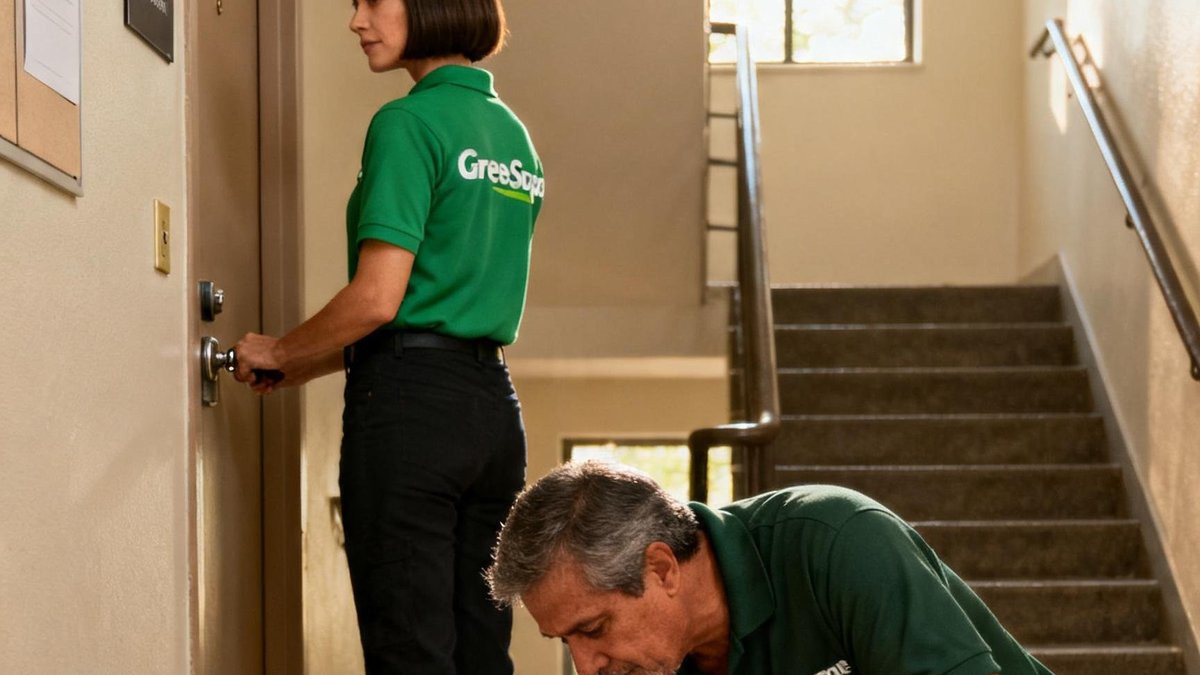
Laura’s door opened. She was in her GreenScape polo, with a clipboard tucked under her arm. She had a wedding band on a chain around her neck — I’d never noticed that before. She looked at him like he was an old utility bill she’d already paid.
“I just came for my torque wrench,” he said. “And… to talk. If you’ve got a minute.”
I could have kept walking. I didn’t. I backed into the alcove by the fire extinguisher and made like I was checking my phone. Walter would have been proud.
Laura stepped into the hall and pulled the door shut behind her, locked it with a click. “The wrench is in the dumpster,” she said. “I threw out all your tools three months ago. The salvage guy took them.”
Dan blinked. “You… you threw out my tools?”
“Fourteen bags of your stuff, Dan. After the divorce was final, I put everything in the dumpster. You said you didn’t want any of it, remember? You texted me, ‘Trash it.’ So I did.”
He didn’t seem to know what to do with his hands. He set the toolbox down. “Laura, listen. I screwed up. Brandi left. Took the baby and moved to her mother’s in Akron. I’m sorry. I was a moron. You look… you look amazing. Can we just have coffee? I miss you. I miss us.”
She said it the way you tell a kid they can’t have ice cream for dinner — gentle but final. “I forgive you, Dan. And I mean that. You’re not a villain, you’re just a man who thought I’d wait forever. But I’m not waiting. I have a full-time job. I’ve got a cat coming on Tuesday. I’m not your backup plan.”
She glanced down at the toolbox, then at his face. “That’s yours, by the way. I kept it by mistake. You should take it.” She nudged it with her foot.
He opened his mouth. Shut it. Picked up the toolbox by the handle, and the bottom gave way — the latch must have been broken — and a mess of old screwdrivers and Allen wrenches clattered onto the tile. Neither of them bent to pick it up. Laura watched him for a beat, then turned and walked past me down the stairs. I heard the main door swing open and her footsteps on the sidewalk. Through the glass I saw a white pickup truck with the GreenScape logo pull up, and the same young guy from before leaned out and called, “Ready to stake out the herb spiral?” She laughed and climbed in.
Dan stood among the scattered screws for maybe a full minute. He didn’t look at me. I walked past him, down to check on the saxophone, and when I came back up twenty minutes later the hallway was spotless — every last bolt picked up, the busted toolbox gone. On Laura’s door, a sticky note in her handwriting: “Vic, please change the locks before Tuesday. Thanks — Laura 3B.” That’s Vic, the super. He’d have them swapped by lunch.
I went up to my apartment. Walter was asleep in a patch of sun on the carpet. I sat down in my chair and thought about all the things people drag from one life to the next — torque wrenches, grudges, a woman’s quiet belief that she deserves a smaller portion of joy. Laura had dropped all of it in the dumpster and called a locksmith. I picked up the checkers game I’d been playing against myself for a week and made a move — a triple jump I hadn’t seen before.
Out the window, the lake was steel blue. Somewhere down in the city, a woman was staking out a garden she’d designed from scratch. The husband, the toolbox, the twenty-two-year marriage — they were all just a plot of dirt she’d decided to stop watering. And I’ll tell you what: dirt that’s finally left alone can grow something nobody planted.