I was sitting on the bench outside the Whitaker Arms apartments, soaked through the seat of my jeans, because my cat Biscuit had woken me at ten-forty with a yowl that could peel paint. Fourteen years old, deaf as a fence post, and loud as a fire alarm. So I did what I always do when she gets like that—I went outside to let the building settle around me.
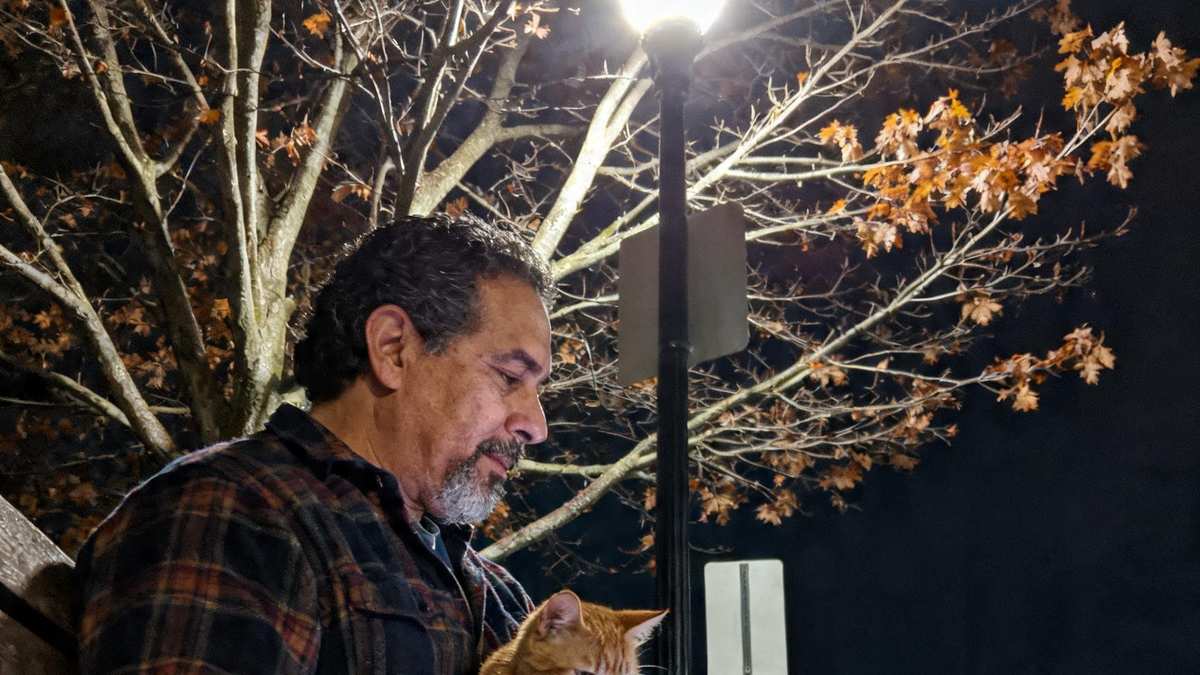
The bench sits under a dying maple tree, the one the HOA keeps threatening to cut down. It was late October. Seattle rain was doing its usual thing—not falling so much as hanging in the air, getting into your lungs without permission. The streetlamp by the gate buzzed like a trapped fly.
A man came out of the building. I'd seen him before. Daniel. Dan. Something like that. He lived on the fourth floor with a wife whose voice I'd heard through their kitchen window—the kind of voice that doesn't ask questions, just issues sentences with periods at the end.
He was carrying a cat. A skinny orange thing with one ear half torn off. The cat had its front legs draped over his forearm, claws hooked into his flannel shirt. I could see a pulled thread on his chest where one claw had snagged the fabric.
He sat down on the other end of the bench. Three feet away, maybe less. I stayed put. Not hiding—just not in a hurry.
The cat started purring. That sound—low and broken, like an engine that won't quite turn over—carried through the wet air. I've heard plenty of purrs in my time. Tom had a cat back when we first got married, a gray tom that would sit on his chest while he watched the Mariners lose. But this purr was different. It had an edge of desperation, like the animal knew it had one shot and was going to purr its lungs out.
His phone buzzed. He took it out, looked at the screen, and the blue light threw shadows across his face. For a long moment he didn't move. Then his thumb came down on the side button. The screen went black. He put the phone back in his pocket.
A moment later it buzzed again. He didn't take it out.
His other hand went to his jacket pocket. He fumbled, then came out with a key ring. Two keys on a small silver ring. There was a nick in the metal—a little scratch that caught the light from the streetlamp. He held the keys in his open palm, turning them over the way you'd turn over a coin you found in a parking lot, trying to decide if it's worth bending down for.
Then he set the keys on the bench between us. Two small pieces of metal on wet wood. He stood up, cradled the cat against his chest, and walked away toward the south gate. The drizzle swallowed him by the time he reached the sidewalk.
I sat there. The keys sat there too. Neither of us moved.
After maybe five minutes, I got up—left hip cracked like a gunshot—and went inside, past the hall light that had been flickering for three years. Biscuit met me at the door, tail straight up like a flagpole. I left the keys where they were. They weren't mine to touch.
—
The next morning, I had to run to the Safeway on Rainier. Out of cat food. Biscuit only eats the salmon pâté, the picky little queen, and I'd been putting off the trip for two days. When I came out the front door around nine-thirty, the keys were still there. Wet now. Beaded with water. The man's car—a dark blue Subaru with a dent in the rear bumper—was still in the parking lot. Same spot as last night. He hadn't driven anywhere.
I bought the salmon pâté. Three cans for four dollars. Also bought a cheap rain gauge because the one Tom installed on the balcony finally rusted through last spring. On my way back, I saw Fernando, the building manager, standing by the bench. He had the keys in his hand, turning them over like a puzzle piece.
"Mornin'," I said.
He looked up. "These yours?"
I shook my head.
"They were just sitting here. No one around." He squinted at the building, then at me. "You see who left them?"
"Apartment 4D," I said. "I think. Dan-something."
Fernando nodded. "Foster. Daniel Foster. His wife's been calling the office all morning—said he didn't come home last night."
I didn't reply. Just adjusted the plastic bag in my hand and headed for the entrance. But I didn't go inside. I stood under the awning, pretending to check my phone, while Fernando climbed the stairs. I could hear him knock on a door on the fourth floor. A woman's voice, sharp and clipped: "What?"
"Mrs. Foster? I found some keys down on the bench. They might be your husband's."
A pause. Then the sound of a door opening. Footsteps on the landing. The jingle of keys.
"He left them outside?" Her voice had an edge now. Like a wire pulled tight and plucked.
"That's where I found them. On the bench, out front."
A long silence. Then the woman said, quieter: "That doesn't make sense." But she didn't say it like she was confused. She said it like she'd just found a crack in a wall she'd spent a long time building.
I went inside then. Biscuit was yowling behind my door before I even had the key in the lock.
—
That afternoon, the rain stopped. I was out on my small balcony, repotting a fern that was one bad day away from giving up entirely, when I saw Mrs. Foster come out of the building. She was wearing a gray raincoat and rubber boots, though the ground was mostly dry by then. She walked to the bench and stood there. Just stood. Then she sat down.
She stayed for twenty minutes. Hands in her lap. Face turned toward the street. A few times she took out her phone, looked at it, put it back. I watched from behind my ferns, the way you watch a car accident from across the highway—not because you want to, but because you can't not.
At one point she picked up something from the bench. A pebble, maybe. She threw it into the bushes with a motion that was more tired than angry. Then she got up and went back inside.
—
I don't know what happened in that apartment before that night. I don't know what she said to him, or what he said back, or how many years they'd been living with that cold air between them.
A few days later, I saw Daniel Foster again. I was walking to the bus stop on Rainier, and there he was—standing under the shelter, same dark jacket, same tired eyes. The orange cat was perched on his shoulder like a parrot, its torn ear flicking at the drizzle. He was saying something to it, low and one-sided, the way people do when they're alone. His mouth twitched up at the corner, and the cat rubbed its face against his jaw.
He got on the number 7 bus heading south. He didn't look back once.
As for the keys—Fernando told me later that Mrs. Foster put them in a plastic baggie and left the baggie in his office with a note: "In case he comes home." She moved out six weeks later. Studio apartment down in Georgetown. I don't know what happened to the baggie. Fernando probably threw it away, along with all the other lost-and-found junk that piles up in a building like that.
That cat weighed maybe six pounds. Maybe seven. And it purred like it weighed a hundred.
Biscuit still yowls at night. I still come out to this bench most evenings, coffee going cold in my hand, watching the maple tree keep losing its argument with October.
Last week, I found a single orange hair on my jacket sleeve. Don't know how it got there. I left it in the pocket, where it's been ever since.