My name's Frank Dolinski, I'm fifty-eight, and I'll tell you straight off — the way my mother-in-law used to describe me to her church friends, you'd think I was some kind of con man who married her daughter for a garage full of tools.
Truth is messier than that. Everything usually is.
I run a transmission shop outside Scranton, Pennsylvania — three bays, a coffee pot older than my youngest kid, and a dog named Rusty who sleeps under the lift. My father-in-law, Ed Kowalczyk, built that place from nothing back in the seventies. When he got sick — pancreatic, the bad kind — I was the one who drove him to Geisinger for chemo every other Tuesday for eight months. Not because I wanted the business. Because Marlene, his wife, couldn't stand hospitals, and their daughter Dana, my wife, was pregnant with our second and couldn't be lifting him in and out of the car.
So I did it. Nobody made me.
When Ed passed that January, he left the shop to me — not to Dana, not split three ways with Marlene. To me, by name, in the will his lawyer drew up two months before he died. I didn't ask for that. I found out the same day everyone else did, sitting in a folding chair in a funeral home on Wyoming Avenue.
Marlene never forgave me for it. Not once in six years.
She'd come by the shop "just to say hi" and stand in the doorway of my office staring at the certificate on the wall like I'd forged it. She told her sister I'd "worked on Ed" for years, buttering him up. She told Dana, at Thanksgiving, in front of my kids, that I only married into the family because I saw dollar signs on a lift and a fifteen-year lease.
I let it go. What was I supposed to do, argue with a grieving widow?
But here's the thing nobody tells you about pride like that — it doesn't stay contained. It leaks into everything. Marlene started telling people at Saint Stanislaus that Dana's husband "never even finished trade school properly," which wasn't true — I've got my ASE certifications framed right next to Ed's. She'd correct me at dinner about torque specs on cars I'd been fixing since before she knew my last name. She once told my son, who was nine, that his father was "not really family, just someone who got lucky."
Nine years old. He came home from her house crying about it.
That's when Dana finally said something to her mother — not me, Dana. I stayed out of it because I figured it wasn't mine to fight. But watching your kid cry changes the math for anybody.
Marlene didn't back down. If anything she got sharper about it — started showing up unannounced with her sister Carol in tow, walking through the shop like she was doing inspection, telling customers in the waiting area that her late husband had "built this place with his own two hands and some people just inherited it by accident." Right there, in front of Mrs. Aldana waiting on her Camry.
I lost two customers that month. Small town — word travels.
The thing that finally cracked it open wasn't a fight. It was March, cold rain, and Marlene had a stroke in her kitchen in Dunmore. Mild one, thank God, but enough that she spent six days at Regional Hospital and needed home care after. Carol lived two hours away in Allentown and couldn't do daily visits. Dana had her hands full with our two kids and a part-time job at the elementary school.
So I did it again. Drove over every morning before opening the shop — six-fifteen — made her oatmeal, checked her blood pressure cuff, sat with her while the physical therapist came. Six weeks of that.
She never once said thank you. But around week four, she stopped correcting my grammar and started asking me things instead — about the shop, about whether business was steady, about how the kids were doing in school. Small stuff. She asked if Rusty still slept under the lift. She remembered his name.
The morning it actually turned wasn't dramatic. She was sitting at her kitchen table, the one with the yellow Formica top Ed never got around to replacing, watching me refill her pill organizer — seven days, two rows, the little plastic lids that never close right. I'd been doing it every Sunday for a month by then.
She said, "Ed used to fill that thing wrong on purpose so I'd yell at him."
First time she'd brought him up to me without an edge in her voice.
I kept sorting the compartments — Sunday, Monday, Tuesday — and didn't look up, figuring if I made it a moment she'd shut the door on it again.
"I've been telling people something that wasn't true," she said, to the sugar bowl more than to me. "About you not finishing school. I know that's not true."
Two weeks later she drove herself — first time since the stroke — to her lawyer's office downtown and signed the small life insurance policy Ed had left her, twenty-two thousand dollars, into a trust for my kids' college fund instead of splitting it between Dana and Carol the way the old paperwork said. She dropped the folder on my workbench next to a torque wrench, wouldn't quite meet my eye, and said, "Don't make a thing out of it. It's not up for discussion at Thanksgiving."
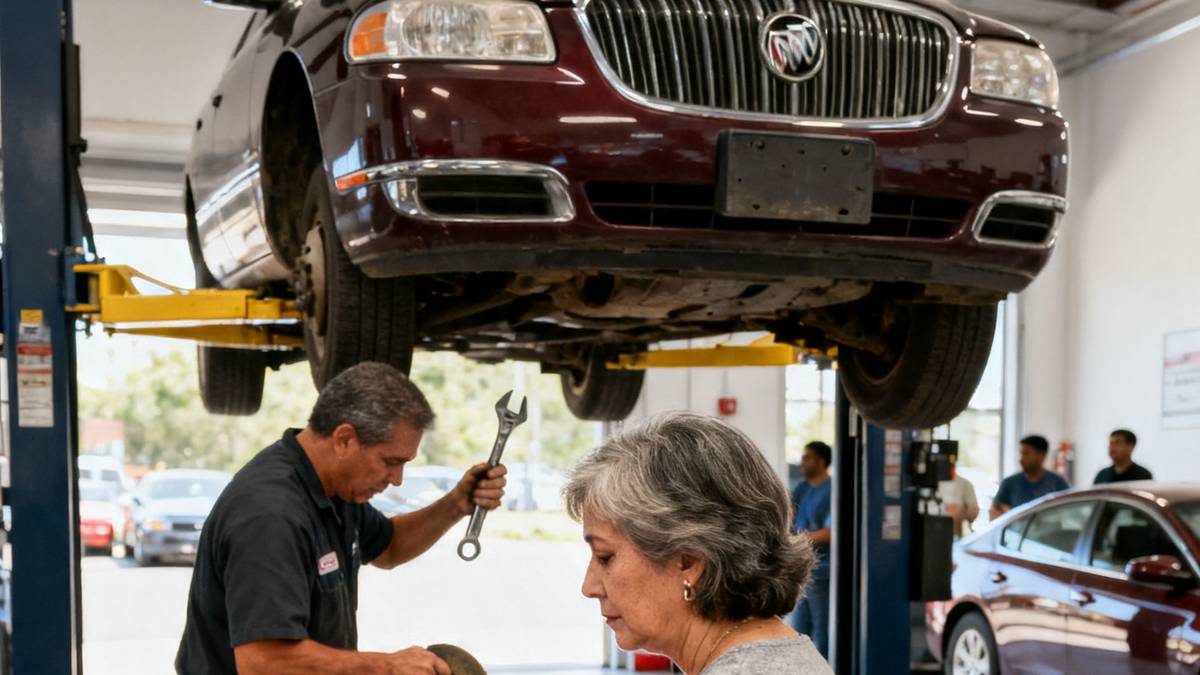
Then, still not looking at me, she said the Buick had been squealing for three weeks and Ed always used to do her brakes for free, so did I have a minute.
I put the Buick on the lift and pulled the front wheel. The pads were worn down to the backing plate, metal shrieking on metal, and I wondered how long she'd been driving it that way, not saying anything to anyone. Marlene sat on the stool in the corner, not offering to help, just talking at the wall about how Ed always put off the brakes until they screamed loud enough to shame him into it.
Rusty crawled out from under the lift and sat on my foot while I worked the caliper bolt loose.