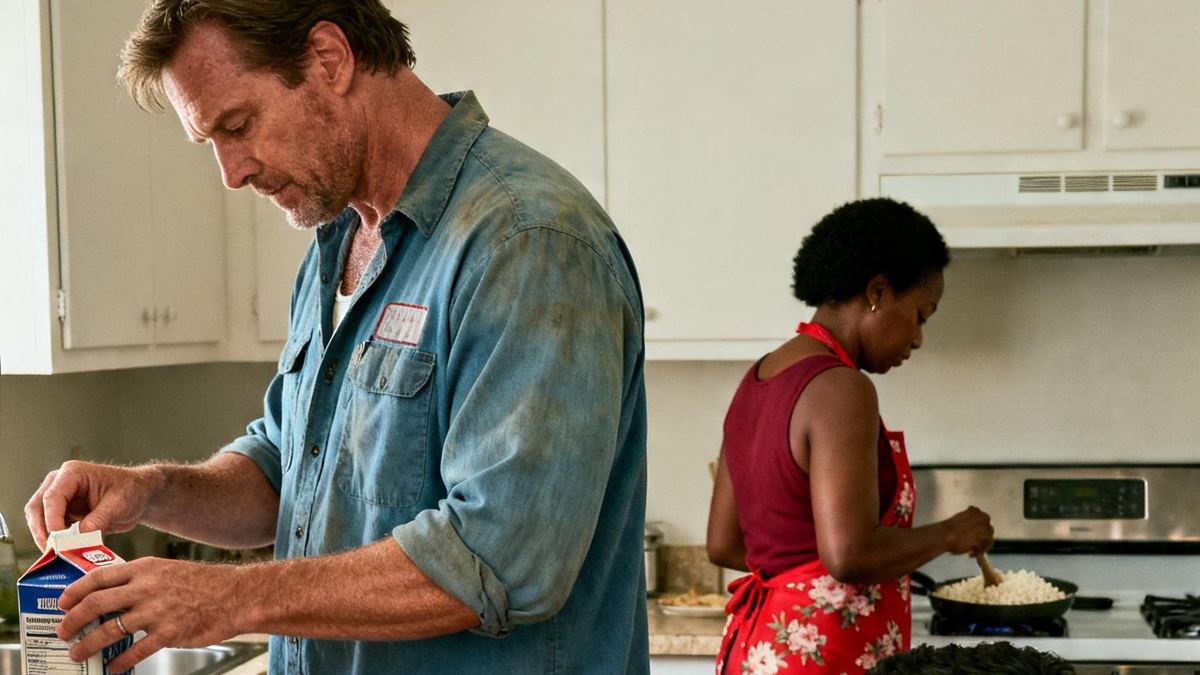
The half-and-half in the fridge had been expired since March 2nd. Marcus noticed it on a Tuesday in late March, when he came through the door at six-fifteen and actually opened the refrigerator for something—anything—that wasn’t a can of Red Bull. He stood there with the carton in his hand, the kitchen quiet except for a voice he hadn’t heard aimed at him in months.
Jenna was on the phone in the other room, laugh spilling into a sentence the way it did when they were twenty-four and broke and she’d narrate the entire grocery list as a stand-up routine. He stayed in the hallway, keys biting into his palm.
“—so I tell her, okay, a geodesic dome cake is going to cost you like eight hundred dollars just in fondant and therapy, and she sends me a Pinterest board with—no, I’m serious, thirty-seven pins. One was literally a photograph of a quartz crystal. What am I supposed to do with that, Simone? A quartz crystal.”
Laughter folded her in half. Marcus could picture it, even if he couldn’t see her.
He coughed, scraped a shoe on the floor, and walked into the kitchen. By the time he cleared the doorway, the laugh had been zipped shut. Jenna leaned against the counter, phone to her ear, a warped bamboo spoon in her other hand. Rice steamed in a scratched-up T-fal pot. She flicked her eyes at him—not hostile, just a door swinging closed.
“Hey, Simone, let me call you back. Yeah, he just got home. Okay, bye.” She set the phone face‑down next to a bag of King Arthur flour. There was a crack in the screen protector he’d never noticed.
“You’re early,” she said.
“Route 240 was clear for once. What’s for dinner?”
“Chicken and rice. Ten minutes.” She turned back to the stove, and the space between them filled with nothing.
He sat at the kitchen table. Chloe’s initials, carved with a butter knife the summer she turned six, were still there in the wood. A burn mark from a hot pan his mother-in-law had set down three Thanksgivings ago. The ring Jenna wore was a platinum band with a single chip—Kay Jewelers, ten years old, cleaned exactly twice. He rubbed a thumb over the burn mark.
“You were laughing pretty hard just now,” he said.
Jenna stirred the rice. “Simone told me something funny.”
“What?”
“Work stuff. You don’t know the people.” Stir. The spoon bumped the edge of the pot, a flat sound.
He tried again. “How’s the bakery going? Sweet Provisions, right?”
Jenna turned around, bamboo spoon dripping on the linoleum. “I’ve been there eight months. I told you when I got the job. I told you about the health inspection back in November—we got a 97, by the way, no thanks to the walk‑in that went down to 44 degrees. I told you about the flour recall in February. You said ‘that’s rough’ and didn’t look up from your email.”
Marcus’s mouth opened. He remembered none of it.
She went back to the stove. “It’s fine. You’re busy.”
The way she said it, flat as a closing cash drawer, was not fine.
Dinner came and went. Chloe gave a play-by-play of a baking-soda volcano that was going to take the science fair by storm, and Jenna answered with questions and warmth and a real smile. Then the girl cleared her plate and disappeared, and Jenna turned back into the woman who saved her laughter for the phone.
Marcus stayed at the table. Jenna started gathering the plates.
“Can we talk?” he asked.
“About?”
“You haven’t looked at me once since I sat down.”
She set the plates back on the table harder than needed. A fork skittered onto the floor.
“I look at you plenty. I look at your phone at breakfast. I look at the back of your head in bed. I look at your F‑150 pulling out at 6:40 every morning and pulling back in after I’ve given up on you being here.” Her arms crossed. She wasn’t crying. She was just reciting facts, voice level as a bank teller’s. “What do you want me to say?”
“Say you’re pissed. Yell. Something. This is worse.”
“It’s not worse, Marcus. It’s later.” She sat across from him, planted her hands flat on the burn mark. “I did yell. Two years ago. I yelled and I cried and I— I told you to come home for dinner once in a goddamn while, and you said I was being dramatic and the business was at a critical inflection point and I should be more supportive. You remember any of that?”
He remembered a fight in the abstract. The exact words were gone. She’d probably carried them around like a receipt.
“So I got supportive,” she said. “I handled everything. The parent‑teacher conferences, the plumber who charged four hundred bucks to snake a drain, the termite guy who drilled holes and handed me a bill for $2,480. Chloe’s asthma—how many times did I call you from the urgent care? Your mother‑in‑law’s surgery. I supported you so hard I forgot why I needed you here.”
“Jenna—”
“You asked me to stop needing things.” A hairline split in her voice, just a crack. “So I did. And now you’re upset because I got good at it.”
The refrigerator kicked on, hum filling the kitchen. A neighbor’s Great Dane, Atticus, who was too big for his yard, started barking at a UPS truck. Marcus looked at his wife: the faint lines by her eyes, the flour smudge on her elbow, her thumb rubbing back and forth over her wedding band.
“I don’t want you to stop needing things,” he said.
“Then act like it.”
He stood up. No speech, no plan. He walked around the table, picked up the bamboo spoon from the floor, rinsed it, put it in the dishwasher. Then he grabbed the sponge and started scrubbing the rice pot. The T‑fal had a scorch mark that was going to need steel wool, which they didn’t have.
Behind him, Jenna said nothing. He could feel her watching his back.
“Simone,” he said, not turning. “She the one with the Great Dane? Atticus?”
A pause. “Yeah. How’d you know that?”
“You mentioned once. I was half-listening. I’m sorry.”
Another pause, longer. Then the scrape of a chair.
“I was going to make cookies for Chloe’s class,” Jenna said. “Ghirardelli brown‑butter chocolate chip with Maldon salt. You can help if you want.”
He set the pot in the drying rack and faced her. She was holding a bag of chocolate chips like it was evidence.
“Show me the recipe,” he said.
They baked until almost ten. She walked him through the brown butter, how you had to watch for the milk solids to turn amber and then get them off the heat before they burned. He measured flour without being asked. She dropped an egg—it splattered on the floor between them—and he cleaned it up with a paper towel and didn’t say a word. When he straightened up, the line between her eyebrows had let go a little.
That night, in bed, Jenna lay on her back instead of curled toward the wall. Marcus stared at the ceiling, listening to the furnace cycle off, then the click of the baseboard heat.
In the morning, he found a note on the coffee maker, written on the back of a receipt from Ingles. *Gone running with Simone. Coffee’s made. There’s a new jar of clover honey on the counter if you want some.*
He opened the cupboard. A jar of honey, unopened, label still clean. She’d stopped buying honey two years ago when the price jumped to nine bucks a pop. He set it next to the coffeemaker and looked at the fridge.
The half‑and‑half was still expired. He’d pick up a new carton after work.