Diane Whitfield kept a chipped coffee mug on the kitchen windowsill in her house outside Tulsa, Oklahoma — the one Marcus made her in third grade, glaze running blue down one side. She wasn't thinking about the mug that October night. She was thinking about the clock over the stove, and the fact that her son had texted "leaving now" at 9:47 and it was already 11:20.
Marcus was twenty-two, working the late shift at a distribution warehouse off Highway 75, saving for a used Silverado he'd found on a lot in Broken Arrow — eleven thousand two hundred dollars, he'd told her three times like repeating it made the number smaller. He drove a fifteen-year-old Honda Civic with a check-engine light that had been on so long she'd stopped mentioning it.
Diane stood at the sink rinsing a plate she'd already rinsed, listening for the specific rattle of that Civic's muffler turning onto Birchwood Lane. Instead she heard nothing. Just the refrigerator humming and, somewhere down the street, a dog barking at something only it could see.
She'd raised Marcus alone since he was nine, after his father moved to Dallas and mostly stayed there except for a card at Christmas. It had been her and Marcus and this house with the porch light that stuck if you didn't jiggle the switch just right. She knew how to worry quietly. She'd had a lot of practice.
At 11:34 she called him. Straight to voicemail. She told herself the warehouse had bad signal, that the battery probably died, that boys his age never charged their phones. She said a version of a prayer she'd said a hundred times before, the words worn smooth like a coin carried in a pocket too long — asking whoever was listening to walk in front of her son on the road home, to put good people around him, to let her hear that muffler before midnight.
Her phone buzzed at 11:41. Not Marcus. A number she didn't recognize, area code local.
"Mrs. Whitfield?" A woman's voice, steady but rushed. "This is Renee, I'm a nurse at Hillcrest — your son's okay, I want to say that first. He's okay."
The words "he's okay" landed strange, because Diane hadn't been told anything was wrong yet, and now the not-wrong came wrapped around something that clearly was.
Renee explained fast: a car had run a red light at 71st and Memorial, clipped the Civic's rear quarter panel, sent it spinning into the guardrail. Marcus had a concussion, a laceration on his forearm needing eleven stitches, and — this was the part Renee kept circling back to, like she needed Diane to understand it — he'd walked into the ER lobby on his own two feet, cracking a joke about how the Civic finally had a reason to die.
Diane drove to the hospital with both hands choking the wheel, running the same red light on 71st herself in her mind before she'd even gotten there, some superstition telling her if she pictured the danger first it couldn't ambush her twice.
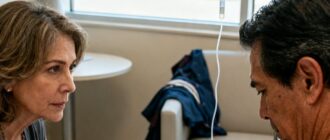
She found Marcus in bay 6, a butterfly bandage over his eyebrow, his left arm wrapped in gauze from wrist to elbow, grinning at her like this was a story he already couldn't wait to tell his coworkers.
"Mom. I'm fine. Seriously." He said it before she'd said anything, which told her exactly how many times he expected to have to say it.
She didn't cry. She'd promised herself in the car she wouldn't, because crying in front of him would make this about her fear instead of his relief, and he needed the relief more. Instead she sat on the edge of the gurney and picked a piece of glass out of his hairline with her thumbnail, the way she used to pick gravel out of his knee when he fell off his bike on Birchwood Lane at age seven.
"The other driver," Marcus said. "Guy was texting. Cop said he admitted it right there on the shoulder."
"Is he—"
"Fine. Car's totaled worse than mine, if that makes you feel better."
It didn't, particularly. What made her feel something closer to steady was watching him sign the discharge papers himself, watching his hand — the same hand she used to hold crossing Yale Avenue on the way to Eisenhower Elementary — write his own signature clean and legible despite the concussion, despite everything.
The insurance settlement came six weeks later: four thousand three hundred dollars for the totaled Civic, paid out by the other driver's carrier once the police report confirmed distracted driving. Marcus wanted to put it straight toward the Silverado. Diane had a different idea, and this was the part that surprised him.
She drove to First Bank of Owasso on a Tuesday morning, the folder with the settlement check and Marcus's birth certificate tucked under her arm, and opened a joint account in both their names — not a gift, a ledger. Four thousand three hundred dollars in, with a note taped inside the passbook in her handwriting: "Half is yours outright. Half sits here until you can show me six months of on-time rent and a mechanic's inspection you paid for yourself." She wasn't punishing him. She was done being the only one who worried on his behalf while he floated through decisions like nothing could touch him.
Marcus came by two Sundays later, sat at the same kitchen table where she'd once bandaged his knee, and slid a manila folder across to her — six months of rent receipts from the apartment he'd been living in with two roommates, and an inspection report from a shop on 41st Street, paid in full, on a used Ford Ranger he'd bought outright with his half plus overtime pay, no loan, no Silverado payment hanging over him. He hadn't told her he'd been keeping the receipts on his own before she'd even set the condition.
Diane looked at the folder, then at him, then reached for the passbook in the kitchen drawer and signed the remaining balance over to him right there at the table, no ceremony, just a pen and her signature under his.
That night she stood at the sink again, rinsing the same kind of plate, and the porch light stuck like it always did, and she jiggled the switch twice until it caught. Down the street, the dog was barking at nothing again. She didn't check the clock this time.