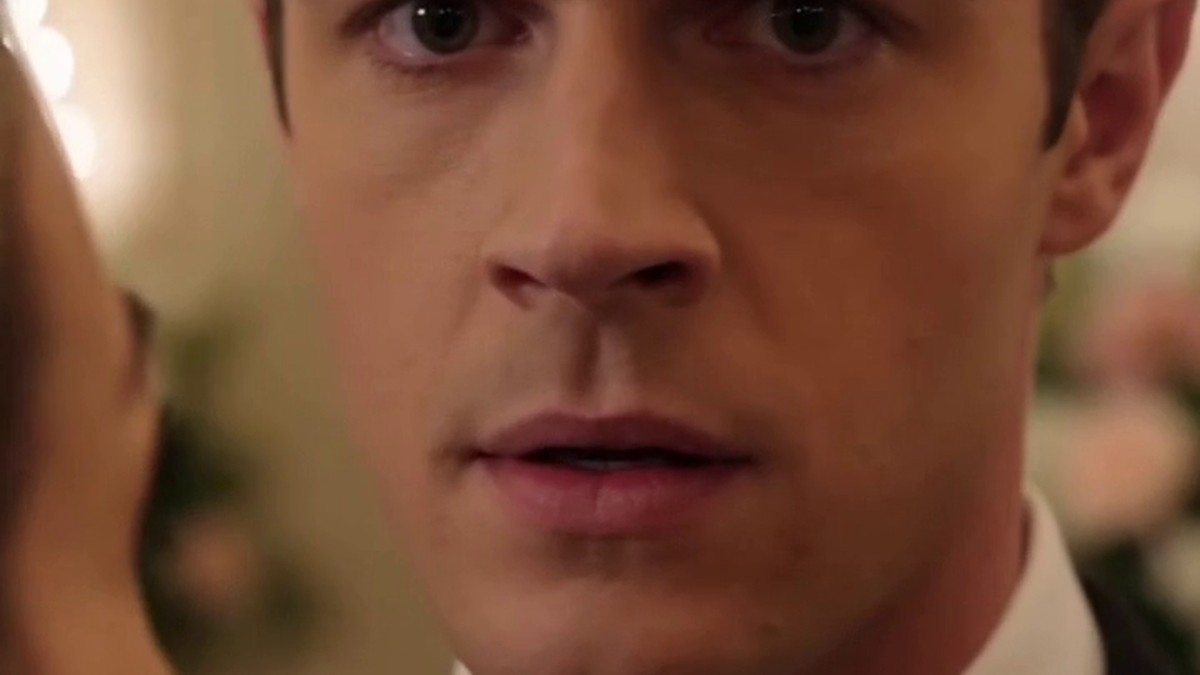
Her hands wouldn’t stop trembling.
Her chest ached with every heartbeat, each one harder than the last.
She had come for nothing more than a quiet moment with the bride before the ceremony began.
What she found instead would never leave her.
The bride.
The groom’s father.
Together.
Tangled in each other’s arms with minutes to spare before the vows.
She stood frozen in the hallway, alone, fighting for breath.
Telling herself she’d misread it. Misunderstood it.
But there was nothing to misread.
Every detail had carved itself into her mind.
The white lace dress.
The whispered words.
The way their eyes met — like a secret with a long, ugly history.
Then she saw her son.
The groom stood at the far end of the corridor.
Tuxedo pressed and perfect.
A white rose pinned to his lapel.
His face relaxed, easy, entirely unaware of what was burning just down the hall.
She moved toward him fast.
“Daniel.”
The word came out broken.
He turned. One look at her face and his smile disappeared completely.
“What’s wrong?”
She grabbed his arm.
Tight. Both hands.
“You can’t go through with this wedding.”
Daniel’s brow furrowed.
“What are you talking about, Mom?”
She glanced back toward the bridal suite. Then dropped her voice low, nearly to nothing.
“I just saw your bride.”
His jaw tightened.
“With who?”
The answer felt like swallowing glass.
“Your father.”
Silence.
The specific kind of silence that fills the air right before something irreparably breaks.
She braced for rage. For tears. For his world to visibly collapse.
Instead, Daniel just looked at her.
Flat. Still. Unreadable in a way that scared her more than anything she’d seen in that room.
“Daniel.”
He didn’t respond right away. His gaze drifted — just briefly — toward the bridal suite. Then it came back to her.
And then something happened that she wasn’t prepared for.
A smile crossed his face.
Slow. Quiet.
Not the smile of a man relieved, or amused, or even hurt.
The smile of a man watching something he’d carefully arranged finally click into place.
His mother took a step back.
Her mouth went dry.
“Why are you smiling right now?”
Daniel reached down and adjusted his cufflink. Unhurried. Deliberate. Like a man with all the time in the world.
Then he leaned in close.
And said four words in a voice barely above a whisper — four words that turned her cold from the inside out.
*”I already know everything.”*
The hallway seemed to tilt.
She pressed one hand against the wall to steady herself.
“What do you mean you know?” Her voice came out smaller than she intended. “Daniel, what are you saying?”
He looked at her the way you look at someone you love who has just, for the first time, seen the thing you’ve been carrying alone for years. With something like tenderness. With something like relief.
“Come with me,” he said quietly.
“I’m not going anywhere until you explain—”
“Mom.” He took her gently by the elbow. “Come with me.”
He steered her around the corner, away from the corridor, away from the murmur of wedding guests filtering into their seats, away from the bridal suite and whatever was still happening inside it. He found an empty anteroom — a dim little space stacked with folded chairs and artificial flower arrangements that smelled of dust and plastic — and he closed the door behind them.
She yanked her arm free.
“Start talking.”
Daniel exhaled. Ran one hand slowly across the back of his neck.
“I’ve known about them for eight months,” he said.
Eight months.
She counted backward without meaning to. Eight months ago she’d been at her sister’s in Phoenix. Eight months ago Daniel had called her on a Tuesday evening, and she’d thought his voice sounded strange, a little compressed, like a man speaking carefully around a bruise — but she’d chalked it up to work stress, to wedding planning, to the ordinary pressure of adult life.
“Eight months,” she repeated.
“I found messages on Elena’s phone. I wasn’t snooping. It was an accident. She’d left it on the kitchen counter and a notification came through, and I…” He paused. “I saw enough.”
His voice was steady. Terribly, unnaturally steady.
“And you stayed.” The words came out like an accusation. She didn’t mean them to, but they did.
“I stayed.”
“You kept planning the wedding.”
“Yes.”
“You stood there this morning and let me pin that rose to your lapel and you *knew* —”
“Mom.” He said her name like a closed door. Firm. Final. “I need you to understand that I didn’t stay because I was weak. And I didn’t stay because I didn’t know what to do.”
She stared at him.
That smile again. Smaller now. Sadder, too.
“I stayed because I needed them to believe I didn’t know.”
—
The silence that followed was a different animal than the one in the hallway.
That one had been shock.
This one was understanding, slowly assembling itself, piece by piece, into something that made her stomach drop.
“What did you do?” she whispered.
Daniel reached into the inner pocket of his tuxedo jacket. He produced a folded envelope — cream-colored, thick, the kind that holds documents rather than letters — and he held it between two fingers.
“Dad’s name is on every account of the construction firm,” he said. “You know that.”
She knew that. She had always known that. His father, Robert, had built the firm from nothing, or that was the story Robert told, loudly and often. The truth was more complicated. The capital had come from her side of the family, from her own father’s estate, folded into the business in the early years when Robert’s ambition had outrun his resources. The contribution had been absorbed, reframed, ultimately forgotten — by Robert, at least.
“Elena’s family has been trying to acquire that firm for two years,” Daniel continued. “Her father has made three separate offers. Dad turned them down every time. Publicly. With considerable fanfare.”
She was beginning to see the shape of it.
“But privately,” she said.
“Privately, Dad was negotiating directly with Elena. Using her as a back channel to her father. A merger instead of a sale. Much better terms for him.” He paused. “And personal terms too, apparently. For both of them.”
“He was going to let this wedding happen,” she said. “He was going to let you marry her knowing—”
“Knowing it would lock in the deal. The families joined. Everything tidy.”
The nausea moved through her in a wave.
“And Elena.”
“Elena gets what she wanted.” His jaw tightened for just a moment — the first crack in the composure, small and quickly sealed. “She was never in love with me, Mom. I think I probably knew that before I found the messages. I just didn’t want to know it.”
She looked at her son — really looked at him. At the careful set of his shoulders. At the exhaustion living just beneath the surface of his eyes. At eight months of keeping this sealed and silent and hidden, of going through the motions, of kissing a woman who was betraying him and shaking hands with a father who was using him.
Her eyes burned.
“Baby—”
“Don’t.” His voice caught, just slightly. “If you cry, I’ll fall apart. And I have about forty minutes of composure left in me, so let’s use them well.”
She pressed her lips together. Nodded.
“What’s in the envelope?”
“A full audit of the firm’s accounts going back six years. Compiled by a forensic accountant I hired in February.” He turned the envelope in his fingers. “It documents, in detail, the original capital contributions from Grandpa’s estate. The ones Dad reclassified. The ones that, legally speaking, represent a significant sum still owed to you.”
She went very still.
“There’s also a record of the private negotiations with Elena’s father. Conducted on company time, using company resources, which makes them subject to certain disclosure obligations Dad has not fulfilled to the other partners.” He paused. “And there are the messages. Between Dad and Elena. Printed, dated, legally notarized.”
“You’re going to use this today.”
“I’m going to use this today.”
“When?”
He glanced at his watch.
“Thirty-seven minutes.”
—
She didn’t try to stop him.
She thought about it — there was a moment, brief and instinctive, when the mother in her wanted to pull him back, to say *there’s another way, let’s go home, let’s let this go* — but she looked at his face and understood that there was no going home from this, that there had been no going home for eight months, that her son had been living in enemy territory with a smile on and a plan in his breast pocket and the only thing she could do for him now was stand at his side.
“Tell me what you need from me,” she said.
Something shifted in his face. Something younger and more fragile than anything he’d shown her yet.
“Don’t let me hesitate,” he said. “If I look like I’m hesitating — don’t let me.”
“I won’t.”
He straightened. Squared his shoulders. Touched the white rose on his lapel — not the way a groom touches a boutonniere, but the way a soldier touches a photograph. For courage.
Then he opened the door.
—
The ceremony hall was full.
Three hundred people arranged in rows of white-draped chairs, the afternoon light falling through tall windows in long golden shafts, a string quartet playing something soft and ceremonial. The air smelled of roses and candle wax and the particular nervous energy of a room full of people waiting for something beautiful.
Robert stood near the front, silver-haired and tuxedoed, speaking in low tones to one of Elena’s uncles. His face was composed, polished, the face of a man who had lived so long in his own narrative that he’d forgotten other people could see behind it.
He turned when Daniel walked in.
Smiled the smile of a father on his son’s wedding day.
Daniel walked directly to him.
She stayed one step behind, close enough.
“Daniel,” Robert began, expansive and warm, one hand already reaching for his son’s shoulder. “You look—”
“I need a word with you.” Daniel’s voice was quiet. “And with Elena.”
A flicker. Barely anything. “She’ll be coming down the aisle in thirty—”
“Now, Dad.”
The word landed precisely.
Robert looked at his son for a long moment. Then his eyes moved to her — a quick, assessing look — and whatever he found there closed something off in his expression.
“Of course,” he said.
—
They used the same anteroom.
By then Elena was there too, summoned by one of her bridesmaids at Daniel’s quiet request, still luminous in her white lace dress, carrying a small bouquet of gardenias she held like a shield in front of her.
She saw Robert first.
A single unguarded second — eye contact, a fractional softening — and then she saw Daniel’s face, and her own went carefully neutral.
“What’s going on?” Her voice was practiced. Smooth.
Daniel placed the envelope on the seat of a folded chair.
“I want to talk about the merger,” he said.
The room changed temperature.
Robert’s expression went very still in the way that faces go still when the body is deciding between fight and flight and hasn’t committed yet.
“This isn’t the time—”
“It’s the only time I have left,” Daniel said. “Once those doors open, I don’t belong to myself anymore. So we do this now.”
Elena set down her bouquet with the deliberate care of someone buying seconds to think.
“I don’t know what you think you know,” she said.
“I know everything,” Daniel said. “I’ve known for eight months. I know about the private negotiation structure. I know about the capital reclassifications. I know about you and my father.” The last sentence came out without a tremble, and she felt a fierce and painful pride in him for it. “I have documentation for all of it. Legally prepared. Ready to be filed.”
Robert’s face had gone a color she hadn’t seen before. Something between gray and red.
“You’re making a scene at your own wedding,” he said, his voice dropping into the register he’d always used to end arguments, to make her doubt herself, to assert the gravity of his own perspective. “This is not the—”
“Robert.” She spoke without planning to.
He looked at her.
“Stop talking,” she said.
Forty years of history in four words.
He stopped.
Daniel reached into his jacket pocket and produced a second document, this one already folded to a specific page.
“This is a settlement agreement,” he said. “Prepared by my attorney. It outlines a transfer of assets representing the original capital contribution from my grandfather’s estate, with interest, to my mother. It also outlines your removal from the firm’s managing partnership and the voiding of any merger agreement negotiated without proper disclosure.” He held it out. “If you both sign this today, I file nothing.”
Silence.
Elena looked at the document. Then at Robert.
Something passed between them — and she saw, in that passing look, the full architecture of what they were. Not love. Not even quite alliance. Just mutual utility, mutual compromise, two people who had found in each other a convenient mirror.
It was, in its way, the saddest thing she had witnessed today.
“And if we don’t sign,” Elena said.
“Then I walk out of this building, and my attorney files before the end of business.” Daniel paused. “And the wedding doesn’t happen either way. That part isn’t a negotiation.”
Elena closed her eyes.
When she opened them, she looked at Daniel with something that wasn’t quite guilt and wasn’t quite respect — some complex alloy of both, maybe, or just the recognition of having underestimated someone.
“Okay,” she said quietly.
Robert said nothing for a long, rigid moment.
She watched him weigh it. Watched him search for an angle. Watched him find none.
“Fine,” he said.
The word came out flattened, deflated. Like air leaving something that had been overfull a very long time.
—
They signed.
The string quartet was still playing when Daniel walked back through the hall to the wide front doors of the venue. She walked beside him.
He pushed them open and they stepped out into the afternoon, into sunlight, into the sound of the city going about its ordinary business entirely indifferent to the extraordinary thing that had just quietly ended inside.
He stood on the steps.
Breathed in.
Let it out slowly.
She put her hand on his back, between his shoulder blades, the way she had when he was small and couldn’t sleep.
“I’m sorry,” she said. “I’m sorry it was him. I’m sorry it was her. I’m sorry you had to do this alone for eight months.”
His throat worked.
“I wasn’t alone,” he said. “I just hadn’t told you yet.”
She didn’t try to stop her eyes from burning this time.
He turned, and for a moment he was not a man in a tuxedo with legal documents and careful plans. He was just her son.
She held him the way mothers hold sons when the world has been particularly unkind — tightly, wordlessly, with the full weight of knowing she couldn’t fix it and intending to stand beside it anyway.
The white rose fell from his lapel.
Neither of them picked it up.
They left it there on the steps, small and bright in the afternoon sun, as they walked away from the building, away from the guests still waiting inside who would slowly, confusedly begin to understand that something had come undone, toward a street corner, toward a coffee shop, toward a quiet table where she intended to sit across from her son for as long as he needed, and listen, and let him fall apart a little, and remind him — as many times as it took — that being the person who tells the truth in a room full of people invested in the lie is not a small thing.
It is, in fact, the only thing worth being.