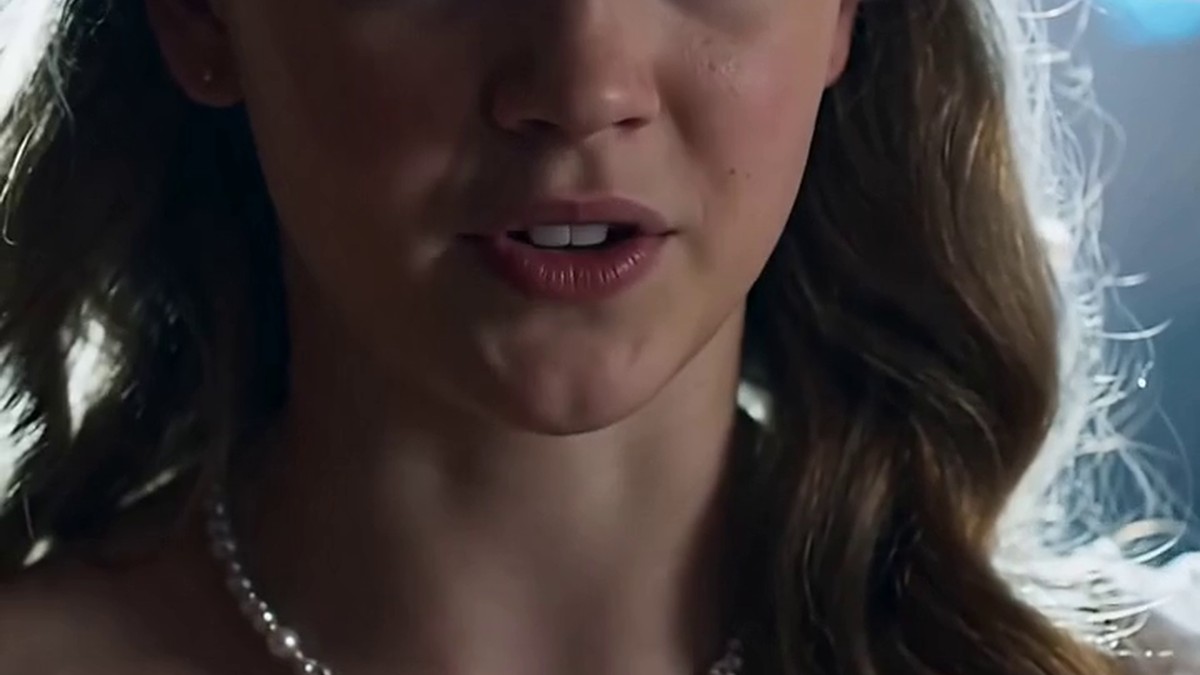
She spun them between her fingers like a party trick, that smirk carved so deep into her face it looked permanent. “Go ahead,” she said, voice dripping with theater. “Let’s find out what’s hiding underneath all those sad little stitches.”
The first sound wasn’t mine.
It was the dress.
The blades caught the fabric and *tore*, and that sound — sharp, violent, final — cut through the ballroom like a slap across the face. Every conversation collapsed mid-sentence. The chandeliers kept glittering. The music choked and died. And for one terrible, weightless moment, the entire room just *held still*.
Then the laughter came.
All at once, from everywhere. Phones rose into the air like torches at a rally. The DJ never touched his equipment again. My humiliation was the main event now, and everyone had a front-row seat. She kept cutting, kept smiling — wider with each strip she peeled away — dismantling the dress I had rebuilt with my own hands during nights that ran too late, paychecks that ran too thin, and tears I’d stopped bothering to wipe away. Every repaired seam held a memory of choosing not to quit. Every careful stitch was proof that shattered things could still be made whole. And they knew it. Every single person in that room knew exactly what that dress meant to me.
That’s why they chose it.
This wasn’t about ruining prom. This was about reaching inside me and tearing out the part that had learned to fight back.
Not one teacher moved.
The chaperones discovered something fascinating in the middle distance and stared at it hard. Even the people who *understood* — who knew the full story, who had watched me piece that dress back together — lifted their phones instead of their voices. Their silence landed differently than the cruelty. Heavier, somehow. More personal. Another strip of fabric hit the polished floor, and one of the girls snatched it up and held it overhead like a winning flag while the crowd actually *applauded*. The old weight returned to my chest, that familiar pressure behind the ribs that steals your air and makes the floor feel unstable. I should have crumbled. I should have run.
I didn’t move.
Because something else did.
When the torn lining split open, a small folded packet of silk slipped free from inside — drifting downward with an almost impossible slowness, as though gravity hadn’t made up its mind about it yet. My first thought was that it was some forgotten scrap, a patch tucked away and lost to time. But it moved wrong. Too gently. Too deliberately, like something being *delivered* rather than dropped. It settled beside my shoes with barely a sound. The laughter unraveled into something quieter, something uneasy. The gold embroidery caught the ballroom light and threw it back in patterns so fine, so impossibly precise, they looked like they’d never aged a single day. Even the girl with the scissors went still. Her hands dropped to her sides. Someone behind me whispered, *”What is that?”* and the question just hung there, unanswered.
Then the doors blew open.
Both of them. Hard enough to shake the walls.
An old man came through at nearly a run — silver hair thrown loose, face the color of old paper, chest heaving from exertion or panic or both. Professor William Harrington. Renowned historian. The kind of name that appeared on the spines of books in university libraries. He didn’t acknowledge the principal who stepped toward him. He didn’t acknowledge the crowd that parted around him. His eyes had already found the silk packet on the floor, and whatever he saw in it drained whatever was left of the color from his face.
He dropped to his knees in the middle of the dance floor.
Nobody laughed.
His fingers reached for the packet with the kind of care you give to something irreplaceable — trembling, deliberate, almost afraid to make contact. “No,” he breathed, barely audible. He turned it slowly in his hands, tracing the gold embroidery like he was reading a language only he knew. His expression moved through confusion, then disbelief, then something rawer — something that looked almost like *recognition*. When he finally raised his eyes to mine, the look in them wasn’t shock.
It was fear.
He swallowed once. His grip tightened around the ancient silk.
“Where did you get this?” His voice was barely above a whisper. “And why does it carry the royal crest that every historian alive has spent *centuries* believing no longer exists?”
Every smile left the room.
What replaced them was something colder, something that had no easy name — because if the impossible had just been pulled from the wreckage of my ruined dress, in the middle of a high school prom, on the worst night of my life…
Then nothing else about this night was going to be ordinary either.
The silence pressed down like a physical thing.
Not the cruel silence from before — not the held breath of people waiting to laugh. This was different. This was the silence of a room that had just realized it was standing at the edge of something vast and dark and entirely beyond its understanding.
Professor Harrington was still on his knees.
He hadn’t moved. His hands cradled the silk packet the way you’d hold a lit match in a storm — terrified to squeeze, terrified to let go. The gold embroidery caught the chandelier light and threw it back in slow, rotating patterns across the ceiling, across the faces of three hundred people who had come here for drama and gotten something else entirely.
“I asked you a question.” His voice was steadier now, but only just. “Where did you get this?”
I looked down at him — this man whose name appeared in textbook acknowledgments, whose lectures filled auditoriums — and I gave him the only honest answer I had.
“It was inside the dress.”
“Inside the *lining*?”
“Yes.”
He closed his eyes. Opened them. “And the dress — where did the dress come from?”
The girl with the scissors was still holding them. She had forgotten they were in her hand. The crowd had contracted without anyone deciding to move, shoulders pressing together, phones finally lowered, because whatever this was, it didn’t fit inside a video frame. It was the kind of thing you needed your actual eyes for.
“My grandmother,” I said. “She left it to me when she died. Three years ago.”
“Your grandmother’s name.”
“Elena. Elena Voss.”
Something moved across his face like weather crossing open ground. His jaw worked twice without producing sound. Then he said, very quietly, as though he was saying it to himself more than to me: “She told me she burned it.”
—
The principal had materialized at the edge of the situation — Mr. Calloway, a careful man, a man who had spent his career choosing not to become part of things. He was choosing now, visibly, with both hands clasped in front of him. “Professor Harrington, I think perhaps we should—”
“Not now, Gerald.”
Mr. Calloway blinked. He hadn’t been called Gerald in a professional setting in twenty years. He stepped back.
Harrington rose to his feet with the slow effort of old knees and heavy thoughts. He was taller standing than he’d seemed on the floor, and when he squared himself to face me, there was something in his posture that made the room give him space without being asked.
“Your grandmother was my colleague,” he said. “Before she left the university. Before she disappeared from all of it — the academic world, the historical community, every conference and correspondence and collaboration we’d built across thirty years.” A pause. “I believed she’d destroyed the research. She told me she had. She was very specific about it. She said she’d burned everything that connected her to the Voss Archive.”
“The Voss Archive,” I repeated.
“Yes.” He looked at me with those frightened, certain eyes. “Named for her family. Four generations of documentation, authentication, and private collection. Artifacts that certain institutions — and certain individuals — have been trying to locate for the better part of a century.” His grip on the silk tightened infinitesimally. “Because whoever holds the crest holds the provenance. And whoever holds the provenance holds the claim.”
“The claim to *what*?”
The chandeliers hummed softly overhead. Somewhere outside, a car alarm started and stopped.
“To a collection of royal correspondence and treaty documents,” he said, “that would rewrite the authenticated historical record of three European dynasties. And invalidate several very significant — and very powerful — modern legal inheritances in the process.”
The girl who had been holding the strip of my dress — Mackenzie, her name was Mackenzie, and she had hated me since the seventh grade for a reason I had never fully understood — let the fabric fall from her fingers. It landed without ceremony on the polished floor. She looked at it like it had burned her.
—
Then the second set of doors opened.
Not with drama this time. No blown-back panels, no theatrical entrance. Just the quiet mechanical *click* of a side exit, and two men in dark coats stepping through with the deliberate calm of people who had learned long ago that urgency advertises itself.
They were not students. They were not faculty. They were not anyone’s parents.
The taller one had a face built for not being remembered — neutral angles, neutral expression, the kind of person who moved through spaces and left no impression behind. His eyes went straight to Harrington and then, a half-second later, straight to the silk in his hands.
The shorter one was already on his phone.
Harrington turned at the shift in the room’s attention. When he saw them, the fear on his face folded into something older and more exhausted — the look of a man who had been expecting this, somewhere in the back of his mind, for a very long time.
“You found it faster than I thought you would,” he said.
“We were already in the area,” the tall one said. “We’ve been monitoring the estate records since the grandmother’s death. We knew something would surface eventually.” His eyes moved to me with the flat professional interest of someone assessing an obstacle. “We just didn’t anticipate the venue.”
Three hundred people in formal wear. A prom court still wearing their sashes. A DJ booth with silent equipment and a young man behind it who looked like he genuinely regretted all of his choices tonight.
“You don’t want to do this here,” Harrington said.
“We don’t particularly want to do it at all,” the tall man said. “We want the packet. We want the crest authenticated and transferred. And then this becomes a very boring administrative matter that nobody in this room needs to think about again.”
His voice was reasonable. His voice was so reasonable it made my teeth ache.
“No,” I said.
The word came out before I’d decided to say it — before I’d done any of the math, before I’d calculated odds or consequences or what two men in dark coats in a ballroom full of teenagers actually meant for my immediate future. It just came out, clean and flat and surprising even to me.
The tall man looked at me fully for the first time.
“No,” I said again, steadier now. “You don’t get to walk in here and ask for something that belonged to my grandmother like it’s a library book with an overdue fee. You don’t get to make it administrative. She hid it. She hid it *from you*, specifically, and she left it to me, specifically, inside something you’d never think to look at, and if you think I’m going to hand it over because you said please in a very calm voice—”
“Nobody said please,” the shorter one noted, looking up from his phone.
“The point stands.”
Harrington made a sound that, under different circumstances, might have been a laugh.
—
What happened next happened fast, the way things do when too much tension has been stored in too small a space for too long.
The tall man moved toward Harrington — not toward me, toward *him*, because Harrington was holding the packet and I was just a girl in a ruined dress — and Harrington turned and pressed the silk into my hands with the sudden, urgent completeness of a relay pass.
“Run,” he said.
I didn’t.
Because Mackenzie, of all people — Mackenzie, who had handed the scissors to the wrong person tonight, who had held up a strip of my dress like a trophy, who had spent six years finding new ways to remind me that I didn’t belong here — Mackenzie stepped directly into the tall man’s path.
She planted herself there like a fence post.
“You need to leave,” she said. Her voice was shaking. Her chin was up.
He stopped. Looked at her. Made a rapid, quiet calculation about the optics of removing a seventeen-year-old girl from his path in front of three hundred witnesses with phones.
The calculation took long enough.
Long enough for Mr. Calloway, who had spent his entire career choosing not to become part of things, to finally make a different choice. He pulled out his own phone and dialed — loudly, deliberately, announcing to no one in particular: “Yes, this is the principal of Westfield High School. I need police at the venue address. I have two trespassers who’ve entered a minor-attended event and are attempting to take property from a student.”
The shorter man said something quiet and sharp to the taller one.
The taller one looked at me. At the silk in my hands. At three hundred phones that had found their purpose again — not as instruments of humiliation this time, but as witnesses. Recording. Uploading. Already, probably, everywhere.
He straightened his coat.
“This isn’t finished,” he said.
“I know,” I said.
They left through the same side door they’d come in. The click of it was the most ordinary sound the night had produced.
—
The ballroom breathed.
Harrington sat down heavily in the nearest chair — someone’s abandoned dinner seat, a half-empty glass of punch still on the table beside it — and pressed both hands over his eyes. When he lowered them, he looked like a man who had been carrying something for a very long time and had just set it down, not in a safe place, but at least out of his arms for a moment.
“She didn’t burn it,” he said. “She was protecting you.”
“She was protecting the history,” I said.
“Yes.” He smiled, small and tired. “She would have said it that way.”
I looked down at the silk in my hands. The gold embroidery was impossibly fine up close — not decorative, I understood now, but *functional*. A language. A record. The kind of thing you’d hide inside something ordinary because ordinary things survive when remarkable things don’t.
She’d built the hiding place out of a dress she’d worn to her own prom.
She’d handed it to me knowing what it was.
She’d trusted me to be the kind of person who wouldn’t throw it away.
—
Mackenzie was standing a few feet off, still visibly shaking, arms crossed over her chest like she was holding herself together. When she caught me looking at her, something complicated moved across her face — not apology exactly, not yet, maybe not ever, but something adjacent to it. Something that acknowledged a debt.
I didn’t say anything.
She didn’t either.
Some things don’t need to be spoken to be understood, and some understandings are too new and too fragile to survive language just yet.
The DJ, with the particular instinct of someone whose entire job is reading rooms, put on something slow and ordinary, and the prom — improbably, stubbornly — resumed around us. Not the same as before. Never the same as before. But the lights kept glittering and people kept moving and the floor held steady beneath my feet.
I stood in the middle of it in my ruined dress, holding a piece of history that had survived because my grandmother had believed ordinary things could carry extraordinary weight.
She had built the hiding place out of love.
She had built it out of faith in me.
I folded the silk carefully — the way he had, the way you handle something irreplaceable — and held it against my chest, and felt, underneath the ruin and the residue of the worst night of my life, something that had no precise name but that lived in the same neighborhood as *chosen* and *trusted* and *not alone*.
The chandeliers kept throwing their light across the ceiling in slow gold patterns.
Outside, sirens were starting up somewhere in the distance.
And the night, which had tried very hard to break me, had instead delivered something my grandmother had hidden for thirty years, waiting for exactly this moment, exactly this version of me — the one who hadn’t run.