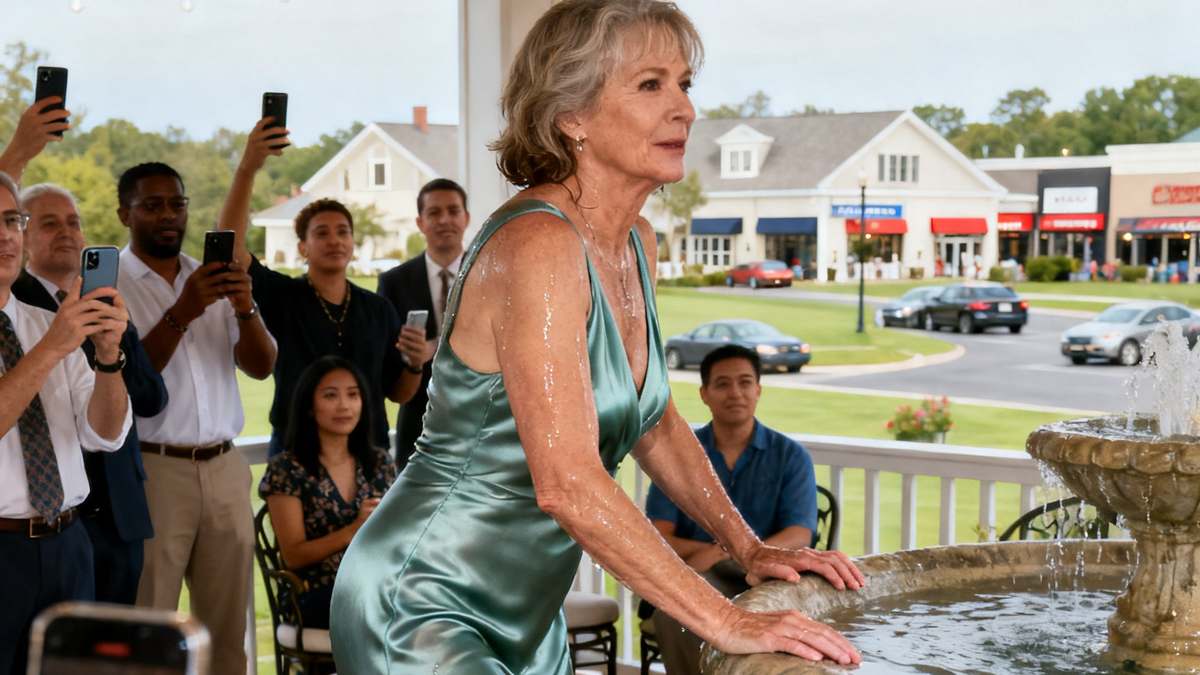
My family laughed when I showed up alone to my sister's wedding, and my father made sure all four hundred guests heard him say it: "She couldn't even find a date." Minutes later, after he shoved me into the fountain and the applause finally died down, I looked him dead in the eye. "Remember this." Because the secret I'd kept for three years was already walking through the ballroom doors.
My name is Renata Kessler, and I'm thirty-four years old. I grew up in Cedar Hollow, a small town outside Lancaster, Pennsylvania, where everybody knows everybody's business and nothing stays quiet for long — except mine.
For most of my life, I was the family's punchline. The oldest daughter, the "difficult" one, the woman who existed mainly to make my younger sister Paige look effortless by comparison. Paige got the cheer squad, the prom court, the golden retriever energy. I got the lecture about my weight at Thanksgiving and the comment about my "attitude" every time I didn't laugh at a joke made at my expense.
So when Paige got engaged to a hedge fund guy named Dalton and planned a wedding at the Cedar Hollow Country Club — white tents, a raw bar, a band flown in from Philadelphia — I knew exactly what my role would be. Show up, smile, disappear into the background. I'd done it my whole life.
I RSVP'd alone. Not because I didn't have someone. Because I'd learned, the hard way, that bringing anyone into that family was a mistake before they'd even parked the car.
The reception was already loud with prosecco and string lights when my father, Walter Kessler, grabbed the emcee's microphone somewhere around ten o'clock. He does this — hijacks a moment that isn't his. He tapped the mic twice, and the band cut out mid-song.
"Everybody look," he said, grinning out at four hundred faces, "there's Renata. All by herself, as usual. Couldn't even scrounge up a date for her own sister's wedding."
The laughter came fast, rolling across the tables like it had been waiting for permission. Aunt Doreen practically choked on her champagne. Paige, radiant in her gown, gave a tight little smile from the head table — the kind that says *I won't stop him, but I also won't join him*, which somehow felt worse.
I backed away from the dance floor toward the terrace, where they'd set up a stone fountain surrounded by potted hydrangeas, string lights looped overhead. I needed thirty seconds where nobody was looking at me.
My father followed.
"Cut the pouting," he said, low enough that only I could hear it, both hands landing on my shoulders like he was steadying a chair, not a person. "You're ruining the pictures."
Then he pushed.
Not hard. That's the part that still gets me — it wasn't a shove anyone would call violent if you played it back in slow motion. Just careless enough. Just enough that my heel skidded on the wet stone edge and I went backward into the fountain, water closing over my shoulders, my dress — a pale sage silk I'd bought specifically because it was the one nice thing I owned — soaking through and clinging to me like a second skin.
The cold hit first. Then the smell — chlorine and old pennies, the fountain water thick with them, coating the back of my throat when I came up gasping.
A few people near the terrace doors actually laughed out loud, a short bark of a thing, before catching themselves. Somebody's phone came up, filming. Cousin Grant clapped twice, slow, like he was watching a magic trick, then looked around and stopped when nobody else joined him. My mother had her hand over her mouth, but she didn't move from her chair. Nobody came to the edge of the fountain. Nobody offered a hand.
I sat there for a second with my palms flat against the wet stone bottom, my dress ballooning up around me, and I watched my father standing over me with the microphone still dangling from his hand, waiting to see what I'd do, the way you wait to see if a dog is going to whimper or bite.
I wiped the water from my eyes and looked up at him.
"Remember this," I said. Not loud. I didn't need loud. "Remember exactly what you just did. Because I will."
His grin flickered — just barely, like a light on a bad circuit.
I climbed out on my own, my heels catching on the fountain's lip, one strap snapping clean off. I walked past the gift table, my dress dripping a trail across the parquet, into the club's front lobby bathroom, where I peeled the ruined silk over my head and left it in the sink, and pulled on the black cocktail dress I'd packed in my overnight bag — a habit I'd developed after enough Kessler family functions to know I should always have a change of clothes in the car. My hands were shaking too hard to get the zipper the first time. I braced my forearm against the wall and tried again. I redid my lipstick, dark red, and looked at the woman in the mirror.
I took out my water-damaged phone, dried it against my thigh, and it took three tries before the screen would even light up. I typed two words to the one contact I'd kept hidden from my family for three years.
*Come now.*
They'd spent my whole life calling me the one who couldn't keep a man. Tonight they were going to meet my husband.
His name is Marcus Reyes. We met three years ago at a legal conference in Pittsburgh, back when I was still working eighty-hour weeks as a litigation associate and he was an attorney at a firm across town. We eloped eight months later at the county courthouse in Allegheny, told no one, and kept it that way — partly because I wasn't ready to hand my family one more thing to pick apart, and partly, if I'm honest, because some small protective part of me wanted one good thing in my life that they couldn't touch.
Marcus had driven up from Pittsburgh that afternoon and was parked outside the club in his car, working through emails on his phone, because I'd told him — three days earlier, half-joking, half-not — that I didn't think I could get through this wedding without wanting him there. He hadn't come inside. That was the deal. I'd text him if I needed him, and otherwise he'd just be close, reading briefs in the driver's seat, in case.
He walked into the ballroom eleven minutes later, still in his gray T-shirt from the drive, hair pushed back where he'd run his hand through it, and the room did the thing rooms do when someone walks in who clearly doesn't belong to the joke being told about them. Conversations stalled mid-sentence. Paige's new mother-in-law actually put a hand to her chest.
He crossed the floor fast, found me standing near the terrace doors in a dry dress with my hair still dripping down my back, and his hand went to my jaw, tilting my face up, checking — checking for what, I don't know, a cut, a bruise, something he could point to.
"You're freezing," he said, and I realized I was shaking, and that he'd noticed before I had.
"I'm okay," I said, and my voice cracked on the second word.
My father found his voice first. "Who — who is this?"
"My husband," I said. "We got married three years ago. I never told you because I knew what you'd do with it."
My father's face went the color of the tablecloths. "You've been married for *three years* and you didn't—"
"I watched him push you," Marcus said, not to me, to my father, his voice flat and even. "From the parking lot window. I saw the whole thing."
Nobody said anything for a second. Somewhere behind us, the band, unsure what else to do, started quietly packing up a mic stand.
I walked to the head table where my mother sat frozen with her napkin still folded in her lap, and I picked up the seating card with my name on it — RENATA, tucked at table fourteen, near the kitchen doors, as far from the family as they could put me without seeming obvious about it — and I put it in my clutch, next to my phone, next to the broken shoe strap I'd shoved in there without thinking.
"I just wanted you to see him," I told her. "That's all."
Paige caught my arm on the way out, still in her wedding dress, mascara starting to blur at the corners of her eyes. "Renata — I didn't know he was going to—"
"You didn't stop it either," I said. I pulled my arm free, gently, and kept walking.
Marcus drove me back to my apartment that night with the heat in the car turned all the way up, and I sat with my knees pulled to my chest, still smelling like the fountain no matter how many times I rubbed my hands over my face. He didn't ask me to talk about it. He just kept one hand on my knee at every red light, like he was checking I was still there.
It took me eleven days to call my grandmother's estate attorney about the trust — the one my father had co-signing rights on since I turned twenty-two, "for safekeeping," he used to say, though I'd never once asked him to safekeep anything. I sat in the attorney's waiting room picking at a hangnail until it bled, and when they called me back, my voice came out steadier than I expected when I said I wanted him removed.
The paperwork came by courier three weeks after that, return receipt requested, addressed to my parents' house so I'd know the exact day it landed.
It landed on a Tuesday. My phone rang four times that afternoon, my father's name lighting up the screen each time, and I let it ring out on the kitchen counter while I stood at the sink washing out the sage silk dress I'd finally taken to a dry cleaner — some habit I couldn't shake, trying to save the one nice thing I'd owned, even though the chlorine smell never fully came out of it. On the fifth call, I picked up the phone, looked at his name, and set it face-down on the counter without answering.