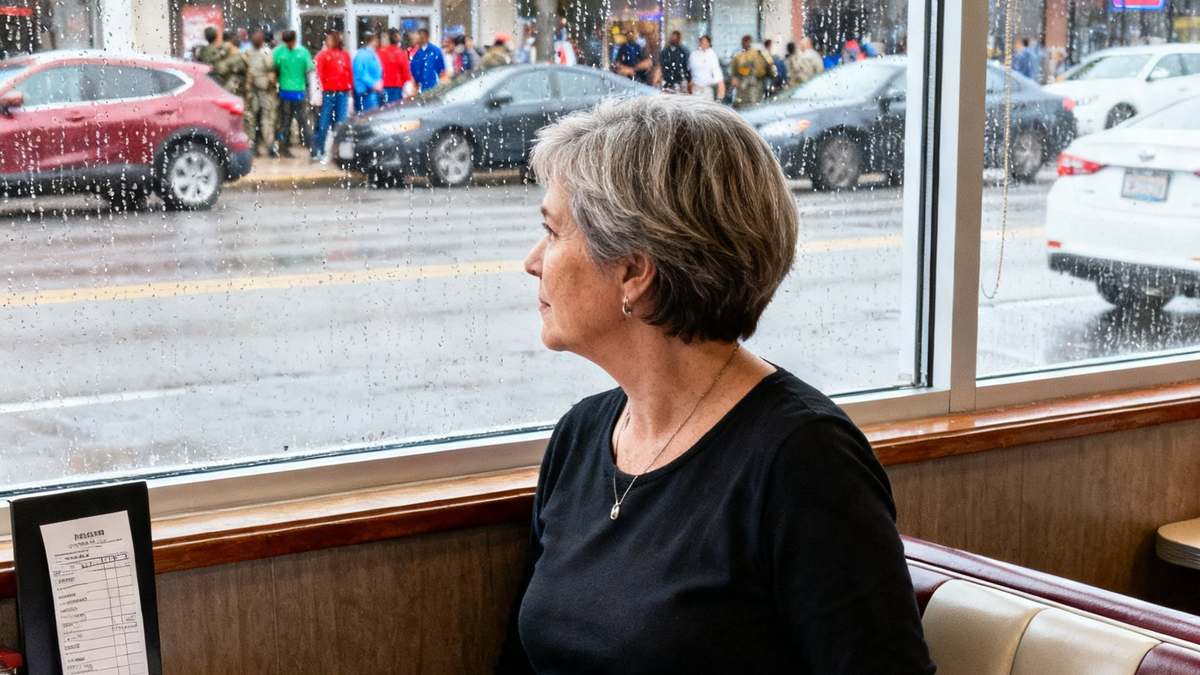
Marlene Whitfield had eaten breakfast alone at the same booth for eleven years. Corner spot, back wall, the one under the flickering exit sign at Pete's Diner off Route 9 outside Scranton. Two eggs over easy, rye toast, black coffee, no refills counted because she never asked for a second cup — she just held the first one until it went cold, turning the mug in slow circles on the Formica.
The waitress, a woman named Donna Pryzik who'd worked the morning shift since Reagan was president, never had to ask what Marlene wanted. She just wrote it on the ticket the second the bell over the door rang.
That morning — a Tuesday, the second week of September, rain coming down sideways on the parking lot — Donna set the plate down and said what she always said.
"Eggs are extra crispy on the edges today. Cook's new."
Marlene didn't answer. She was looking at the empty side of the booth, the side that had been empty since her husband Walter died of a heart attack in the garage eleven years ago, wrench still in his hand, radio still playing a Pirates game nobody finished listening to.
She'd come to the diner because Walter used to come here every Tuesday before his shift at the rail yard. After he died, she started ordering his breakfast instead of hers — the eggs he liked, the toast he liked — like setting a place for him that only she could see.
"You okay, hon?" Donna asked.
"I keep thinking today's the day I stop missing him," Marlene said. "And then I don't."
Donna refilled a cup that didn't need refilling and sat down across from her for exactly as long as her manager would let her get away with. "My mother used to say some people don't leave. They just change the room they're in."
Marlene managed something close to a laugh. "Walter would've hated being compared to a room."
"Walter would've hated the eggs today too. Overcooked."
That got a real laugh out of her, short and surprised, like it had been sitting in her chest waiting for permission.
What nobody in that diner knew — not Donna, not the cook, not the trucker two booths down nursing his third coffee — was that Marlene wasn't just grieving a husband that morning. She was three days away from losing the house.
Walter had left the mortgage half-paid and a life insurance policy that turned out to be worthless paper — a scam his brother-in-law, Ray Kessler, had talked him into eight years before he died, some whole-life policy from a company that folded before Walter's body was even in the ground. Marlene had spent a decade patching the gap with substitute teaching and a part-time job at the fabric store in town, but this year the property taxes had jumped, the roof needed four thousand dollars of work she didn't have, and the bank had sent a letter with a date circled in red: September 19th.
Ray Kessler — the same brother-in-law who'd sold Walter that policy — was the one holding the second mortgage note. He'd loaned Marlene eleven thousand dollars four years back, quietly, family-style, no lawyers, just a handshake and a promise she'd pay him back "whenever." She'd been paying him back. Ray had decided "whenever" meant now, all at once, or he'd call the note and force a sale, take his cut off the top before the bank even got its share.
He'd told her this on the phone two nights before, voice flat, like he was reading a weather report. "Business is business, Marlene. Walter would understand."
Walter would not have understood. Walter would have driven to Ray's auto body shop on Pittston Avenue and put a wrench through the office window. But Walter wasn't there, and Marlene was sixty-one years old with a part-time paycheck and a stack of paperwork she didn't know how to read.
She finished the eggs. She left three dollars on the table, same as always, though Donna never seemed to keep any of it — Marlene had caught her once slipping it into the tip jar meant for the new busboy.
Then she drove to the county courthouse instead of the fabric store.
She'd called a legal aid clinic the week before, one of those free consultation numbers she'd found taped to the bulletin board at the library. The attorney, a young woman named Priya Desai who couldn't have been older than thirty-five, met her in a windowless room with a folding table and two chairs that didn't match.
"The handshake loan doesn't hold up the way he thinks it does," Priya said, flipping through the two pages of notes Marlene had scribbled from memory — dates, amounts, the one text message Ray had sent confirming the loan. "No promissory note, no signed terms, no notarization. He can sue you for the eleven thousand. He cannot force a sale of your house over a verbal agreement. That's not how a second lien works in Pennsylvania."
"He said he'd call the bank. Tell them I'm behind."
"Are you behind?"
"Two months. I was going to catch up next paycheck."
Priya wrote something down. "Then we get you current with the bank first, buy breathing room, and send your brother-in-law a letter explaining that if he wants his eleven thousand dollars, he can file in small claims like anyone else — and explain to a judge why he never put a dime of it in writing."
Marlene sat with that for a moment, hands flat on the folding table. "He's family."
"He's a creditor who forgot to act like one," Priya said. "You don't owe him your house because he's family. You owe him what you agreed to, on the terms you actually agreed to — which, legally, barely exist."
Three days later — September 19th, the date circled in red — Marlene didn't lose the house. She walked into the bank with two months of back payments in cashier's checks, an updated hardship plan Priya had helped her draft, and a folder thick with bank statements, the useless insurance denial letter, and a copy of the text message from Ray. The loan officer, a tired man named Gary Fenn who'd clearly seen worse, approved the modification in twenty minutes.
Ray called that evening. Marlene let it ring twice before picking up.
"You went and got a lawyer," he said. Not a question.
"I went and got current with the bank," Marlene said. "You'll get your eleven thousand back the way we should've done it from the start — in writing, with a schedule, notarized, filed with the county so nobody's memory does the negotiating next time. My attorney's drafting it. You can sign it or you can take me to court and explain to a judge why there's no paperwork for a loan you're suddenly in such a hurry to collect."
There was a long stretch of static-quiet on the line, the kind where you can hear someone deciding whether to keep pushing.
"Walter would be disappointed in you," Ray finally said.
"Walter would be disappointed you sold him a fake insurance policy and then tried to take his house eight years after he died," Marlene said. "I've got the denial letter from the insurance company right here on the table if you want me to read you the date he signed with you."
He hung up.
The papers came back signed a week later, notarized, filed, twelve monthly payments spelled out in black and white — no more handshakes, no more "whenever." Marlene mailed the first payment herself, a check for exactly $916.67, tucked into an envelope with nothing else in it. No note. No forgiveness. Just the payment, on time, on paper, the way it always should have been.
That Tuesday, she went back to Pete's Diner. Same booth, same rain-streaked window, same two eggs over easy across from a chair nobody sat in.
Donna set the plate down. "Eggs are better today. Told the cook to knock it off with the crispy edges."
"Good," Marlene said. She picked up her fork, then set it down again and looked at the empty side of the booth one more time. "I kept the house, Walter."
Donna didn't ask what she meant. She just refilled the coffee that didn't need refilling, and let her sit with it.