Denise Carraway had learned to read her son-in-law's mood by the sound of his truck door. A soft click meant a decent day at the shop. A slam meant somebody had ripped him off on parts again, and dinner would be quiet except for the TV.
Tonight the door didn't slam. It didn't even close all the way — she heard it bounce twice against the frame before Marcus gave up and left it hanging open, the dome light burning a hole in the dark driveway.
She was at the sink rinsing green beans when he came in still wearing his coveralls, grease under his nails, and set a manila envelope on the kitchen table like it might go off.
"Sit down a second, Denise."
She dried her hands on the dish towel hanging off the oven handle. "Where's Paige?"
"Putting the baby down." He pulled a chair out but didn't sit in it. "This is between us."
Her daughter Paige had married Marcus eight years back, right after he'd bought the failing transmission shop on Route 9 from old man Hollis for next to nothing — a leaking roof, three dead lifts, and a sign that said HOLLIS AUTO in faded red letters. Denise's husband Walt had put up eleven thousand dollars from his pension buyout to help Marcus get the doors open again, no paperwork, just a handshake at this same table. Walt had died two winters later. The shop kept running. The handshake had no witnesses left but Denise.
She opened the envelope. Inside was a printout from the Secretary of State's business registry — Carraway Transmission & Auto LLC — and a single sheet: an operating agreement, dated three weeks ago, listing Marcus as 100% sole member.
"You had a lawyer draw this up," she said.
"Guy at the Rotary breakfast does small business stuff. It's just — cleaner this way. For the bank, for insurance."
"Your father-in-law's eleven thousand dollars is what kept the lights on that first winter, Marcus. I've still got the deposit slip in a shoebox."
"That was a loan to me. Not to a business that didn't legally exist yet." His voice had the flat, rehearsed sound of something he'd practiced in the truck. "Paige knows. She's fine with it."
"Paige is upstairs with a six-month-old and hasn't slept a full night since March. Don't tell me what she's fine with."
He picked the envelope back up like the conversation was over. "I'm not trying to cut anyone out. I just need it clean if I'm going to add the second bay."
Denise didn't raise her voice. She'd never been a yeller — Walt used to say her silences did more damage than most people's shouting. She folded the dish towel in half, then in half again, and set it on the counter.
"All right," she said. "Clean it is."
—
She didn't call a lawyer that week. She didn't say anything to Paige either, not yet — her daughter was surviving on protein bars and two-hour sleep windows, and Denise wasn't about to hand her a grenade before Marcus even set the pin. Instead she drove out past the shop most mornings on her way to her shift at the pharmacy counter in town, watching the new sign go up — CARRAWAY TRANSMISSION — bright white vinyl over the ghost of Hollis's faded red.
What Marcus didn't know, because he'd never once asked, was that the shoebox in Denise's closet held more than a deposit slip. It held the actual promissory note Walt had insisted on writing up himself the night before the money changed hands — three sentences in his blocky mechanic's handwriting, signed by both men, Denise as witness. Marcus had probably forgotten it existed. Walt had never brought it up again after that night; that was Walt's way, generous and then embarrassed by his own generosity.
She also knew something Marcus definitely didn't know: the building itself, the actual lot on Route 9, wasn't part of that operating agreement he'd shown her. Old man Hollis hadn't sold the land — he'd never trusted banks enough to hand over a full deed to a twenty-eight-year-old with no credit history. He'd structured it as a long-term lease with an option to buy, and when Hollis died six years ago, that lease and the buyout option had passed, per his will, to the one person in town who'd sat with his wife through chemo every Tuesday for a year. Denise.
She'd never told Marcus. There'd never been a reason to.
—
The reason came on a Sunday in October, at Paige's kitchen table this time, three weeks after the envelope. Marcus had gone ahead and filed the buyout paperwork on the shop's equipment with the bank, using the LLC documents as collateral — a $40,000 expansion loan for the second bay, cosigned by nobody, because in his mind he didn't need anybody's name on it anymore.
Denise brought her own folder. She set it down next to Paige's coffee mug, not Marcus's, and slid out three documents: the promissory note in Walt's handwriting, a letter from the bank confirming Denise Carraway held the lease and purchase option on the Route 9 property, and a notice — dated that Friday — that she was declining to renew the lease past its current term, effective the following June.
Marcus read it twice standing up. "You can't just—"
"I can. It's my name on the option, not yours. Has been since before you and Paige even got married." She kept her voice level. "You wanted it clean. I made it clean. The building's mine to lease to whoever I decide, and right now that's not settled."
"You'd shut down my shop over eleven grand?"
"I'd shut it down over being lied to in my own kitchen." She looked at Paige, whose hand had gone still around the mug. "Not over him. Over the lying."
Paige didn't cry. She picked up the note in her father's handwriting and ran her thumb over his signature, once, like she was checking it was real, and then she looked at her husband.
"You had three weeks to just tell me," she said. "Three weeks, Marcus. You told the bank before you told me."
Marcus sat down at that table for the first time since he'd walked in, coveralls and all, the fight gone out of his shoulders. "I told the loan officer Tuesday," he said. "I couldn't figure out how to say it to you."
"So you said it to a man in a tie instead."
He didn't answer that. He reached for the promissory note, then stopped himself and pushed it back toward Paige's side of the table instead, like even touching it wasn't his to do anymore. Paige left her hand flat on top of it and didn't move it away from him — she just didn't hand it over either.
—
The lawyer who drew up the new papers that fall worked out of a strip mall office above a dry cleaner, and it took him two visits to get the percentages right: Denise ended up with ten percent of Carraway Transmission & Auto, the lease renewed for five years under her name for good, the second-bay loan restructured with her as cosigner instead of collateral nobody agreed to. Paige sat in on both appointments with the baby on her hip and didn't say much, but she started calling it "our shop" again by November, which she hadn't done since the envelope.
Marcus still slams the truck door on bad days. Denise still reads it from the kitchen window before he's even out of the cab.
One morning in January, cold enough that her windshield needed two full minutes of defrost before she could see through it, she drove past the shop on her way to the pharmacy and saw his truck already parked, engine ticking as it cooled, at the far end of the lot instead of by the bay doors. She slowed without meaning to.
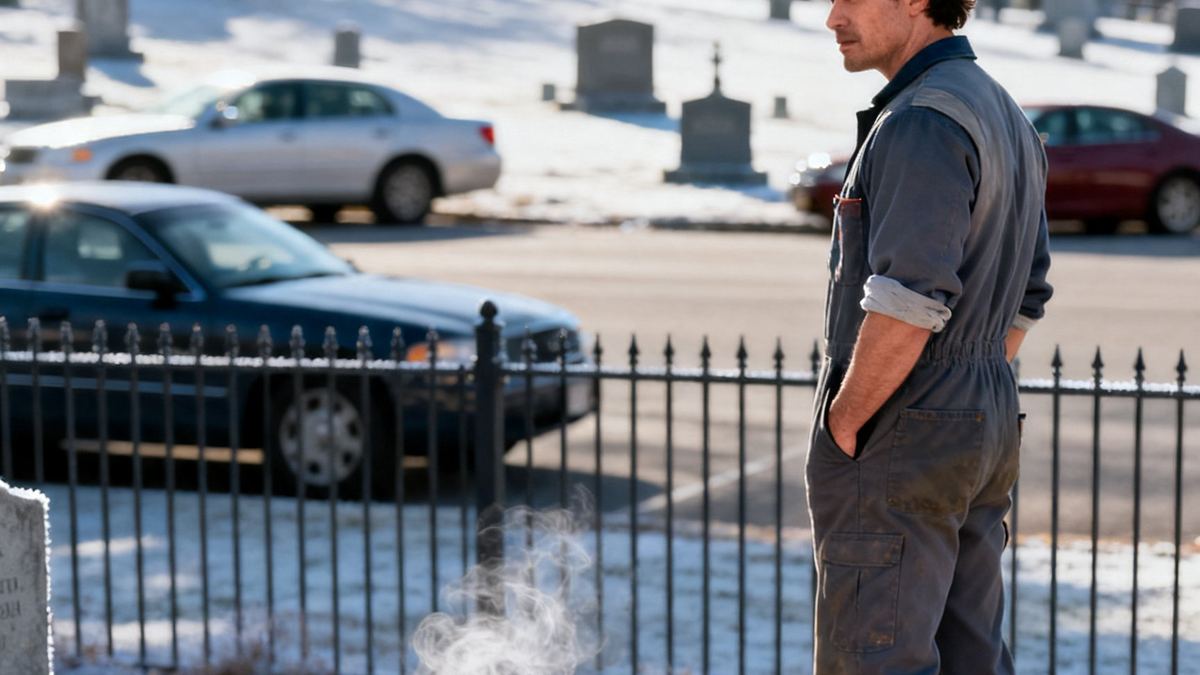
Marcus was up on the hill behind St. Anne's, past the shop's back fence, a gas station coffee cup balanced on the flat granite top of Walt's headstone, steam coming off it thin and fast in the cold. He wasn't saying anything that she could see. He stood there with his hands jammed in his coverall pockets for maybe a minute, then picked the cup back up, took it with him, and walked back down toward the shop to open the second bay.
Denise didn't slow down again. She just kept driving, watching him get smaller in the mirror, and didn't mention it to him that night, or the next, or ever.