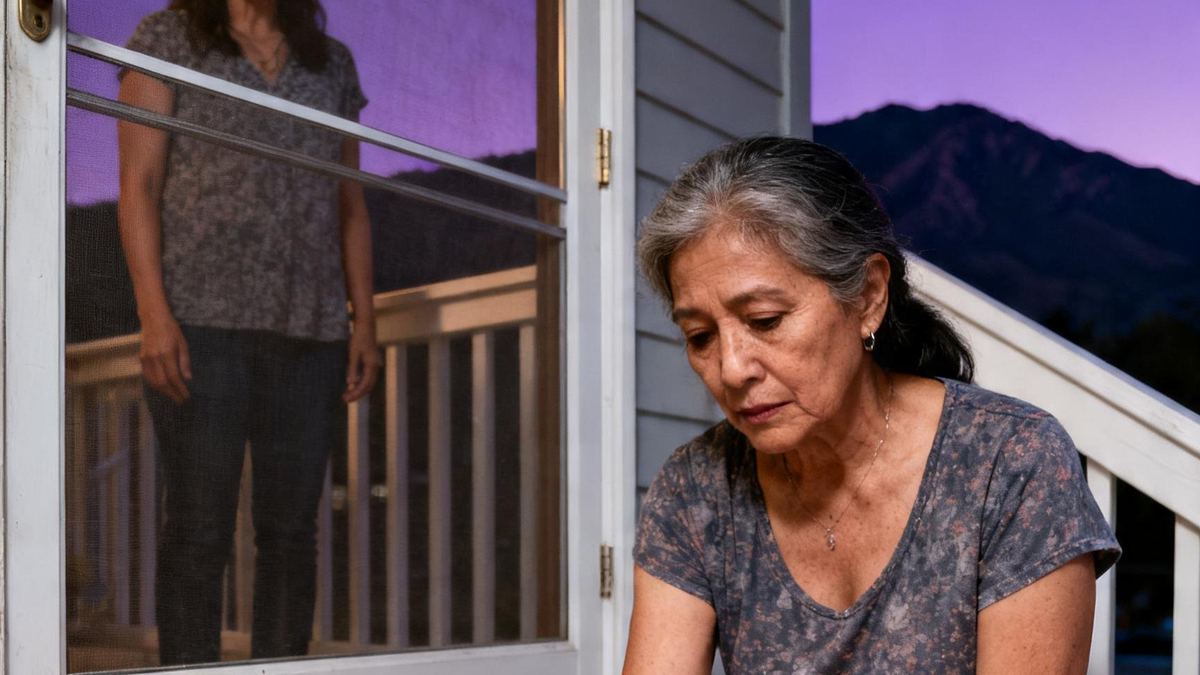
I’d just set a pecan pie on the windowsill to cool when I heard my sister’s voice drifting up from the driveway through the open kitchen window. Loretta has a way of talking that doesn’t ask for permission to be heard. Her words cut through the evening crickets as clean as a knife through that still-warm pie.
“I’m telling you, Roy, it’s the only decent thing to do. June is just one person. One person in a four-bedroom house on three acres. It’s ridiculous. We’ve got three kids and we’re piled on top of each other in that condo off Blowing Rock Road. She can move into town. Mary at church told me about a little two-bedroom apartment for rent over on King Street. A two-bedroom is plenty for her.”
My hand stopped an inch from the pie dish. The heat from the glass stung my palm, but I didn’t move it. I just stood there, frozen in my own kitchen, listening to my sister divvy up my life like it was a leftover casserole she had every right to hand off to a neighbor.
My name is June. I’m fifty-eight years old. For thirty-two years, I got up every morning and drove to the Watauga County Register of Deeds office in Boone, North Carolina, where I examined land titles until my eyes blurred and my shoulders ached. I retired last spring. My husband, Ben, a civil engineer who knew more about soil compaction than anyone I’d ever met, died of a heart attack nine years ago, leaving me this house perched on a ridge with a long view of Grandfather Mountain. We’d bought the raw land in 2001, lived in a single-wide trailer while we saved, and built this place board by board with our own hands. His hands, mostly. I was on nail-punch duty.
The house is in my name. Ben and I signed the deed together on our twenty-fifth anniversary. A joint tenancy with the right of survivorship. I know the exact phrasing because I typed it into the county system myself. When he died, the title slid to me alone, clean and silent as a whisper. There was no mortgage, no lien, no cloud. The property was as free and clear as the creek water that runs along the eastern edge of the pasture.
Loretta hadn’t spoken to me about any of this. She’d driven up from her condo in town, walked right past me with a bag of grocery-store dinner rolls, and announced she needed to “talk to Roy” on the back deck. Roy is her husband. He’s a decent man who sells farm equipment and has spent twenty years perfecting the art of saying nothing while his wife makes grand pronouncements.
I pulled the screen door open and stepped onto the back porch. They didn’t hear me. Loretta was leaning against the railing, her back to the house, her arms crossed. Roy was sitting in Ben’s old Adirondack chair, staring at a knothole in the deck boards.
“I already told Mom it makes sense,” Loretta continued. “June can’t manage this place alone. The roof needs work, the pasture fencing is sagging, and she’s going to break a hip one of these days falling off that tractor. We’d be doing her a favor.”
Roy looked up. He saw me. His face went the color of cold oatmeal, and he opened his mouth, but no sound came out. Loretta didn’t notice. She was too busy being generous with my property.
“I’ve even talked to a realtor,” she said. “Larry Hanes. He thinks if we stage it right, we could list at four hundred and eighty thousand. That gives us plenty to pay off our place and have a cushion.”
Four hundred and eighty thousand dollars. The number hung in the air like woodsmoke. I could practically see the dollar signs floating past her ears.
Roy finally managed a strangled little cough. “Loretta…”
“Don’t interrupt, Roy, I’m finally figuring this out.”
“Loretta.” My voice came out flat and calm, the same tone I used to use when a developer would stride into the office demanding I fix a surveying error that was perfectly correct.
She spun around. For a split second, her face registered genuine surprise. Then it smoothed over into the practiced warmth she uses at church potlucks.
“June! Good, you’re here. Come sit down. Roy and I were just talking about some ideas to make things easier for you.”
“I heard what you were talking about.”
She had the decency to pause. Not to feel bad, I knew, but to recalibrate.
“Well,” she said, unfolding her arms, “maybe it’s better to have it all out in the open. You know I love you, Junie. But this house… it’s too much for one person. And we’re family. Family helps family. Mama’s worried sick about you up here all alone.”
“Mama called me yesterday to ask if I’d found any morels yet this spring,” I said. “She didn’t sound sick with worry.”
Loretta’s smile tightened. “She doesn’t like to say things directly.”
“No. That seems to be a talent unique to you.”
Roy shifted in the chair. The old wood creaked. A hummingbird buzzed the feeder hanging from the eave, then zipped away. I could smell the mown grass from the lower field, the faint mineral tang of the creek. This was my land. Every square inch of it was soaked in memory and work and loss.
“Loretta, let me ask you something,” I said. “Who holds the deed to this property?”
She rolled her eyes. “You do. On paper. But Ben was my brother-in-law. This was supposed to be family land.”
“Ben was my husband.”
“And I’m your sister.”
“Yes. And a sister doesn’t get to take her sister’s house because her condo feels cramped.”
Her expression hardened. The charm sloughed off like cheap paint. “You’re being stubborn. You always have been. Even when we were little, you’d rather let a toy gather dust than share it.”
“You wanted my Chatty Cathy doll so badly you cut all its hair off with Mama’s sewing scissors,” I said. “You were six. It’s a pattern, I think.”
Her face flushed. “That was forty years ago.”
“And this is now. Same habit. Same scissors, different doll.”
I turned around and walked back into the kitchen. The pie was still cooling. I picked it up, set it on the counter, and took down a green folder from the shelf above the refrigerator. The folder had a label on the tab in my handwriting: *Deeds, Surveys, Tax Records*. I’d kept it there for nine years, untouched since Ben’s funeral.
When I came back out, Roy had stood up. Loretta was glaring at him as if this were all his fault.
“What’s that?” she asked, eyeing the folder.
“A conversation,” I said.
I sat down on the porch step, spread the folder open on my knees, and started pulling papers out one by one. I’d been a title examiner for three decades. I could reconstruct the entire chain of ownership on a piece of land back to a king’s grant if I had to. This folder was child’s play.
“Deed of trust, paid in full. Warranty deed, dated June fourteenth, two thousand and two. Right-of-survivorship affidavit, filed September eighth, two thousand fourteen, after Ben passed. Property tax receipts, current through this year. Survey plat, showing the three-point-two acres.”
I laid each document on the porch boards like I was dealing a hand of gin rummy. Loretta looked down at them, her jaw working.
“This is pointless,” she said.
“No. This is title. This is the law. This is thirty-two years of my professional life telling you, as a personal favor to my only sister, that you have exactly zero claim to anything you’re standing on.”
“I never said I had a claim. I said it would be the decent thing.”
“Decent for whom?”
She threw her hands up. “For the family! My children deserve space to grow up. You don’t even have children, June. You have an empty house and a mower that won’t start half the time.”
The words landed where she meant them to. In the hollow place that never quite healed, the one shaped like a child who never came. Ben and I tried. We tried for years. After a while, we stopped talking about it and just lived our life, the two of us, in the house we built with the view of the mountains. That hollow place was ours. Hers to weaponize.
I didn’t cry. I didn’t shout. I just reached into the folder and pulled out one last piece of paper. A yellowed letter, handwritten, in my mother’s looping cursive.
“Do you know what this is?” I asked.
Loretta squinted at it. “No.”
“It’s a letter Mama wrote me twenty-two years ago. After my third miscarriage. She said that God had a different plan for me, and that sometimes our greatest inheritance isn’t money or land, but the capacity to bear witness to the beauty of what we’ve been given. I’ve read it maybe a hundred times.”
I paused. The crickets were getting louder as the light faded. The sky behind Grandfather Mountain was turning a deep bruised purple.
“Mama also wrote something else in this letter. Something that felt strange at the time, so I stored it away. She said, ‘June, I want you to know that I’ve added a small clause to my will. It’s a curious thing, but your father’s family has a long history of property disputes, and I won’t have my daughters torn apart by them. The clause is simple: any child who attempts to seize, through legal or coercive means, the primary residence of the other child will forfeit the entirety of her own inheritance under this will.’”
The silence that followed was the loudest thing I’d ever heard on this porch. Even the crickets seemed to hold still.
Loretta’s face went through several colors. First white, then a patchy red, then a peculiar shade of gray.
“That’s not real,” she whispered.
“It’s real. Mama drafted that will with Carson & Tate, the law firm on Depot Street. I know because I notarized the codicil myself.” I looked at her evenly. “I’m not threatening you, Loretta. I’m just telling you the facts. Push this any further, and you won’t be taking my house. You’ll be losing whatever Mama leaves behind. And you know as well as I do that includes the beach cottage at Emerald Isle that you’ve been planning to inherit since you were twelve.”
Roy finally spoke. His voice was quiet. “Loretta, we need to go home.”
She didn’t argue. She didn’t apologize. She looked at the papers on the porch, at my face, and then she turned and walked down the steps toward the driveway. Roy followed, his shoulders hunched. I heard their car doors slam, the engine turn over, and the crunch of gravel as they disappeared down the long drive.
I sat on the porch step for a long time. The pie cooled completely. The sky went dark, and the stars came out one by one. I thought about Ben, about the way he used to sit in that same Adirondack chair and name the constellations. He’d point at the Big Dipper and say it looked like a soup ladle. He was brilliant about soil and stone and drainage gradients, but he never could see a bear in the stars.
The next morning, I called down to Carson & Tate and made an appointment. I drove into town, parked in front of the brick building with the crepe myrtles out front, and sat down across from Martha Carson, who’d done our estate planning for twenty years.
“I need to update my will,” I said.
“Of course. What are you thinking?”
“I want to place this house and the acreage into a conservation trust. The Watauga Riverkeeper has a program. The land stays undeveloped, in perpetuity. No one builds condos on it. No one sells it off in parcels. It stays the way it is, with a walking easement for the public along the creek.”
Martha raised her eyebrows. “That’s a significant decision, June. Do you want to think about it for a week?”
“I’ve thought about it for twenty-two years,” I said. “I just didn’t know it until last night.”
She nodded slowly and pulled out the forms.
I also added a single provision, typed cleanly into the document: any family member who contested the trust, or who attempted to challenge the disposition of the property in court, would forfeit any other bequest made to them under the will. A poison pill. Martha called it that with a small, grim smile. I called it a lesson in title.
A week later, Loretta showed up at my door. No Roy this time. No bag of dinner rolls. She stood on the porch with her hands shoved in her jacket pockets, looking smaller than I remembered.
“Can I come in?” she asked.
I stepped aside.
She walked into the kitchen and stood by the table, not sitting. Her eyes swept the room, lingering on the pie safe, the blue enamel coffee pot on the stove, Ben’s old jacket still hanging on the peg by the back door.
“I talked to Mama,” she said.
“I figured you would.”
“She told me the letter was real. The clause is real.” She swallowed. “I didn’t believe you, not really. I thought you were bluffing.”
“I don’t bluff about title,” I said. “It’s a professional failing.”
A short, unhappy laugh escaped her. “You always were the thorough one.”
“No. I was the one who read the fine print. There’s a difference.”
She was quiet for a long moment. Outside, the wisteria vine that climbs the porch trellis was dropping purple blossoms onto the railing. One of the petals had landed on Ben’s chair. It would be nine years this October.
“I was so angry,” Loretta said finally. “About the condo, about the kids, about… I don’t know. Roy’s hours got cut. The transmission went out on the minivan. Everything felt like it was caving in, and you were up here on this beautiful ridge with all this space, and I just… I wanted something to be easy. I wanted someone to just hand me something for once.”
I poured two cups of coffee from the pot. I pushed one across the table toward her.
“I understand wanting something to be easy,” I said. “But you don’t get to take from me to make your life easy. That’s not how this works. That’s not how it ever worked.”
She wrapped her hands around the mug. Her knuckles were red and chapped. It was only then that I noticed how tired she looked. The deep lines around her mouth. The gray roots showing in her hair.
“Are you really going to put the land in a trust?” she asked.
“I already did. Martha filed the paperwork yesterday morning. It’s public record now. You can look it up on the county GIS if you want.”
She nodded slowly. A tear tracked down her cheek, but she wiped it away quickly, almost angrily.
“I’m sorry,” she said.
I studied her for a moment. Then I reached into the folder, still sitting on the counter, and pulled out a single sheet of paper.
“This is the name of a loan officer at the credit union,” I said. “She specializes in first-time rural homebuyer programs. There’s a development of new-construction homes off Bamboo Road, three bedrooms, decent square footage, and they qualify for a zero-down USDA loan because it’s considered a rural zone. Roy’s income more than qualifies you. I already called and talked to her. She’s expecting your call.”
Loretta stared at the paper in my hand. She didn’t take it.
“Why would you do that?”
“Because you’re my sister,” I said. “Because I want your kids to have space to grow up. Because Ben would have wanted me to help, and I’m doing it. But I’m not doing it by handing over my home. I’m doing it by handing you the tools.”
She took the paper. Her hand was shaking.
“I don’t deserve this.”
“No,” I agreed. “Not today, you don’t. But maybe next month you will. Call her.”
She left an hour later, after we’d finished the coffee and she’d eaten a slice of the pecan pie I’d finally cut the night before. She didn’t apologize again, but she didn’t make any more demands either. She just sat at my table and ate pie and looked out the window at the mountains.
Three months later, Loretta and Roy closed on a house off Bamboo Road. It had a big backyard with an old apple tree and enough bedrooms that the kids didn’t have to share. I went to the housewarming with a gift: a green folder, just like mine, with tabs labeled *Deed*, *Insurance*, *Tax Records*. She opened it and looked at me, and for the first time in forty years, I saw my sister without the armor.
“Read the fine print,” I said.
She laughed. Not the tight, polished laugh from before. A real one.
“I will.”
That evening, I drove back up the ridge and parked the truck next to the tractor shed. The wisteria blossoms had all fallen, leaving a purple carpet on the porch. I sat in Ben’s chair and looked out at the dark spine of the mountains. The trust paperwork was filed and recorded, stamped with the county seal in black ink. The land would stay as it was, which was the only thing I’d ever wanted. Not to punish anyone. Just to keep what was mine, and to let it remain, long after I was gone, the way Ben and I had dreamed it.
The Big Dipper was out. It still looked like a soup ladle.
I went inside, took the folder off the shelf, and wrote a single line on the inside cover with the pen Ben used to keep in his work vest.
*Title is not a feeling. It’s a fact.*
I closed the folder and put it back. The house settled into its nighttime quiet. And I sat there in the kitchen, in the house on the ridge, a woman who’d held her ground with nothing but paper and patience and the long practice of knowing what belongs to whom.