The banjo started up around seven-thirty, same as it had every evening for two months. I was out on the back porch with a glass of sun tea, listening to that rolling, finger-picked melody drift across the cow pasture between our properties. Four months since Dale’s heart attack. Four months of cooking for one, washing one plate, sleeping on the right side of the bed with my arm stretched out into cold sheets where nobody breathed.
Mabel, my old calico, sat on the railing and blinked at me like she understood every thought I was too tired to say out loud. She was the only creature in this house who didn’t have an opinion on how I ought to grieve.
The music came from Walt Haskins’ place—two acres over, past the collapsed sheep shed. He played a five-string Deering with brass fingerpicks, and the sound carried clear across the evening pasture, over the queen anne’s lace and the rusted-out Ford Fairlane Dale had been meaning to restore since 1998. Walt never played fast tunes. Just slow, winding melodies that settled on my shoulders like a borrowed flannel shirt.
Widowed at sixty-one. That’s not grief—that’s the floor dropping out of a house you’d spent forty years building, one mortgage payment and packed lunch and load of laundry at a time.
I went inside, slid the deadbolt, pulled Dale’s chamois work shirt from the closet shelf and pressed my nose into it. The smell was almost gone. Cedar from the closet, mostly. And something that used to be him—motor oil and Dial soap and the particular warmth of a man who worked outside. The disappearing hit me harder than the death had.
First to show up was Phyllis from the post office, who happened to drop by with a zucchini bread and a load of unasked-for information.
“Margaret, you know Walt’s been playing every night. Just sits there on his porch, poor thing.”
“So?”
“Well, people have noticed he kind of looks this way when he plays.”
“Who’s people?”
“Just… people, Maggie.”
“People” in a town of nine hundred is a courtroom with no judge and no appeal. They decide, and you live with the verdict whether you showed up for trial or not.
I walked Phyllis to her Subaru, washed the single plate in the drying rack. The banjo had stopped. The silence that followed was worse—dense and heavy, like August air before a thunderstorm.
The next morning, I found a mason jar of wild blackberry jam on the front steps. Still warm from the water bath, lid concave, sealed proper. No note. Just the jar sitting on the welcome mat like it belonged there.
I knew where it came from. Walt kept bees on the back five acres and picked berries along the county road every July. His wife, Elaine, died six years back from ovarian cancer, and as far as I knew, he hadn’t so much as looked at another woman since.
I brought the jam inside. Had it on toast. And caught myself humming.
By Thursday, a bundle of rhubarb appeared—ruby-red stalks tied with cooking twine, propped against the screen door. Sunday brought a small brown bag of morel mushrooms, still gritty with soil, the way only someone who’d crawled through the underbrush himself would bring them.
I sautéed those morels in butter with a pinch of thyme, ate them over toast, and felt something unclench in my chest that I hadn’t known was clenched.
Then my daughter, Karen, called from Burlington.
“Mom. Phyllis mentioned Walt Haskins has been leaving things on your porch.”
“He brought some jam, honey. And a few morels.”
“Dad’s been gone four months, and you’re accepting jam from a widower?”
I stirred my coffee longer than it needed stirring. “What exactly is the crime here?”
“It’s not a crime, Mom, it’s just—people talk. You’re sixty-one years old. You really want to be the woman who—”
“The woman who what?”
“You know what.”
I didn’t know, actually. I didn’t know why I was supposed to sit in this house and let the silence press in on me until I was as dusty and still as the furniture, just so the neighbors could approve of my widowhood.
Karen’s real question sat unspoken between us: *Why can’t you just be done?*
My son, Travis, called two nights later. He lives in Montpelier, manages a brewery, and has adopted what I call his “boardroom voice” for family conversations. “Mom. People are saying things. Walt’s leaving you… preserves.”
“Preserves.” I almost laughed. “Sounds like a federal indictment.”
“It’s not funny. Dad dies, and four months later you’ve got some guy leaving jam on your porch? It looks bad.”
“Looks bad to who, Travis? The Tuesday morning coffee clutch at the general store?”
“Don’t do that. You know what I’m saying.”
I did know. He was saying that a widow was supposed to be a memorial, not a person. A plaque on a bench, not a woman who might enjoy a fresh morel or want to hear a banjo played within arm’s reach instead of from across a pasture.
Walt came to the door himself on a Saturday. Late afternoon, the light going gold through the sugar maples. He wore a pressed plaid shirt with the collar buttoned, clean jeans, his white hair combed back wet. He held his banjo case in one hand and a small potted geranium in the other—bright red, the kind they sell outside the hardware store in June.
“Margaret.” He nodded at my flower beds. “There’s a contra dance at the Grange tonight. Thought you might want to come.”
I stood there in my gardening clogs, dirt under my nails, wearing an old UVM t-shirt of Dale’s with a hole in the sleeve. This was the moment, apparently. Fate had terrible timing.
“Walt, people will…”
“People already are.” He set the geranium on the porch railing. “Been talking since the jam. Might as well give them something real to talk about.”
I should have said no. I should have done what Dale’s memory demanded, what my children expected, what the whole town’s silent jury had already decided. A proper widow. Mourning on schedule.
“Give me ten minutes,” I said.
I pulled out the blue linen dress I’d worn to Travis’s wedding four years ago. Earrings—little silver hoops Dale bought me at a craft fair in Stowe. Lipstick. I looked in the bathroom mirror and thought: *There she is. Still in there.*
We walked the half-mile to the Grange Hall, past the Congregational church and the library and the volunteer fire station. Walt carried his banjo. I carried his geranium. Mrs. Pendleton from the quilt shop stared at us from her porch swing. I waved with my free hand.
At the hall, Walt tuned up, joined three fiddlers and a bass player on the creaky wooden stage. The caller—a woman in her seventies with a braid down to her waist—started walking the group through a Virginia reel. Walt’s banjo kicked in, bright and percussive, and the whole room began to move.
We danced every set. Walt two-stepped with the enthusiasm of a man who hadn’t held a woman in six years, which meant we collided a fair amount. But he smelled like cedar soap and his hand on my back was steady, and when I stepped on his foot during a waltz, he just grinned and said, “That one’s been stepped on before.”
Travis showed up at my house Sunday morning. Didn’t call first. Walked in the kitchen door while I was watering the geranium.
“So you went dancing.”
“I did.”
“At the Grange. With Walt Haskins. While half the town watched.”
“That’s what a dance is, Travis. People watch, some of them dance. I’d be happy to teach you.”
He didn’t laugh. “This is humiliating. You’re acting like you forgot who Dad was.”
I set down the watering can. The kitchen felt very small suddenly, the afternoon light sharp through the window above the sink.
“I haven’t forgotten your father for one minute of one day for four months. But I am alive. And being alive isn’t an insult to the dead.”
He shook his head, jaw tight, and walked out. Didn’t slam the door—Travis never slams doors. He just… disappeared from the doorway, like a photograph fading.
The geranium had dropped one red petal onto the windowsill. I picked it up, set it in the potting soil. Waste not.
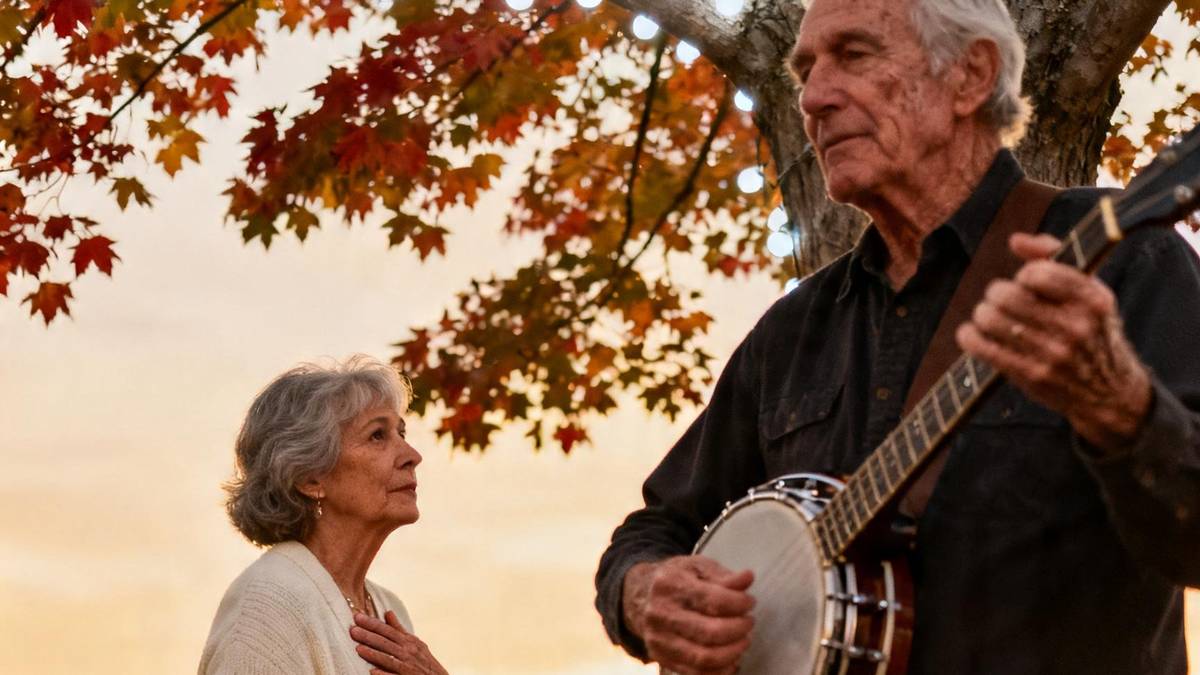
The wedding was in late September, under the big sugar maple in Walt’s front yard. Folding chairs borrowed from the Grange, white Christmas lights strung through the lower branches, a potluck table groaning with hot dishes and deviled eggs and three kinds of pie. Walt’s nephew, a justice of the peace from Rutland, did the short version of the vows. Fifteen people came. Not fifteen hundred. Fifteen.
Karen sent a card the week before. *I need time,* it said. That was all. Travis didn’t send anything.
Dale’s sister, Aunt Jo, left a voicemail I erased halfway through. The words I caught were enough: *too soon, not right, what would Dale say.*
What would Dale say? Dale would have said: *Maggie, you never could sit still.* And he’d have been right.
After the ceremony, Walt picked up his banjo and played “Shady Grove,” and the guests clapped along, and I stood there in a cream-colored cardigan and sensible flats, looking at my new husband’s hands—big, callused, a lifetime of outdoor work in every knuckle.
When the last guest left, Walt took the deed to my house—*our* house now, I suppose—out of a manila folder and set it on the kitchen table. He’d had a lawyer draw it up the week before: a transfer-on-death deed, the kind that passes property outside probate. My name stayed on it alone. His name would never appear.
“This is yours,” he said. “Always yours. I’m just renting space.”
I looked at the document, at the county seal, at the precise legal language that said, in essence: *She keeps what she built.*
Later that evening, my phone buzzed. A text from Travis.
*We need to talk about the house. I talked to a lawyer. If you remarry, the property—*
I typed back three words, then shut the phone off and walked outside to where Walt was playing his banjo on the porch. The music floated out across the pasture, same as it always had. But this time I wasn’t listening from a distance.
*It’s already done,* I’d written. And it was.