The five-string banjo started up at seven-thirty, same as every evening. I was on the back porch with a glass of sun tea, listening even though I’d never admit it to a soul. Fourth month without Howard. Fourth month of cooking for one, sleeping on my side of the bed only, and talking to the dog, Buster, like he could answer. Maybe he could — he was the only creature in the house who didn’t have an opinion about how I ought to grieve.
Through the scrub oaks and across the dried-up creek bed, Walt Jennings sat on his own porch picking out something slow and lonesome. Not bluegrass — he knew I couldn’t stand the fast stuff. This was an old Carter Family tune, the kind that rolls out over the kudzu and the power lines and settles on you like a quilt you didn’t ask for.
Widowed at sixty-one. That’s not just grief — that’s the floor dropping out of a life you spent forty-two years building, one paycheck and one mortgage payment at a time. Howard was gone, and suddenly there was nothing to hold onto.
I went inside, slid the deadbolt, pulled his old flannel shirt from the closet — the green one with the elbow worn through — and pressed it to my face. The smell was fading. That was the worst part.
First one to show up was Darlene from two doors down. She brought a squash casserole and the news.
“Maggie, Walt Jennings plays that banjo every single night. Sits out there all by himself.”
“So?”
“Word is, he’s got his eye on you.”
“Who’s saying that?”
“People, Maggie. People.”
“People” in a town of nine hundred carries more weight than a court ruling. People talk — and you’re guilty before you’ve done a thing except walk to the mailbox at the wrong hour.
I sent Darlene home and washed the casserole dish. The banjo stopped mid-tune. The silence hit me like a door slamming in an empty house.
Next morning, there was a paper sack on the front step. Morels. Pale, honeycombed, smelling of damp leaves and creek bottom, wrapped in a dishtowel to keep the sun off. No note. Didn’t need one — Walt hunted mushrooms every spring, took his old beagle and a walking stick and was back by nine.
I took them inside. Fried them in butter with an onion, tossed in three eggs. Caught myself humming. First time in four months.
That evening the banjo played again.
Three days later, a bundle of ramps appeared by the garage door, tied with kitchen twine. Then a quart of blackberries in a Mason jar. Then a single pink peony, the stem wrapped in wet paper towel, propped against the birdbath.
My daughter Kelly called from Charlotte.
“Mom. Darlene phoned. Walt’s leaving you mushrooms and flowers? Dad’s been gone four months.”
“He left some morels. I made an omelet. Is that a crime, Kelly?”
“You’re sixty-one years old. What do you need a man for? The whole town’s talking. You’re embarrassing us.”
I didn’t answer. What was I supposed to say? That loneliness isn’t a virtue — it’s a sentence, and I didn’t commit the crime?
My son Travis called two hours later. He lives in Raleigh, works in a John Deere dealership, hasn’t set foot in this house since the funeral.
“Mom, what are you doing? Dad isn’t even cold in the ground and you’re running around with the neighbor?”
“Running around? The man left mushrooms by the garage. I didn’t even see him.”
“I’m coming up there this weekend. This stops, or I’ll have a word with him myself.”
He hung up. The peony sat on the windowsill in a juice glass, pink as a sunrise, utterly indifferent to my son’s opinion.
Walt showed up Saturday morning. Not at the property line — at the front door. Clean jeans, pressed shirt, hair slicked back. Banjo in its case at his feet. The early light was behind him, and his shadow stretched all the way across my front hall.
“Maggie. There’s a contradance at the fire hall tonight. I wondered if you’d go.”
I stood there in my garden clogs, dirt under my fingernails, in a shirt with a coffee stain down the front. This is how happiness finds you — when you’re not ready, when you look a mess, when you least expect it.
“Walt, people will talk.”
He shrugged. “They’re already talking. Might as well give ’em something real to chew on.”
I should have said no. Said it was too soon, that my children wouldn’t understand. Done exactly what Kelly and Travis and every self-appointed judge in Polk County expected.
I said: “Give me ten minutes.”
I wore the yellow dress with the little white flowers, the one I bought for a church picnic three years ago and never took the tags off. Sandals instead of clogs. My mother’s turquoise earrings. I looked in the bathroom mirror and thought: I’m still here.
We walked the six blocks to the fire hall, right down Main Street. Walt carried the banjo case. People stopped on the sidewalk. Let them.
The caller was a woman from Hendersonville with a scratchy microphone and a fiddle player who’d had two beers too many. Walt tuned up and we danced every reel. The floor shook. The windows fogged up. Somewhere around the third dance — a waltz, finally — I stopped worrying about who was watching.
Travis drove up Sunday morning in his Silverado. Didn’t knock, just walked in and stood in the kitchen with his arms crossed.
“So you went out with him. The whole town saw you.”
“I did.”
“And our opinion?”
“You gave it. I heard it. I’m still going.”
He slammed his fist on the counter. The juice glass with the peony tipped over, water pooling on the Formica. The stem was bent but not broken.
“You’re making a fool of yourself,” he said, and walked out.
I straightened the peony, topped off the water, set it back on the sill. It didn’t die. It kept blooming.
We married in September, in the backyard under the sugar maple. Walt’s daughter flew in from Portland, Oregon. A few folks from town came — Darlene brought a ham, the mail carrier brought her husband, Walt’s poker buddy Ed showed up with a bottle of Maker’s Mark. Maybe thirty people. Kelly didn’t come. Travis didn’t come. I set places for them anyway, two empty chairs with two empty plates, because that’s what a mother does.
Howard’s sister Brenda left a voicemail: “It’s barely been a year, Maggie. Have some respect.”
I deleted it.
Walt played the banjo that evening, the same Carter Family tune he’d been picking since April, except now he was sitting on *my* porch, and the music drifted out over the tomato plants and the compost pile and the clothesline, and I leaned against the doorframe with a glass of sun tea and didn’t feel like I had to explain myself to anyone.
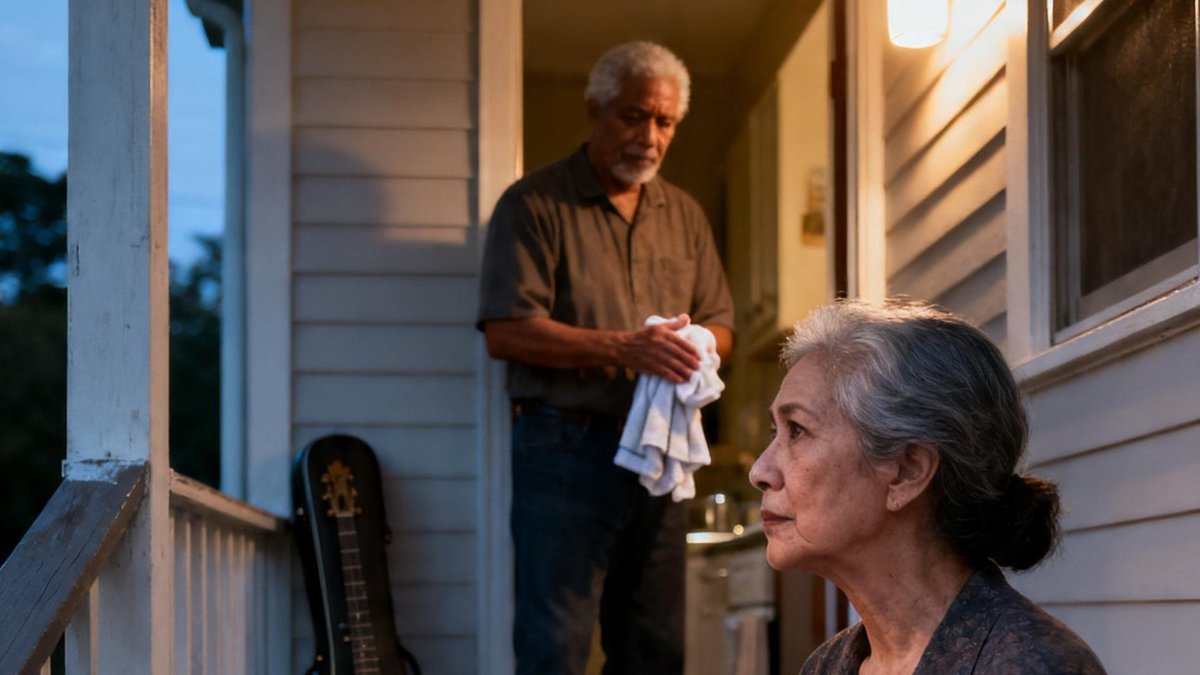
Travis showed up three weeks later, unannounced, at dusk. I was on the porch. Walt was inside, washing the supper dishes — his idea, not mine.
My son stood at the bottom of the steps. Didn’t come up. Just looked at me.
“The house,” he said. “Dad’s house. What happens to it now?”
There it was. The real question. Not morals, not grief, not what the neighbors thought. The asset.
“I’m still living in it, Travis. Same as before.”
“And if something happens to you? Does *he* get it?”
I stood up. Brushed off my jeans. Went inside, came back out with a manila folder.
“This is the deed,” I said. “It’s in my name. Has been since your father died. And I’ve already had the paperwork drawn up — when I go, the house goes to you and Kelly. Fifty-fifty. Walt knows. He helped me find the lawyer.”
Travis blinked. He hadn’t expected that. He’d come ready for a fight about a gold-digging stranger, and instead he got his mother, holding a folder, calm as a lake at dawn.
“But,” I said, “there’s one condition. It’s written in. The house can’t be sold for five years after I’m gone. If either of you wants out before then, the other gets the right of first refusal at the tax assessment value. Not a penny more.”
“Why?”
“Because two phone calls,” I said. “Two phone calls in April, both of them telling me to bury myself alive. That’s what bought the five-year clause.”
He opened his mouth. Closed it. Turned around, got in his Silverado, and drove off.
I sat back down on the porch. Walt came out, hands still damp from the dishwater, and handed me my tea. The banjo was inside, but the crickets were loud enough.
“You okay?” he asked.
“I’m okay.”
The folder sat on the wicker table between us. The tab said *Last Will & Testament — Margaret Anne Collier*. Inside, page seven, paragraph three: the five-year clause. I’d added it the week before, typed it up myself at the public library, paid a paralegal in Hendersonville eighty dollars to make it binding.
Eighty dollars. That was the price of my answer. Not a shout. Not a door slammed. Just a paragraph in a folder on a quiet evening, while the man who’d left morels by the garage dried his hands on a dishtowel and asked if I wanted more tea.