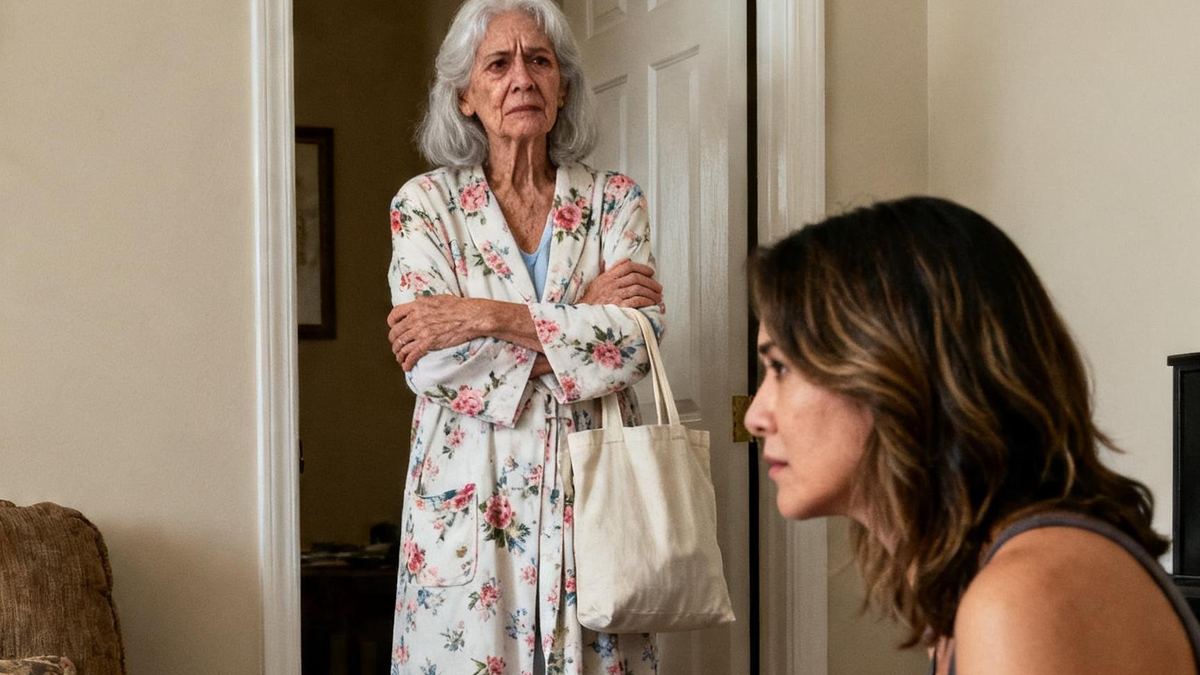
Patricia stood in my bedroom, smoothing a blouse onto a hanger as if she were decorating her own summer cabin. “Don’t be ridiculous,” she said. “I’ve been here two years.” It was mid-July, and Bozeman was baking. The window was cracked open, and the smell of hot pine needles and somebody’s charcoal grill drifted up from the courtyard on South Black Avenue. A bunch of kids were bombing the community pool down the street, shrieking every time a cannonball hit the water. Inside my eight-hundred-square-foot condo, an entirely different timer was counting down.
“You’ve been here two years,” I said, “because I allowed it. Permission is now revoked.”
She turned from the closet with a look of mild indigestion, not alarm. “You’re not an animal, Chloe. Where am I supposed to go? My hip still acts up when the barometric pressure drops. And Matt will be here on weekends anyway—you’re not strangers.”
“We are exactly strangers. The divorce was finalized on Tuesday.”
The divorce. Matt and I had walked into the Gallatin County Courthouse, signed the last sheet, and walked out into a flat white sky. No kids, no joint property worth going to court over. The condo was mine, purchased in 2012 for $198,000—a number I still have memorized because every cent of the down payment came from three years of seventy-hour weeks running logistics for a medical device company and picking up shifts at a trade-show booth. Matt had moved into a finished home with a functioning dishwasher and a woman who kept the ship steady. For a while, he admired that. Then he got used to it. Then he started treating it like a natural resource.
Patricia had arrived two years earlier, supposedly for a few weeks after hip surgery. The surgery was real. The “few weeks” were a polite fiction nobody had bothered to revise. Her own small house out in Belgrade sat empty. Her daughter Jessica had a spare room over in Four Corners, but Jessica’s husband worked unpredictable shifts and Patricia had announced that she “couldn’t handle the chaos.” So Patricia’s blood-pressure cuff colonized my bathroom counter, her medication schedule dictated my grocery runs, and her commentary on my slicing technique, my coffee brand, and my general fitness as a woman took over every dinner hour.
I didn’t explode. I watched. I listened. And I understood that my endurance had become the family operating system.
The Thursday after the divorce, I came home empty-handed. Patricia was standing in the kitchen doorway, scanning me for grocery bags. “Where’s the food?”
“At the store.”
“Excuse me?”
“I picked up dinner for myself on the way home.”
She recalibrated, the way a cat recalibrates when the furniture has been moved. “Chloe, I have dietary restrictions. I can’t just eat whatever.”
“Your son knows that.”
“Matt is working.”
“Then he can stop at the Co-op after work.”
That evening, she called Matt with a kind of urgency I hadn’t heard from her before. Fragments of the call leaked through the wall: “she’s being strange,” “didn’t buy anything,” “you need to come.” Matt showed up an hour later, his Subaru Outback still ticking from the drive, armpits damp in his wrinkle-free shirt. He found his mother perched at the kitchen table wearing the expression of a plaintiff in a small-claims drama.
I didn’t come out until I had finished the email I was drafting. I closed my laptop, walked to the kitchen, and laid a folder on the table. Not thrown, not dramatic. Just placed. “In there you’ll find the deed to the condo, purchased before marriage. A letter from the HOA confirming Patricia was never on the lease and never registered as a resident. A summary of the nine thousand four hundred dollars I spent on her medication, groceries, and co-pays over the last two years. I’m not asking for any of it back. I’m informing you that the clock stops tonight.”
Matt flipped open the folder. His jaw went hard. “You kept a ledger?”
“So you couldn’t pretend you didn’t understand.”
Patricia stretched her neck toward the papers. “Oh, so this is who you are. Counting every pill?”
“No,” I said. “I was counting what it costs when someone calls their entitlement ‘family help.’”
I gave her ten days. She turned my condo into a small, air-conditioned theater. Mornings, she sighed heavily over the espresso machine I’d bought myself for my thirty-fifth birthday. Afternoons, she called retired friends back in Belgrade and told them her ex-daughter-in-law was throwing a sick woman onto the street. Evenings, she cranked the volume on the living-room TV as if reclaiming sonic territory.
I didn’t argue. I bought my own groceries and kept them in a separate bin in the fridge. I ate dinner at my desk or at the taco place on Mendenhall. I didn’t touch her things. But every night, I checked my phone calendar and struck off one more day.
On day six, Mrs. Callahan from the unit below caught me by the mailboxes. “Chloe, honey, can I ask you something? Patricia’s been telling me you’re throwing her out with no money and a bad leg. That true?”
Mrs. Callahan is a sharp-eyed widow who volunteers at the food bank and knows the property-tax records of everyone in the building. She also hates feeling manipulated. I gave her the short version: my condo, no registration, temporary stay that metastasized, divorce finalized, ten days’ notice. Her eyebrows lifted a quarter inch. “Huh. She told me you were obligated to keep her.”
“Exactly what doesn’t add up, Mrs. Callahan.”
By evening, the courtyard grapevine had shifted. Patricia returned from a bench session with two other neighbors looking flushed, her tote bag clutched against her chest. “You humiliated me to the neighbors!”
I looked up from a project budget. “I answered a question.”
“You made me sound like a freeloader!”
“You told the whole building I was legally obligated to support you.”
“I never used that word!”
“The meaning was clear.”
She took a step into the room. “Listen carefully. I’m not going anywhere. Matt lived here, so I’ll live here. You won’t dare throw an older woman out. The neighbors won’t allow it.”
I closed the laptop very slowly. Then I stood up. “The neighbors don’t have a vote on my property deed.”
The family summit happened on a Tuesday. Matt arrived with his sister Jessica, who strode in wearing a bright blouse and a pre-assigned verdict. “Chloe, this is just not kind. Mom is stressed. She has her age.”
“Jessica, kitchen. The conversation will be short.”
I had three sheets of paper ready. One: an inventory of Patricia’s belongings—clothes, the small flat-screen she’d brought, a stack of Tupperware with lids that never matched, two suitcases of medication. Two: the final date and time for removal—Saturday, 6 p.m. Three: phone numbers for a local moving service and a home-care agency, in case the children needed logistical support.
Jessica picked up the inventory sheet. Her forehead creased. “You handled this like an office project.”
“That’s because it is one.”
“Can’t you just be human about it?”
“I was patient for two years. I’m just done.”
Matt stood by the window, hands clasped behind his back, the posture of a man who wants the problem to evaporate without him. “Chloe, Mom doesn’t want to go back to Belgrade.”
“That’s a preference, not a legal argument.”
“The house there is old.”
“It’s her house.”
“Jessica’s place is tight.”
“That’s a family matter.”
Jessica looked at her mother. “Mom, why don’t you want to stay with me, even temporarily?” Patricia’s face flickered—annoyance that her own daughter had asked a real question instead of just prosecuting the enemy. “You have children. I’d be in the way.” “I’ve got an empty room while Mike’s on overnights. You’ve said so yourself.” “Your husband has a strong personality.” “And Chloe is supposed to have zero personality?”
The room’s air pressure changed. The family front cracked. Patricia’s alliance was suddenly down to one unreliable son. Matt saw it too. “Jess, don’t start.” “No, wait,” Jessica said. “Mom lived here two years. We all got comfortable. I’m as guilty as anyone. But the divorce is final. It’s bizarre to expect your ex-sister-in-law to keep running the boardinghouse.”
Patricia went pale. “Whose side are you on?”
“The side of logic.”
Matt drove his fist against the tabletop—not hard, but enough to rattle a spoon. “Enough. Everyone’s tired.”
I turned to him. “There won’t be a war if your mother packs her things and returns the keys. You’re the one who likes quiet resolutions. This is it.”
That Saturday, the temperature hit ninety-four by ten in the morning. The sky over the Bridgers was a washed-out blue, and the air felt like cotton batting. Jessica arrived early with her husband Mike, a quiet, broad-shouldered man who surveyed the pile of half-empty boxes and said, “This isn’t fitting in one trip. Should’ve started packing a week ago.”
Patricia sat on the sofa, arms folded, watching her belongings as if someone else had ordered them evicted. Two duffel bags sat by her feet. The rest of her clothes were still hanging in the closet. Jessica stood in the bedroom doorway. “Mom, what did you do for seven days?” “I didn’t feel well.” “Too unwell to pack, but well enough to spend two hours at Mrs. Callahan’s yesterday?” Patricia’s chin came up. “Are you interrogating me now?” “No. I’m packing.” Jessica yanked the closet open and started folding sweaters into trash bags with the efficiency of a woman who had no more patience.
By noon, the place was a mess of cardboard and coat hangers. Matt showed up late, wearing the expression of someone who believed he could still rewrite the day’s outcome with sheer male presence. It didn’t work. His mother was losing territory by the minute. Mike lugged boxes to the pickup. I stood in the hallway with a notepad, checking off items so nothing of mine accidentally drove away.
At four o’clock, Patricia played her final card. “I can’t find the keys.”
I looked up. “You’ll find them.”
“Memory’s not what it was. Age.”
Jessica turned. “Mom.”
“What? I don’t remember where I put them.”
Matt rubbed the back of his neck. “Mom, don’t do this.”
“I’m telling you, I don’t remember!”
I shut the notepad, walked to the entryway, and picked up my phone. “Okay. I’ll call the Bozeman PD non-emergency line and document your refusal to return keys after your move-out deadline. While I’m at it, I’ll call a locksmith. New locks go in tonight. If the keys turn up later, they won’t fit anything.”
Patricia’s back straightened. “The police? Over keys?”
“Over your refusal to vacate my home without a performance.”
“You’re embarrassing me.”
“You chose the audience.”
I had the number half-dialed when Patricia’s hand shot into the pocket of the housecoat she’d draped over a kitchen chair. She yanked out the key ring and brandished it. “Fine. Choke on your keys!”
She made to throw them on the floor. I stepped forward and held out my palm. “Into my hand.”
“You wish.”
“Into my hand, Patricia.”
For four seconds, we just looked at each other. Then she dropped the keys into my palm like a hot stone. My hand was steady, but my pulse throbbed in my temples. I checked every one: deadbolt, knob, mailbox. I slid the electronic fob off the ring and pocketed it separately.
“Now it’s correct.”
“You’ll regret this,” she hissed.
“Maybe. But not today.”
By six, the last duffel was in the truck. Mike asked Jessica, “That everything of hers?” I walked the unit—closet empty, bathroom cleared of ointment bottles, kitchen shelf bare of her peculiar herbal tea collection. “That’s everything.”
Patricia stood in the doorway, somehow smaller without the armor of her grievances. “I thought you’d turn out to be a human being.”
I opened the door. “I turned out to be the one on the title.”
The locksmith came at seven-fifteen, a no-nonsense guy named Rick who’d rekeyed half the units in the building. He had the old cylinders out in twenty minutes, new ones in, tested each key three times. Thunder was cracking over the Tobacco Roots, and the first fat drops of a summer storm smacked the sidewalk just as he handed me the fresh set. The total came to $142. I paid him with a Zelle transfer while he packed his tools, then I stood in the front hallway, turning the new deadbolt back and forth.
After he left, I walked through the condo. In the bedroom, I ran a finger along the empty closet shelf. The bathroom smelled like nothing but soap. The entryway no longer had a cluster of bags I tripped over every morning. I opened the living-room windows wide. The storm had passed, and the air that rushed in smelled of wet sagebrush and cooling pavement. Down in the courtyard, a neighbor’s dog was barking at a puddle. I sat on the edge of the bare mattress for a minute, my hands loose in my lap, then I got up.
I blocked Matt’s number for a week. Not forever—he could still reach me by email if something genuinely legal came up. But I wasn’t taking midnight accusations on my cell. The next day, he texted from a new number: “Mom’s been crying. Happy now?” I screenshotted it and replied: “Your mother is with her own children. That’s how it should be. My condo is free of non-residents. That’s also how it should be.” One minute later: “You’ve become cruel.” I typed, “I’m not cruel. I just stopped being a doormat.” And I blocked that number too. That night I lay in bed with the ceiling fan on, unable to sleep, replaying the way Patricia’s voice had cracked. But by morning, I felt nothing but the weight of my own quiet condo.
A week later, I ran into Mrs. Callahan by the mailboxes. She tilted her head. “How are you holding up, honey?” “Good.” “Patricia called me. Said she’s not comfortable at her daughter’s.” I adjusted the strap of my shoulder bag. “She’s not in danger. She just doesn’t like the new situation.” Mrs. Callahan blinked, then let out a short laugh. “Fair enough.” “It’s true, though.”
Summer rolled on. I’d wake up on a Sunday to nobody’s cough on the other side of the wall, no talk-radio playing on a phone speaker, no grocery list left on the counter like a royal decree. I made coffee with beans from the roastery on Wallace Avenue, cut up a Palisade peach, and sat by the window with a book I’d been failing to finish for a year. Nobody called me from the other room. Nobody asked me to run to the pharmacy. Nobody informed me that a good woman was supposed to be softer.
Jessica called one evening in late August. I watched her name on the screen for three rings, then picked up. “I’m not calling to fight,” she said quickly. “Just wanted you to know Mom is with me. It’s hard, sure. But we’re managing. And I get it now. Why you did it. Late, but I get it.” I stayed quiet. “We all got used to you carrying the weight,” she said. “Matt got used to it. I got used to it. Mom sure got used to it. It was convenient. Not fair, but convenient.” “Convenience doesn’t give itself up,” I said. “I had to end it.” “No. So you ended it yourself.” There was no acid left in her voice. Just fatigue and the kind of clarity that comes after the bill is paid. I respected clarity. Even belated. “Jessica, I don’t hold a grudge against you. But that door won’t open in that direction again.” “I know.”
In September, the heat broke. The cottonwoods along the creek turned gold practically overnight, and the morning air carried a high, thin chill that tasted like the end of something. I hired a cleaning crew to deep-clean the condo, threw out the tired sofa cover, and converted what had been Patricia’s clutter zone into a small workspace for my side projects. I didn’t rearrange the furniture in any grand symbolic gesture. I just erased the last fingerprints of someone else’s occupancy and gave the place back its real job: mine.
Matt showed up in the courtyard one evening. I saw him from the window—standing next to his Subaru, holding a grocery bag like an offering, staring at the building entrance without buzzing. After a while, he dialed. I didn’t answer. He sent an email: “Can we talk? No drama.” I responded an hour later: “If it’s about paperwork, email me. If it’s about your mother, work it out with Jessica. If it’s about us—there is no us.” He didn’t write back. That was the best possible reply.
The night after I changed the locks, I cooked a proper dinner—roasted vegetables, a piece of salmon, a glass of wine that nobody else commented on. Eating alone at my own table, I heard a key turn in the lock of the unit next door, and then the muffled sound of a neighbor’s music. That was it. Just the ordinary hum of a building where every door opened for the person who had the right to open it. I locked my door, poured another inch of wine, and sat down at the table by the window.