The cat was at his spot before I was at the bus stop, same as every morning. Seven twenty-five on the nose. The gray one with the torn ear had a way of keeping time without a watch. He sat by the corner of the building, where the downspout angles past a flowerbed that's been dead since November, and he watched the entrance door with that patient look cats get when they're owed something.
I got all the way to the bus stop before it hit me: the bowl wasn't there.
That's the thing, right? You go eleven years without noticing something, and then one morning the absence of it tracks you down at the corner of Farwell and Brady and won't leave.
I've lived in this building eleven years now. Five-story brick walk-up on the East Side of Milwaukee. Maple trees out front that the city keeps threatening to trim. Two swings in the courtyard that the landlord promised to repaint back when Obama was in office. A building where everybody knows each other's faces but not their stories. You nod in the stairwell. You hold the door. You go on with your day.
The gray cat showed up in spring, scrawny and jumpy, hiding under parked cars and bolting from under the wheels so fast drivers would slam on the brakes. I remember thinking: that cat's a goner.
Then around June I came out at seven-thirty and saw Ray down on his haunches by the corner, setting out two bowls — one water, one dry food. The cat was already there, rubbing against his knee, trying to knock the bowl over before it touched the ground.
"Hold your horses," Ray said. "Lemme put it down right." He nudged the cat back with one hand, leveled the bowl with the other.
I walked past without saying anything — didn't want to interrupt. But the whole day it kept replaying in my head.
Ray from the first floor. Forty-five, tall, skinny, always in the same brown Carhartt jacket. Lives alone. I knew exactly as much about him as you know about a person you've said "morning" to in the entryway for eleven years.
After that day I started noticing it was every single morning. Seven twenty-five. The cat would already be posted up. If Ray was two minutes late, the cat would pace along the wall and yowl — short, demanding, like knocking on a neighbor's door when you know they're home.
By fall Ray had slid an old piece of plywood under the bowls so they wouldn't sit in the mud. In winter he started bringing warm water down in a thermos, pouring it out fresh because the overnight water would freeze solid. One morning I watched him chipping ice out of the dish with a butter knife, muttering under his breath about needing a better system.
He called the cat Boss.
"Well, Boss, morning to you too. Sorry it's chicken again. It was on sale."
The cat listened. I swear that cat actually listened.
I didn't say anything to Ray until November. We were both waiting at the bus stop on Farwell, and I don't know why I opened my mouth, but I heard myself asking, "So how long have you had him?"
Ray didn't get it at first. "Had who?"
"The cat."
"Oh. He's not mine."
"What do you mean?"
"He's not anybody's. He's his own cat. I just walk past."
"Uh-huh," I said. "You walk past every morning at seven twenty-five."
He made a face like I'd caught him at something embarrassing and looked off toward the newspaper stand by the gas station.
"It takes two minutes," he said after a second. "What's two minutes?"
Then he started talking about how the 30 bus was running behind schedule again. I felt like I'd caught him doing something almost shameful. Which is ridiculous. Feeding a stray cat isn't a crime.
Shirley Kowalski filled in the rest. She lives on the second floor and I ran into her in line at the post office on Oakland. We got to talking, the way you do when you're both waiting on a slow clerk and someone's Christmas wreath is still hanging on their door in the middle of February.
"Claire, are you only just now seeing this?" She pushed her glasses up onto her forehead. "That man replaced my kitchen faucet last year. I'd called a plumber, he came out, sucked his teeth, said I needed all new supply lines — four hundred and eighty dollars plus parts. I didn't sleep for a week. I'm on Social Security and I'm still paying off my washing machine on a store card."
"And?"
"I complained about it in the stairwell. Just to nobody. Two days later Ray knocks on my door, takes a look, runs to Home Depot, and does the whole job in an hour and a half. Wouldn't take a cent. I told him, Ray, at least let me pay for the parts. He says, 'Shirley, what am I, a licensed contractor?'"
She kept going. I stood there and sorted through eleven years in my head. Ray changed a stuck mailbox lock for old Mrs. Lindquist on the fourth floor. He picks up prescriptions at Walgreens every Wednesday for the woman who can't get out much — the one whose granddaughter only visits once a month. He put up a shelf at the daycare across the street where his old classmate's grandson goes. He hauled somebody's drywall scraps out of the stairwell after a renovation crew left them there and took off.
And I never once heard him mention any of it.
Then Shirley said the thing that made my coffee go cold in my hand.
"It didn't start with him, you know. It was his mother, Marian. She fed those cats for twenty years. Same corner. She had this green bowl with a chip in the rim — the whole building knew that bowl. Some people grumbled about her feeding strays. She never paid them any mind."
"And Ray?"
"He moved in here when she couldn't manage on her own. Gave up his studio apartment over in West Allis. He was here for three years before she passed. That was two winters ago. January."
Shirley shifted the package under her arm.
"He started coming out with the cat food the week after the funeral."
So that's how it went. Marian fed strays at that corner for twenty years. When she died, Ray just kept doing it. Like picking up a fallen scarf and putting it back on the hook.
February hit with an ice storm that turned the whole sidewalk into a skating rink. The city never got around to salting our block. And one morning the Boss sat at his spot and Ray didn't come.
Day one, I figured he'd overslept. It happens.
Day two, the cat wasn't sitting still anymore. He paced back and forth along the wall, stopping to watch the entrance, then pacing again. He didn't yowl. He just kept walking. I stood in my window with a mug of coffee and watched him for ten minutes.
Then I put on my coat, walked to the gas station on the corner, and bought a bag of the cheapest dry food they had. I didn't know what brand Ray bought. I couldn't bring myself to touch the old green bowl — it sat there by the wall, and something told me it wasn't mine to move. So I poured the food onto a piece of cardboard I tore off a box in the recycling bin and set it next to the bowl.
The cat wouldn't come near me. He watched from under a Honda with a dented bumper until I backed off twenty paces.
Day three, he came closer.
And I caught myself standing there waiting for him to eat. Wanting him to recognize me. To react. To show some kind of gratitude.
Ray never waited for that. Ray never once looked around to see if anyone was watching.
That was the part that got me. Two years Ray had been doing it. Before him, Marian had done it for twenty.
And I'd walked past every single time.
It turned out Ray had fallen. He slipped on black ice by the garages behind the building, came down on his knee, and the joint locked up so bad he couldn't get his shoe on for the first two days. Shirley told me this because Ray called her — once, in all the years she'd known him — and asked if she'd buy a loaf of bread.
Just bread.
He didn't say one word about the cat.
He came out on the fourth day, leaning on an old wooden cane that must have been his mother's. And he stopped.
Because by the corner of the building, there were three bowls.
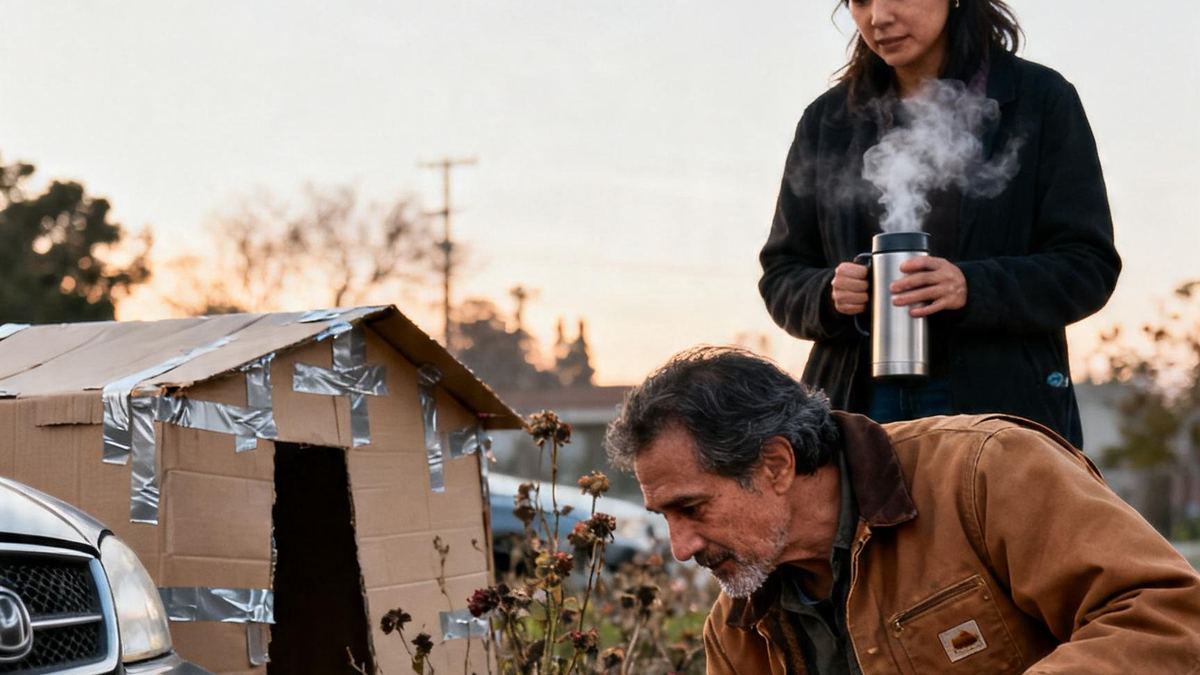
The green one with the chipped rim. A white plastic takeout container, which was mine. A stainless steel one, who knew whose. And next to them, a cardboard box wrapped in duct tape, lined inside with an old flannel shirt.
The box was Milo's, from the third floor. He's twelve and he'd spent two evenings fighting with the tape until his dad had to step in and show him how to brace the corners.
Ray stood there for a long while, looking at that setup. Then he turned toward the windows.
"Who did this?" he asked when I came out of the entryway.
"The building," I said.
He didn't answer. He stood a minute, shifted his weight off the bad knee, and eased himself down — it had to hurt, you could see it in the way he gripped the cane — and he moved the green bowl back to its exact spot, millimeter by millimeter.
"Just give him fresh water," he said at last. "Not from the gutter."
That was it. We never talked about it again.
Last Wednesday I came down with a thermos of warm water. It was barely light, the kind of gray Milwaukee morning where the Lake Michigan wind cuts through your coat and the salt trucks haven't been by yet. Ray was already there, setting the green bowl just so.
He looked at the thermos. Then he looked at me.
"Good," he said. "I was running low."
The Boss brushed against my leg. I stepped back without thinking — eleven years of that cat bolting from people, and now he walks up to me like I owe him rent.
Ray's mouth twitched at the corner. "He's getting spoiled. Three bowls. A heated… well, not heated. But the flannel helps."
The 30 bus went by without me. I didn't even check the time.
Two minutes. That's all. What's two minutes?