The dog showed up on a Tuesday, the same day Doris always watered the marigolds.
She had the hose coiled in a figure-eight by the back steps, the cold well water sputtering before it found its rhythm. The marigolds along the fence were drooping in the late August heat, and she was bent over, thumb pressed into the nozzle, when she noticed a shape beyond the gate. A dog. Rust-colored, broad-shouldered, with a muzzle gone almost white. Sitting on the gravel shoulder like it had been waiting for the number seven bus.
Doris straightened up. “You’ve got the address wrong,” she called out. “Nobody here but me.”
The dog’s tail gave one thump against the dirt. It didn’t whine. It didn’t come closer. It just blinked.
She finished watering, coiled the hose back into its figure-eight, and went inside. Through the screen door she saw the dog lie down, paws crossed, chin on the gravel. The chain-link gate was latched, but the dog acted like the space on this side of it already belonged to her.
She didn’t come out again until after lunch.
—
The next morning, the dog was still there.
Doris had to get the mail. She pulled on her straw hat and walked down the gravel drive, and the dog rose and limped after her, keeping pace along the fence line. The back left leg dragged just a touch with every step, a hitch in the rhythm. At the mailbox, a faded blue metal box with a dent from the time the snowplow clipped it, she paused. The dog stopped too, panting.
The mail carrier’s truck was already a quarter-mile down the road, its dust plume settling into the corn. Inside the box was a stack of coupons, a Social Security statement, and a flyer from the Super Saver: pork chops at $2.99 a pound.
She looked at the dog. The dog looked at the road.
“You’re persistent, I’ll give you that.”
Back at the house, she found a yellow plastic bowl in the garage, left over from a cookout fifteen years ago. She filled it with water and set it outside the gate. The dog drank, then lay down again.
That night, Doris opened a can of beef stew for her own supper. She spooned a third of it onto a paper plate and placed it next to the water bowl. The dog ate with a care that said it hadn’t eaten well in a while. Then it crossed its paws on the gravel and watched the house, and Doris watched it from the kitchen window until the light failed.
—
Friday was when Kevin, the mail carrier, brought a package that needed a signature. He was a square man in his late twenties, with a USPS polo shirt stretched tight. He hopped out of the truck and pointed at the dog.
“Hey, that’s Buster,” he said.
Doris was signing the digital pad. “Who?”
“Your neighbor’s dog. Harold Jenkins, over on Walnut. Two streets down. You know Harold.”
Doris handed the pad back. She did know Harold. A retired middle-school science teacher with an Iowa State ball cap and a wave every morning. Every morning for nine years, she had waved back from her garden. Never once had she walked over to talk.
“What happened to him?”
Kevin’s face went careful. “He passed, ma’am. About ten days ago. Pancreatic cancer. His daughter came from Des Moines, packed up the house in a weekend, and left. I guess Buster here… got overlooked.”
He left the package—a new garden hose nozzle she’d ordered—and rumbled off. Doris stood with the cardboard box in her hands, the August sun hot on the part in her hair, and the dog—Buster—watched her from the gate.
—
That afternoon, she walked over to Walnut Street.
The Jenkins house was a white bungalow with green trim, set behind a picket fence. The gate was unlatched. A wind chime made of bent spoons and forks, the kind Harold probably made himself, hung silent in the dead air. On the porch post, hooked over a rusty nail, was a faded John Deere cap. The brim was sweat-stained white along the edge, frayed where fingers had tugged it a thousand times.
Doris reached out and touched the cap. The fabric was stiff with sun and salt.
She stood on his porch for a long minute, a woman she once was standing next to her, a woman who had spent three years answering “good morning” to the dirt instead of the man saying it.
—
Back home, she went to the pantry. Behind the canning jars and the old pressure cooker, on the bottom shelf, sat a blue enamel bowl with a white speckle. It had a dent on one side and a chip in the rim. Three years ago, she had held that bowl in both hands while her husband, Leo, spooned oatmeal from it. He’d been too weak to lift a mug. She’d fed him one mouthful at a time, talking about the black-eyed Susans, the weather, anything to keep his eyes open a little longer.
She hadn’t touched the bowl since the funeral.
Doris filled it with cool water from the tap. She carried it to the back door, unlatched the screen, and set it on the floor just inside the kitchen. Then she walked down the steps, unhooked the gate, and looked at the dog.
“Come on, Buster.”
The dog limped up the path, through the open door, and stopped at the blue bowl. She drank.
That evening, Doris moved the bowl to a spot by the refrigerator, next to the baseboard. She laid down an old quilt, one Leo’s mother had pieced from flour sacks. The dog circled three times, a habit of old bones, and settled onto the squares of faded calico with a sigh.
—
On Saturday, a gray Honda CR-V pulled into the drive. The woman who got out was in her forties, sharp-jawed, with sunglasses pushed into her hair. She carried a brand-new leash—bright orange, stiff, the price tag still dangling from the clasp.
“Mrs. Ackerman? I’m Patty, Harold’s daughter. I think you have my dad’s dog.”
Doris stood on the back steps, a dish towel in her hands. “She’s here.”
Patty glanced toward the house, where the dog lay in a square of morning light on the kitchen floor. “I heard from the mail carrier. I’m so sorry about this. I meant to take her with me, but with everything… I’ve got a studio apartment in Des Moines, no pets allowed. I found a no-kill shelter in Waterloo that said they’d take her. I just need to bring her in.”
Doris folded the towel once, twice. “She’s ten or eleven years old. Maybe twelve. A shelter won’t keep her long before they call her unadoptable.”
“They said they’d try—”
“I lost Leo three years ago,” Doris said, and her voice didn’t shake. “I know what it looks like when someone gets set aside because they’re inconvenient.”
Patty’s fingers tightened on the leash. She looked at the dog, then at the blue enamel bowl on the kitchen floor. The dog hadn’t moved. Her tail beat once against the quilt, a slow rhythm.
“Dad talked about you,” Patty said. “He said you were the only one on this road who never pretended you didn’t see him.”
Doris swallowed something thick. She thought of the cap on the nail, the spoons hanging in the still air. “She stays here,” she said. “You don’t need the leash.”
Patty stood still for a beat. Then she unclipped the price tag, wadded it into her pocket, and held the leash out. Doris didn’t take it. After a moment, Patty slid it back into her purse.
“Thank you, Mrs. Ackerman.”
The Honda backed out of the drive and turned toward the highway. Gravel crunched. Dust rose and thinned. The dog lifted her head, watched the window for a moment, then lowered it back onto the flour-sack quilt.
—
That night, Doris filled the blue bowl with fresh water and placed it beside her own bed. The dog limped in, nails clicking on the pine floor, and curled up on the quilt in the corner. Doris slid under the covers and listened to the breathing, a steady rasp that wasn’t a machine, wasn’t a memory.
For three years, she had woken to a house that answered her in silence. She had said “good morning” to the coffee pot, to the garden hose, to the patch of kitchen floor where Leo’s slippers used to sit.
Now there was a dog.
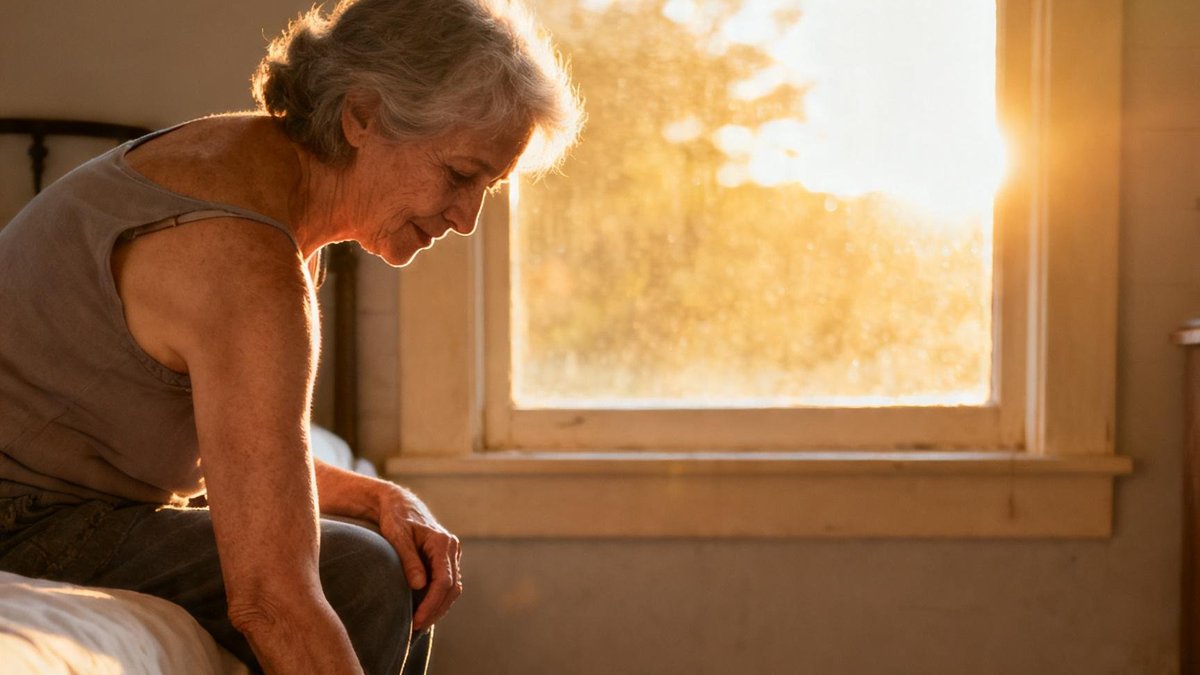
The sunrise came through the east windows, warm and gold, and the dog stretched her back leg with a grunt. Doris sat up and set her feet on the floor. The blue bowl glinted in the light.
“Good morning, Buster,” she said. The tail thumped the quilt.
And for the first time in eleven hundred days, someone in the house heard her.