The clock in Sam Carver’s kitchen ticked like a metronome left on after the music stopped. It was an old wind-up model his ex-wife had dragged home from a flea market in Columbus, Georgia, and it had one job: fill the silence of a house where only one person now lived. Three years of Saturdays spent in the garage, a carburetor rebuild here, a chisel sharpening there—anything to keep his hands busy and his ears full of something other than that ticking.
The garage smelled of gear oil and hot metal, the radio tuned to a classic rock station out of Atlanta that crackled every time a train rolled by on the tracks behind the backyard. Sam was leaning over the workbench, a half-disassembled Holley carburetor on a grease-stained towel, when the hum of flies began to bleed through the open bay door. Not the lazy buzz of a couple of houseflies, but a dense, frantic vibration, like a frayed electrical wire spitting current. It came from the vacant lot beyond his fence, a patch of kudzu and red clay where a utility pole had stood since the Eisenhower administration.
He put down the screwdriver, wiped his hands on a rag that reeked of gasoline, and walked out. The July heat was a wet blanket, heavy with the smell of pine sap and the faint rotten-egg whiff of the paper mill eight miles down the road. He pushed through the weeds, swatting horseflies that bit at the back of his neck. And then he heard it—a low, mechanical rasp underneath the buzzing, a sound like something trying to breathe through a crushed straw.
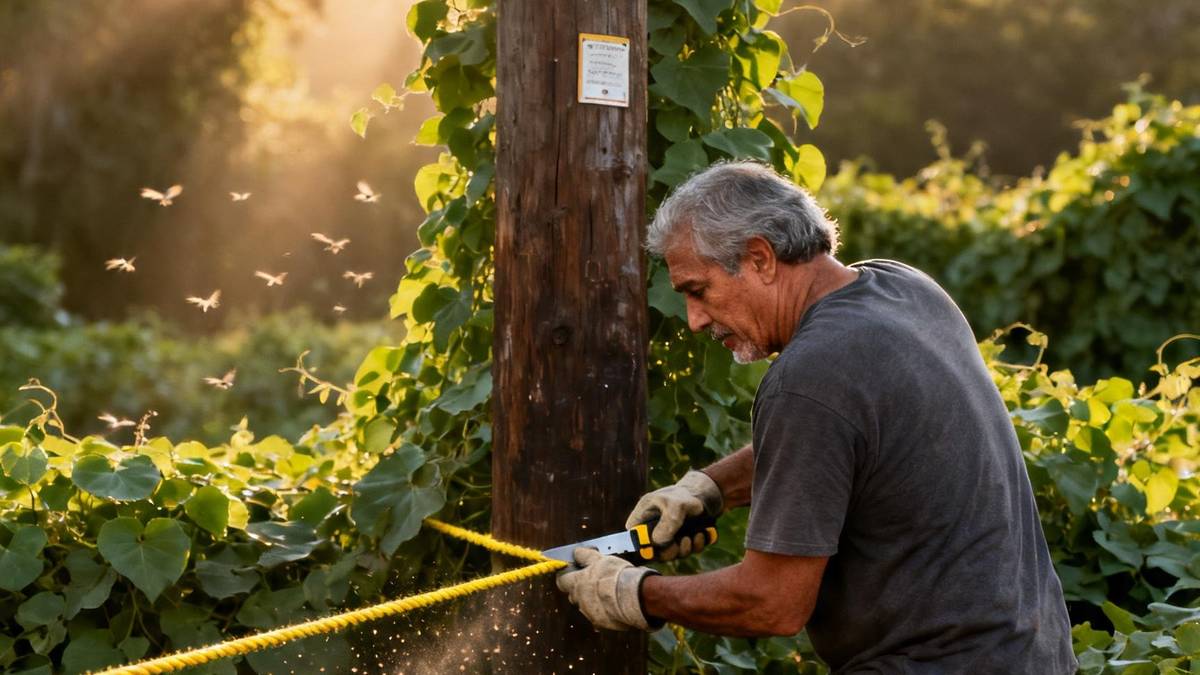
She was lying in a hollowed-out circle of dirt at the base of the pole. A brindle pit bull mix, so thin that every rib pushed up against her hide like knuckles beneath a sheet. A yellow nylon tow rope, the kind sold at any Home Depot, was double-knotted around her neck and hitched to the pole. The rope had sawed into the skin, and the wound was alive with black clusters of flies. Her front paws were stretched out, back legs tucked, and the dirt around her traced the exact radius of that rope—a pacing track she’d worn into the ground until she couldn’t pace anymore.
Sam crouched. The dog’s eyes, cloudy with exhaustion, rolled up to meet his. Her tail gave two weak thumps against the dirt, raising a puff of dust, and that movement—that ridiculous, hopeful thump—hit him harder than the smell or the flies or the rope. He noticed the collar half-hidden under the rope: frayed red nylon with a brass tag, the engraving worn almost smooth. Home. This was somebody’s dog.
He went back to the garage for a utility knife, a beach towel, and a half-full bottle of water from the mini-fridge. The knife blade was dull from cutting gasket material, and the nylon rope fought back, its fibers springy and synthetic, the knot tightening with every motion. The dog whimpered, a high, thin sound, and Sam stopped to wet her gums with a dribble of water. Her tongue, dry as sandpaper, flicked out and caught his wrist. He kept cutting, jaw clenched, until the rope fell into the dirt.
The Pine Ridge Animal Clinic was a converted gas station on County Road 12, with a neon sign where the “R” in “VETERINARY” flickered even in broad daylight. Sam carried the dog inside wrapped in the towel, and a vet tech with a hummingbird tattoo on her forearm led him to an exam room that smelled of antiseptic and wet fur. Dr. Elaine Parrish, a woman whose hands never stopped moving, clipped away matted fur and flushed the wound with a syringe. “She’s been out there at least a week,” she said, not looking up. “Dehydrated, malnourished, infected. She’s lucky you found her.” A microchip scan pulled up a name: Daisy. Registered two years ago. Owner: Tyler Jacobs, twenty-four, last address in Columbus.
Sam stood in the parking lot, the sun glinting off the hood of his Silverado, and dialed the number on the printout.
A man answered after five rings, voice thick with sleep. “Yeah?”
“Tyler Jacobs?”
“Who’s asking?”
“Sam Carver. I found your dog. Daisy. She was tied to a utility pole in a lot off Mill Creek Road, near dead.”
A pause. In the background, a television game-show audience applauded. Tyler said, “Oh. Yeah, man, look—I moved into a new place in Phenix City. No pits allowed. I didn’t want her to run out in traffic, you know? So I tied her up. Figured somebody’d spot her, she’s a friendly dog.”
Sam studied the printout. The dog had been out there without water, without shade, with a knot so tight it would scar. “You tied her in a lot where nobody goes,” he said.
“I was doing her a favor, man. I made sure she’d stay put so someone could find her. She’s better off with somebody else anyway.” The man’s tone was casual, as if he were explaining why he’d left a couch on the curb.
Sam ended the call. He crumpled the paper and dropped it in the oil-stained trash can outside the clinic door.
At home, he made a bed from an old quilt in the mudroom and set a bowl of water next to it. Daisy wasn’t strong enough to walk on her own, so he carried her inside, her bandaged neck resting against his shoulder. She sighed, a deep, full-body exhale, and licked his earlobe.
The rope from the lot was still in the pocket of his cargo shorts, coiled and stiff with dried filth. Sam took it to the backyard, to the rusted fire pit he hadn’t used since the last cookout before his son stopped coming on weekends. A faded, cracked Frisbee lay half-buried in the weeds near the fence, a relic of that same lost life. He dropped the rope into the pit, struck a match, and watched it catch. The nylon sizzled and shrank, melting into black tar that dripped through the grate. Smoke curled up past the power lines, acrid and thin. He stood there until the flame died, until what was left was just a greasy smudge on the metal.
When he turned around, Daisy was in the mudroom doorway, the white bandage bright against her brindle coat. She limped forward, sniffed the air, and lowered her head to the bowl. The sound of her drinking—steady, messy, unapologetic—cut through the evening stillness. Sam grabbed a glass of sweet tea from the kitchen, walked back out, and sat on the back steps. The neighbor’s wind chimes clinked in a breeze that smelled of honeysuckle. A train whistle blew somewhere down the line, two long, one short.
He picked up the Frisbee, wiped the dirt off on his jeans, and set it on the step beside him. The clock in the kitchen kept ticking, but Sam didn’t hear it. Daisy finished drinking, lay down at his feet, and rested her chin on his boot.