I lost Sophie three months before graduation. A rain-slicked curve on I-26, a semi that crossed the yellow line, and the life I’d built on her smile just… ended. She was seventeen. She had already mapped out the next ten years: UNC Chapel Hill, med school, a clinic somewhere in the mountains where she could treat kids who couldn’t afford care. That was Sophie. Always handing out slices of herself before anyone asked.
The morning her classmates would walk across the stage at Thomas Wolfe Auditorium, I was still sleeping in my clothes. I hadn’t opened her bedroom door in weeks. But two days earlier, I forced myself to turn the handle. The prom dress hung in the closet, still in the garment bag from Belk, tags on. Silver-blue, with a beaded neckline she’d picked out online and made me drive all the way to Greenville to try on. She spun in the store mirror and said, “If I don’t get into Chapel Hill, at least I’ll look like I run the place.”
I didn’t want the dress to die in the dark with everything else.
So I called the school. The guidance counselor connected me with a girl named Rosa, a senior whose single dad had just lost his job at the paper mill. No prom dress, no ticket, no car. I handed the garment bag to Rosa in the parking lot of a Food Lion, and she cried into my shoulder. I didn’t cry. I was hollowed out. I went home and scrubbed the kitchen tile with a toothbrush just to feel something press back against my hands.
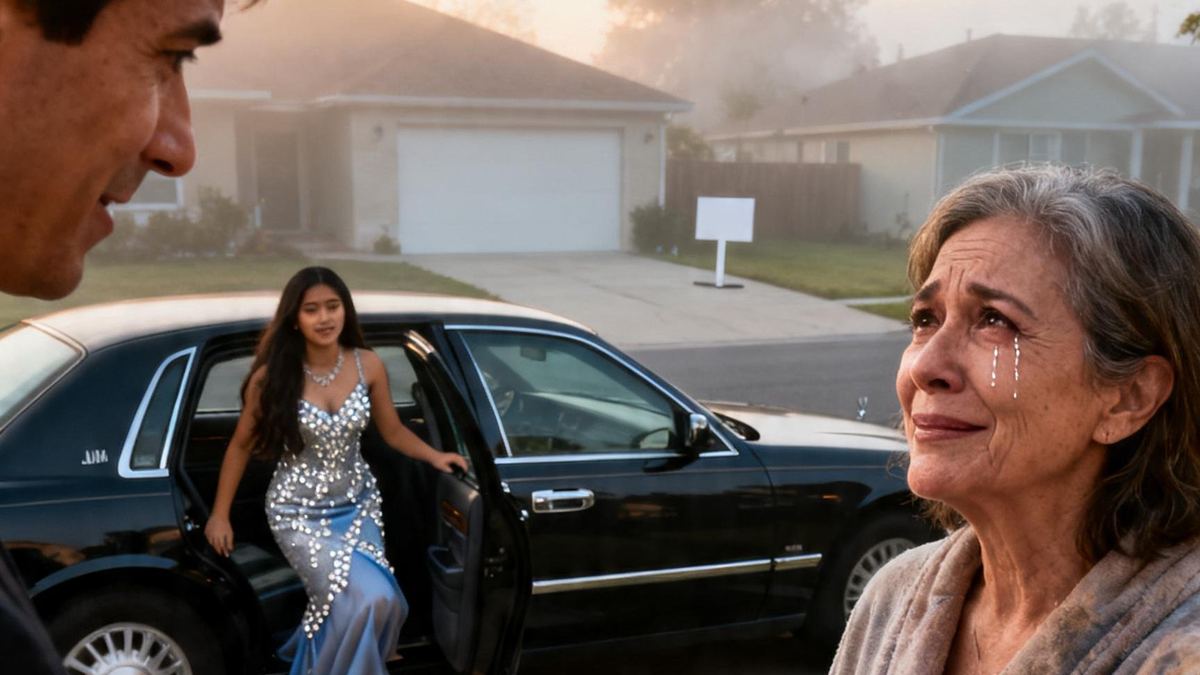
At six-thirty on graduation morning, a horn blasted outside the house. I stood up from the kitchen table, coffee mug still in my hand, and looked through the window over the sink. A black Lincoln Town Car sat idling at the curb, exhaust puffing into the cool air. The neighbor’s golden retriever, Beau, started barking from his porch. The driver got out, walked around, and opened the rear passenger door like something out of a movie.
I stepped onto the front stoop. The air smelled like wet magnolias and Folgers from the apartment upstairs. The driver didn’t say a word—just gestured toward the open door.
I bent down and looked inside.
Rosa. In the silver-blue dress. The beads caught the early light, glittering across her collarbone the same way they had on Sophie in the store. She’d had the hem taken up just a little, the straps shortened. It fit her like it had been waiting.
The mug slipped out of my hand and shattered on the concrete. I didn’t pick it up.
“Mrs. Calloway,” Rosa said, her voice already cracking, “I had to show you.”
I couldn’t get my mouth to work. I just stood there, one hand braced against the car, looking at a girl who should have been Sophie.
She climbed out and pressed a small manila envelope into my palm. The paper was soft, like it had been carried around for a while.
“My aunt’s a seamstress,” Rosa said. “When she let the hem down, she found this inside the lining. Near the hip. It’s… it’s her handwriting, I think.”
I opened the envelope. A single sheet of notebook paper, folded into a sharp square. The ink was purple—Sophie only wrote in purple. She said black was for bureaucrats and doctors’ charts.
*If you’re reading this, I guess things didn’t go the way I planned. But you got the dress, and that means you’re going to prom, and that’s what matters. Put on some obnoxious lipstick and eat the bad cake they always serve. Also—don’t let anyone tell you that where you start is where you end. I was gonna write something about working hard, but really, just be the person who shows up. For yourself. For the people next to you. Do that, and you’re already ahead of half the world. P.S. If my mom ever sees this, tell her the midnight-blue nail polish was totally worth the grounding.*
My lungs hitched. I read the last line three times, my thumb brushing over the word *mom* like I could feel her through the ink.
Rosa took my wrist. Not my hand—my wrist, the way Sophie used to when she wanted my full attention. “I got accepted into the nursing program at Appalachian State,” she said. “Full ride. I found out yesterday. I wore the dress around the house and then I got the call, and I know that sounds superstitious, but… I think she would’ve laughed.”
A noise came out of me that wasn’t a laugh or a sob. Somewhere in between. The dog barked again. Two houses down, Mr. Jimenez was watering his azaleas, pretending he wasn’t watching.
“She would’ve said you did it yourself,” I told Rosa. “The dress doesn’t get credit for your grades.”
The corner of Rosa’s mouth lifted. “No. But you gave it to me. You didn’t have to.”
The driver cleared his throat. Ceremony was at nine. Rosa had to be there early for the class photo.
She gave me back the envelope, but I shook my head. “Keep it. You’re the one who found it. Take it to chapel or whatever you do up there in Boone.”
She ducked back into the limo. The door closed, and through the tinted window I could see her smoothing the skirt, then pressing the envelope flat against her knee. The Town Car rolled away, and Beau stopped barking.
I stood on the stoop in my bare feet, surrounded by shards of ceramic, and watched the car disappear around the corner. The sun hit the roof of Sophie’s bedroom window and lit it up gold.
After a long moment, I went inside. I opened her door and sat on the edge of her bed, not to pack, not to cry, just to be there. The room smelled faintly of lavender and old paperback books. Morning light moved across the quilt, slow and warm. The silence wasn’t crushing anymore—it had loosened into something I could breathe inside.
Somewhere outside, a single shard of that coffee mug caught the light near the porch step. I didn’t get up to move it.