That much was obvious from the moment she sat down on the marble floor — small, dirty, out of place in a lobby built to make people like her disappear. Golden sconces bathed the walls in warm light. The chandelier overhead scattered diamonds across the polished floor, across the expensive shoes of people who never looked down. The staff stood like sentinels near the entrance, trained for exactly this kind of situation. Trained to remove whatever made the wealthy uncomfortable.
So when the girl grabbed the designer handbag, no one stopped to wonder why.
They only saw what they wanted to see.
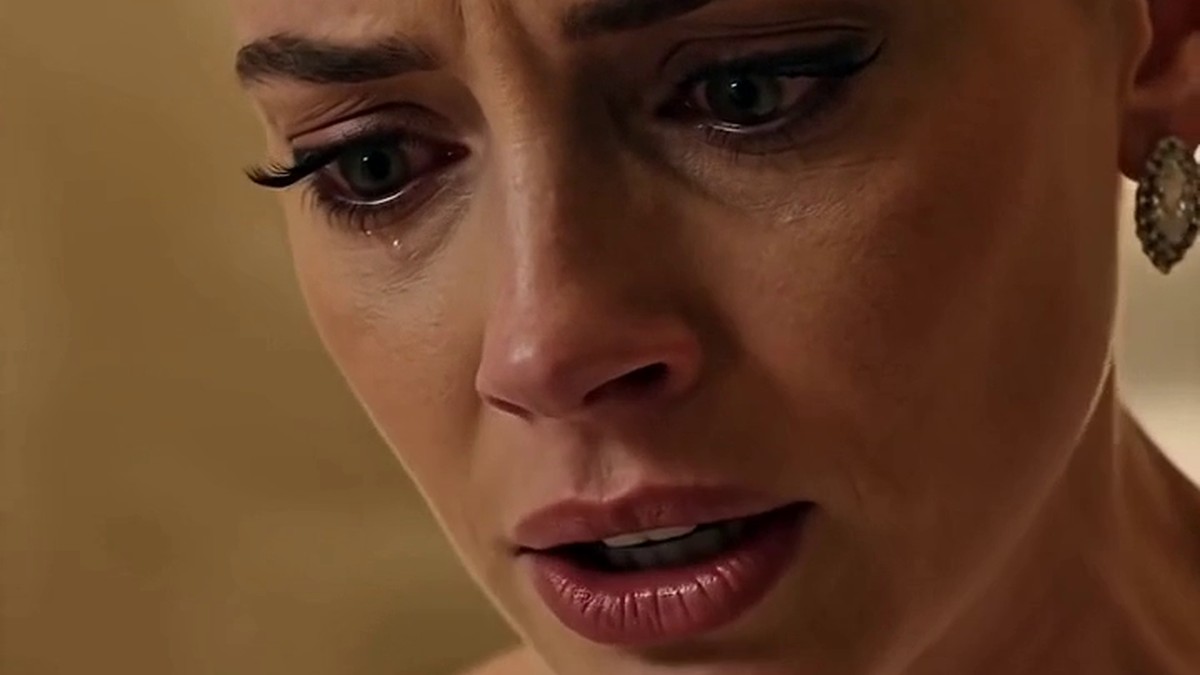
The woman holding the bag spun around fast. She was the kind of beautiful that kept people at a distance — white dress, red mouth, gold at her throat and wrists. Untouchable. The little girl had both hands locked around the brown leather strap, knuckles pale with the effort of holding on.
“Please.” Her voice barely made it out. “Don’t take that bag.”
The woman’s eyes went cold and sharp.
“Let go of it. Now. You little thief.”
Someone gasped. A whisper moved through the lobby like a draft. *Call security.*
The girl’s face crumpled with fear, but her hands didn’t move.
“It belonged to my mother.”
The woman let out a short, disbelieving laugh. “This bag belongs to *me.*”
The security guard materialized at the girl’s shoulder, dark suit pressed, expression flat.
“Miss. Release the bag.”
The child shook her head. Hard. Desperate. Tears cut clean lines through the grime on her face.
“She told me I had to protect it.”
The woman yanked.
The girl held on.
For one suspended moment, the entire lobby held its breath — two people locked in a silent war over a handbag, one of them barely reaching the other’s waist.
Then the clasp gave way.
The bag lurched sideways and hit the floor.
A photograph skated across the marble.
A small bracelet tumbled after it, catching the light as it rolled.
The guard reached them first. He crouched, picked up the photo — and went completely still.
“Wait—”
The woman tore it from his hand, furious.
Then she looked at it.
Her face came undone all at once.
The photograph showed a young woman — barely more than a girl herself — cradling a newborn wrapped in pink. On the baby’s tiny wrist, visible even in the old faded print, was a bracelet. The same bracelet now resting on the cold marble floor.
The woman lowered herself slowly, hand trembling, and touched it.
“This bracelet.” Her voice had lost all its edge. “It belonged to my daughter. My daughter who disappeared.”
The lobby had gone absolutely silent.
The little girl stared at her from across the scattered contents of the bag.
“My mother said her real name was Lily,” she whispered.
The woman’s breath caught somewhere in her chest.
“My daughter’s name was Lily.”
The child swallowed. Steadied herself. “She told me — if I ever found the woman in the white dress — I was supposed to give her the bag. No matter what.”
The woman looked back down at the handbag. And this time she saw what she had missed before — a seam in the interior lining, slightly raised, slightly wrong. Her fingers found the edge of something tucked inside.
A folded envelope.
She turned it over.
Three words on the front, written in a hand she would have recognized anywhere.
*Mom, forgive me.*
The bag had carried more than a bracelet.
It had carried a daughter’s last goodbye.
The lobby held still around them like a painting.
No one moved. No one spoke. The chandelier went on scattering its indifferent diamonds across the floor, across the photograph, across the bracelet that had survived everything its owner hadn’t.
The woman sat down on the marble.
Just like that. No grace, no performance. The white dress pooled around her and she sat, holding the envelope in both hands, and for a long moment she didn’t open it. She only breathed. In and out. Like she was preparing for something she’d been waiting eleven years to survive.
The security guard stood back. Someone near the elevators quietly pressed the button and left. The rest stayed, though they wouldn’t have been able to explain why.
The little girl hadn’t moved an inch.
She stood with her arms pressed tight against her sides, watching the woman on the floor with the careful stillness of a child who has learned that sudden movements cost you things. Her shoes were wrong for the weather. Her coat had a torn pocket. But her eyes — dark, watchful, older than her face — never left the envelope.
“You can open it,” she said softly. “She wanted you to.”
The woman looked up at her.
“How old are you?”
“Eight.”
A pause. The math landed visibly, quietly, like something set down rather than dropped.
“What’s your name?”
The girl hesitated. The way children hesitate when they’ve been taught that their name is a thing to be careful with.
“Everyone calls me Rue.”
“Rue.” The woman said it like she was memorizing it. “Where is she, Rue? Where is your mother now?”
The child’s jaw tightened. Her chin didn’t tremble — she wouldn’t let it — but the effort of holding it steady was plain and heartbreaking.
“The hospital said three weeks ago.”
The word *hospital* did something to the woman’s face that no word had managed to do before. It broke through the last of whatever she’d been holding in place. She pressed the back of her hand to her mouth.
Three weeks.
She had been three weeks too late.
—
She opened the letter standing up. That mattered to her, though she couldn’t have said why. She stood, smoothed the front of her dress with one hand the way people do when they need a second to become themselves again, and unfolded the pages with steady fingers.
The handwriting was Lily’s. Of course it was. She would have known it in the dark.
*Mom,*
*I know what you must think when you see this. I know what I cost you. I’m not going to argue it, because you were right about most of it and I was seventeen and I thought being right was the same as being free.*
*I need to tell you about Rue.*
*She came five years after I left. I wasn’t ready. I was never ready. But she was so much herself from the very first day that I forgot to be scared, mostly. She has your hands. I noticed it before anything else. Long fingers. The way she holds things — careful, like they matter.*
*I got sick in February. I didn’t tell her how sick. She’s eight and she already knows too much about how things end.*
*There is no one else. That’s the truth I have to say out loud: there is no one else. Her father was never a real thing. The friends I made in those first years are gone or worse than gone. I have run out of road.*
*The bag was always the one thing I kept. You gave it to me the Christmas before. You said it was too good for a seventeen-year-old but you bought it anyway because you said I had your taste even if I didn’t have your sense yet. I used to take it out and just hold it in the bad years. It felt like an argument I could still win.*
*I’m sending Rue to find you. I know how that sounds. She’s eight years old and I’m sending her across the city alone with your bag and a photograph and instructions she has memorized so many times she recites them in her sleep.*
*But she’s also yours. And I think — I have to believe — that you will see it the moment you look at her.*
*Mom. I am so sorry. I was so angry for so long and then I wasn’t angry anymore and by then I didn’t know how to come back. I wrote this letter four times. I couldn’t find the right beginning. There isn’t one.*
*Take care of her. She’s the best thing I ever did right.*
*I love you. That was always true.*
*Lily*
—
The woman folded the letter back along its creases.
Her name was Catherine. Nobody in this lobby knew that. They knew her by her husband’s last name, by her table at certain restaurants, by the particular way she held a room. They did not know that she had spent eleven years sleeping with the light on in a daughter’s bedroom she couldn’t bring herself to change. They did not know about the private investigator she’d hired three times, the false leads, the one phone call four years ago from a number that rang through to nothing. They did not know that she had bought this bag’s twin — the exact same style, the exact same color — because she couldn’t stand for that one object to exist only in the past.
They didn’t need to know any of that.
Only the child in front of her needed to know it.
Catherine crossed the marble floor.
She went down onto one knee — all the way down, white dress and all, right there in the middle of the lobby — so that she was level with Rue’s face. So that there was nothing between them but a few feet of chandelier light and everything that had already been decided.
She looked at the girl’s hands.
Long fingers. The way she held her own arms — careful, like they mattered.
“She told you to find the woman in the white dress,” Catherine said.
Rue nodded.
“She tell you anything else?”
The child was quiet for a moment. Her eyes moved across Catherine’s face with that same watchful precision, reading her the way kids read adults when their whole life depends on getting the read right.
Then she reached into the pocket of her torn coat and produced a second, smaller envelope. Bent at the corners. Worn soft from being handled.
“She said this one was just for me. She said I’d know when.”
Catherine waited.
Rue turned the envelope over in her hands once, twice. Then she held it out.
“I think it’s when.”
Catherine took it. She looked at the front. In the same handwriting, smaller, rounder — the way Lily had written before she’d learned to write cool:
*My Rue. For when you find her. Don’t be scared. You already did the hard part.*
Catherine handed it back without opening it.
“That one’s yours,” she said. “Read it when you’re ready.”
Something moved through the girl’s face — fast, unguarded, young. Surprise, maybe. Or relief. The look of someone who has been braced for a wrong answer for so long that the right one lands like a shock.
The security guard had not moved from his post. He was looking at the ceiling now, jaw set, blinking at the chandelier.
Catherine stood. She picked up the bracelet from the floor and held it in her palm, the gold catching the light the way it had caught it in the photograph, the way it apparently had caught it on a tiny wrist the night Lily was born in the room upstairs that still had a stuffed rabbit on the bookshelf and a height chart penciled into the doorframe.
She fastened it around Rue’s wrist.
It was too big. It slid down toward the girl’s hand, gold against her dark skin, loose and ancient and exactly right.
“Your mother wore this the day she came home from the hospital,” Catherine said. “And now you’re wearing it the day you’re coming home.”
Rue looked down at it.
Her chin did tremble, then. She let it.
“I was really scared,” she admitted. “The whole way here. On the subway and then walking. I kept thinking — what if she’s mean. What if she doesn’t believe me.”
“I know.”
“I almost went back twice.”
“I know.” Catherine put her hand on the girl’s shoulder — gently, the way you touch something you’re afraid of breaking before you remember that it’s stronger than it looks. “But you didn’t.”
Rue shook her head. “Mom said you’d be wearing white.” A breath. “She said I’d recognize your hands.”
Catherine didn’t answer that. She couldn’t, quite. But she kept her hand on the girl’s shoulder and the girl didn’t step away, and after a moment the lobby started moving again around them — heels on marble, elevator chimes, the ordinary machinery of a world that had no idea what had just happened in its center.
The photograph was still on the floor.
Rue picked it up. Looked at it for a long moment — her mother young and unguarded, the baby on her chest, the bracelet catching the flash of a disposable camera.
She tucked it into the bag and held the bag out to Catherine.
“She said to give you this too. She said you’d know what to do with it.”
Catherine took it. Held it. Set it over her shoulder, where it settled into place like something returning to its right position in the world after a long time of being wrong.
Then she took Rue’s hand.
The girl’s fingers closed around hers — careful, like it mattered.
And they walked out of the lobby together, into the gray afternoon light, where nothing was resolved and everything was just beginning, and the door swung shut behind them on the chandelier and the marble and the scattered diamonds of a life that had been waiting, for eleven years, for someone small enough to pick up what had been lost and stubborn enough not to let go.