I found the note at 11:40 p.m., after Colleen Bridger had stopped hammering on my screen door and left me with a three-day notice taped over the deadbolt. The swamp cooler in Unit 7 had died again, so I was sitting at the kitchen counter with a frozen bag of peas against my neck, sorting damp tip money. The air inside smelled like hot paper and old grease.
The note was a square of lined paper, folded to the size of a matchbook, stuck to the bottom inside seam of my windbreaker pocket. I found it while reaching for a loose Advil. My fingers came out with the paper instead.
The handwriting was thin and slanted. The pen had skipped over the lines in some places. It said:
*My name is Harold Bridger. I own the building at 2218 East Main Street. Colleen is my daughter. She has medical power of attorney, not property power. The leases she is using are forged. The proof is in locker 47 at the Greyhound station in downtown Phoenix. Code 26-41-18. Give the folder to my lawyer, Dana Okafor. Do not tell Colleen.*
I read it three times with the note pinned under a coffee mug. Then I sat on the floor with my back against the refrigerator and tried to remember the old man’s face.
Twelve hours earlier, I was at the Sun-Up Diner working a double. The lunch special was green chile pork, and the diner’s swamp cooler was only a little better than mine. Two electricians sat at table four with their caps pushed back. They kept saying they’d go back out to the truck “in a minute.” The tips came to forty-one dollars by two-thirty. My shoes were sticky from lemonade.
The walk to the bus stop on Main Street took seven minutes. The bank sign across from the Circle K said 114 degrees. The sidewalk threw heat up through my insoles. A half-crushed water bottle lay on the curb, brittle from the sun. The bus shelter smelled like hot metal and old urine.
Inside the shelter, an old man sat with both hands on a wooden cane. His shirt was pale yellow and soaked along the collar. No one else was there. The schedule said the next bus was in twenty minutes, but the 3:14 had already gone.
I stepped into the smell of hot metal and said, “Sir, do you need water?”
He answered, “I’m waiting for the 3:14.”
“That one came and went.”
He tried to stand. One leg folded under him, and I caught him. He went down anyway, and I went with him, my apron slipping on the hot concrete. I kept his head from hitting the walkway.
“I’m Tess,” I said, over and over. “What’s your name?”
He couldn’t get a sound out. His eyes went up and out. I called 911 and gave the dispatcher the cross street. A woman in green scrubs looked over, then stepped around us into the Circle K. A man in a golf shirt hopped the curb without missing a beat, phone pressed to his ear. I folded my apron under the old man’s head and kept talking—about Pickles, the one-eyed courtyard cat, and the price of a dozen eggs at the gas station.
The ambulance came with the back doors already open. Before they lifted him, the old man’s hand fumbled at my windbreaker pocket. I thought he was reaching for my arm. There was a tiny tug at the fabric, and then he was on the gurney.
I did not find the note until after Colleen had come by.
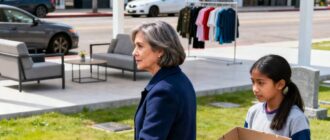
Colleen was waiting at the bottom of the stairs when I got home. She wore a beige linen blouse and stood under the metal awning, tapping one red nail on the notice she had already taped to my door. The notice said:
*Three-day notice to comply or vacate. $1,850 due. Water overage, pest control, unapproved window film.*
I didn’t have a cat on the lease. Pickles was a stray. The window film was on the carport window, and it wasn’t mine. But arguing with Colleen in the courtyard was like opening the oven door in a heat wave—it just made everything worse.
I said, “I paid my rent.”
She said, “You paid what you say you paid.” She tapped the notice again. “Friday. If you’re not out, I’ll have a deputy here while you’re working.”
Then she walked out the front gate and let it slam.
After she left, I sat on the steps a long time. Pickles came out from under the oleander and put one paw on my shoe. That was when I went inside and found the note.
I didn’t sleep. At dawn, I called the diner and told Lupe something had come up, a family thing. Then I put on my other shoes and caught the Route 40 bus into downtown Phoenix.
The Greyhound station smelled like hot dust and floor wax. A wall of windows faced west, and the morning sun through the tint made orange stripes on the floor. Locker 47 was on the end, below a dead pay phone.
I punched in 26-41-18.
The door popped open with a chunk. Inside sat a manila folder, thick as a brick, bound with two rubber bands. I carried it to a bench near the ticket counter and opened it.
The first page was a property deed with Harold Bridger’s name printed across the top. Below it, his name appeared eleven times on other pages. The signature on my own lease didn’t match. The H looped the wrong way; the slant was wrong. Someone had practiced the name enough to get close. Not enough to get it true.
There were bank statements, a stack of tenant ledgers, and a notepad in Colleen’s handwriting—the same tight print as on my door. One line read: *Twelve units × $200 unauthorized pet fee = $2,400 a month. Keep off the books.*
Then I saw my own name. Unit 7, listed with a $40-a-month window film charge. A window I didn’t have. I closed the folder and reached for my phone.
The lawyer’s business card was paperclipped to the inside cover. Dana Okafor answered on the second ring.
“Mr. Bridger called me from the ER last night and said he’d given the locker code to a woman in a yellow apron. I wasn’t sure you’d go through with it.”
I said, “I’m at the station. I’ve got the folder.”
“Bring it to my office. I’m at First Avenue and Adams.”
Ms. Okafor’s office was on the fourth floor, near the county courthouse. She didn’t make me wait. She went through the folder page by page, pausing to clip groups of documents together with paper clips from a drawer. Then she picked up the phone and asked for an emergency hearing.
I sat in the waiting room and drank two cups of water from the dispenser. I counted the dots in the ceiling tiles. The cooler clicked on, blew one hot breath, and clicked off.
The judge signed the temporary order at 4:35 p.m. The time stamp on the blue-backed copy said 4:35 p.m. Ms. Okafor handed it to me.
“Do you want to be the one to serve it?”
I said yes.
On the bus back, I kept the folder on my lap and the blue-backed order on top of it. I didn’t know Colleen would already be in the courtyard throwing my clothes onto the sidewalk.
When I turned the corner, I saw my mother’s sewing box open in the dirt beneath a palo verde tree. Buttons from her button jar were scattered across the gravel. A black trash bag had split in the sun, and my bedsheets were tangled in the bougainvillea. Colleen stood at the top of the steps with another bag over her shoulder.
“You’re done,” she called. “I’m changing the locks.”
I crossed the street with the order at arm’s length.
“Colleen Bridger, this is a temporary emergency order signed by a Superior Court judge at 4:35 this afternoon. You’re removed effective immediately. You don’t get to change locks. You don’t get to touch my things.”
She let the bag slide off her shoulder onto the steps. A lamp shade rolled out and bumped down two stairs.
“You’re a liar,” she said.
“I have the folder that says different.” I tapped the manila file.
She laughed, flat and hollow, like a car door closing.
A white Lincoln Town Car stopped at the curb. A Phoenix Police SUV stopped behind it. The car door opened, and a man with a cane climbed out on one side while an officer came around the other.
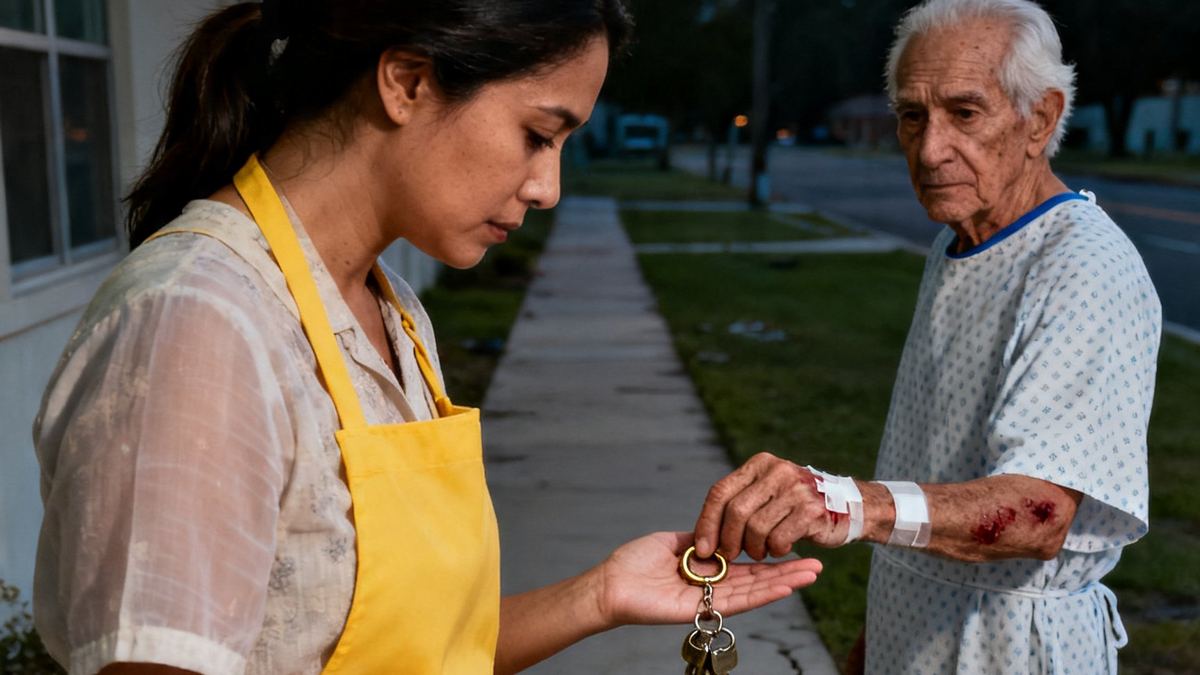
It was the old man. Harold Bridger. He wore a hospital robe over a johnny. An IV bruise ran along the back of his hand.
He didn’t speak to Colleen. He came up the walkway past the pile of my things, and I handed him the blue-backed order. He turned it over once.
“Colleen.”
That was all he said.
An officer took her by the elbow. She said, “Daddy. You can’t.” The officer turned her toward the car. She said it louder: “Daddy, I’m your daughter.” The door closed on the third try.
Harold turned to me. He didn’t look like a man who had won.
“She’s been at this for nine years,” he said. “The property account is short two hundred and seventeen thousand dollars.”
Then he reached into the pocket of his robe and placed a ring of keys in my hand. The brass one had an H stamped on the top.
“The building needs a manager,” he said. “You’re the only one in that folder who wasn’t trying to take something from me. I’ll pay you a fair salary. Starting Monday.”
I looked at the keys. Then at the sewing box in the dirt.
“I’ll take it,” I said, “but I’m signing something first.”
Ms. Okafor had emailed a one-page management agreement to Harold’s phone. We signed it on the hood of the police car, with the heat still lifting off the metal. I used the clipboard the officer had in the trunk.
My first act as manager was Unit 2. Colleen had padlocked it three weeks earlier over a late fee, locking out a retired bus driver named Mr. Okada. I pointed to the lock as the officer came back with bolt cutters. The jaws crunched once, and the padlock fell.
I turned the new key. The deadbolt slid back. The lock clicked open.
I left the door open for Mr. Okada. Then I picked up my mother’s sewing box from under the palo verde and carried it back toward Unit 7. Pickles was waiting on the bottom step with his one good eye on the key ring in my hand.