Three belonged to the hungry little boys huddled on the curb at the edge of the road.
The fourth was hers.
But when the smallest boy locked his hollow, frightened gaze on that pot, Rose lifted her own bowl without a word and emptied it into his cracked plate.
“There,” she murmured, smoothing the dust from his knotted hair. “Get it down before it goes cold.”
The child studied her worn apron, her thin wrists, the careful way she held nothing.
“But aren’t you hungry too?”
Rose smiled. Her stomach had been empty since the morning before.
“Mothers don’t get hungry when their children are eating.”
The boys had no way of knowing she had no children.
Not anymore.
Years back, Rose had been a young widow with a newborn and barely enough crust to see the week through. One bitter winter night she found three small brothers shaking behind a bakery and gave them the supper she’d been saving for herself. By the time dawn broke through the frost, her baby was gone. The landlord said social workers had come. Said she was too poor. Said it quietly, the way people say things they don’t want questioned.
No address left behind.
No name.
No grave to stand over.
Only an empty blanket on the floor and a question she would carry the rest of her life — whether her child had cried out for her before the silence took hold.
So she kept feeding other people’s children. Every season. Every hungry face that turned her way.
It was the only answer she knew how to give.
Then one afternoon, engines split the quiet of the dusty street.
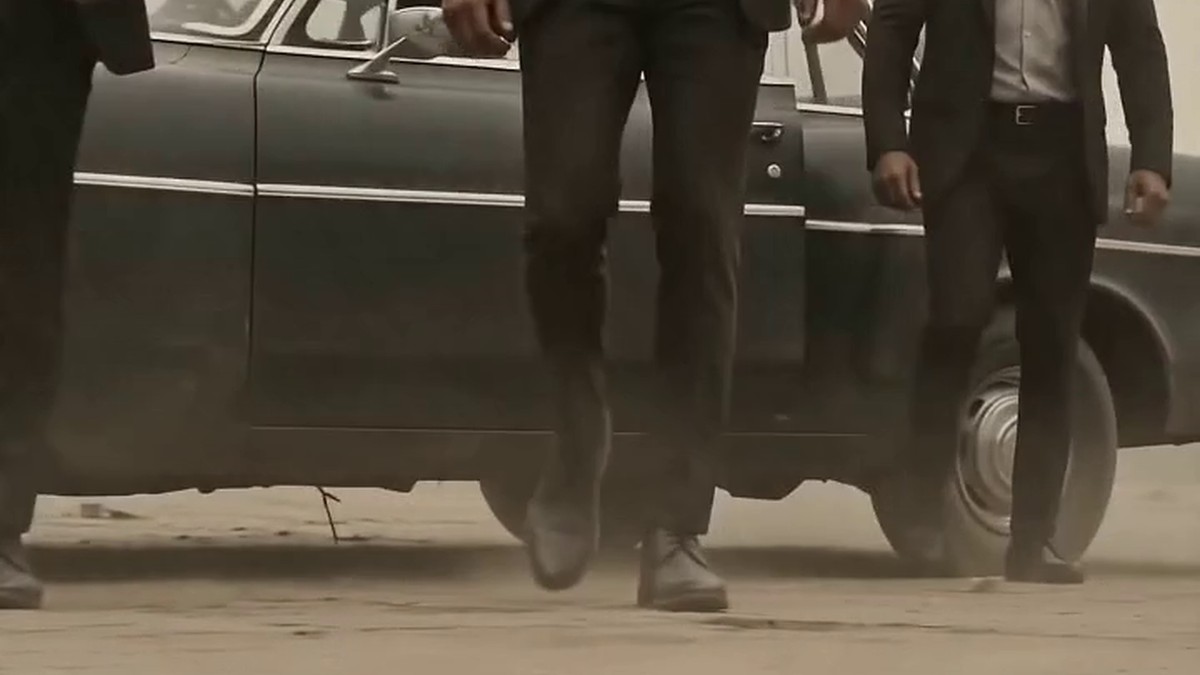
Two black cars, polished and expensive, screeched to a halt and kicked a spray of dirt straight across the little fire. The flames shuddered. The boys shrieked and threw themselves behind the shelter of Rose’s dress, fingers knotting into the fabric.
“Stay right behind me,” she said, and her voice came out steadier than she felt.
Three men climbed out. Tall. Dark suits. Shoes that cost more than her monthly rent.
They crossed the dirt toward her the way men cross distances they’ve been measuring for decades.
Rose squared her shoulders.
“Can I help you?”
The man in the middle stopped just short of arm’s reach. His eyes swept the empty pot, the trembling children, and then settled on her face with an expression she couldn’t name — something between grief and relief, like a door finally swinging open.
“You already did,” he said softly.
He reached inside his jacket and produced a small object wrapped in faded cloth. He unfolded it carefully, the way you handle something that has survived too much.
It was an old dented spoon.
A tiny flower scratched into the handle.
The plate dropped from Rose’s hands and hit the dirt.
She had carved that flower herself. Sitting by a fire not so different from this one. For three small boys who hadn’t eaten in days.
Thirty years ago.
“No.” The word came out barely a sound. “That’s not possible.”
All three men had tears running openly down their faces now.
“We were those boys,” the man said, his voice catching on every syllable. “You fed us when the whole world had already looked away.”
Rose pressed both hands over her mouth. Her shoulders shook.
Then the man in the center moved closer. He reached back inside his coat and drew out something else — something soft, faded to almost nothing, edges worn smooth with age.
A baby blanket.
The same one that had been lifted from her arms and carried out into a winter morning she never stopped replaying.
His voice fractured completely.
“One of us was not an orphan the night you found him.”
Rose couldn’t speak. Couldn’t move. The air had left the street entirely.
He brought the blanket to his chest and held it there.
“I was your son.”
The word landed like a stone dropped into still water.
Rose stood motionless while the ripples moved through her.
Then her knees buckled.
The man — her son, her boy, the child she had spent thirty years not naming because naming him made the loss a living thing — caught her before she hit the ground. His arms wrapped around her the way only one kind of arms can, instinctively, as though his body remembered a weight it had carried before it knew what carrying meant.
She grabbed the front of his jacket with both fists.
“I looked,” she said into the fabric. “I looked everywhere. I asked everyone who would stand still long enough to listen. I wrote letters. I wrote so many letters.”
“I know.” His voice was barely a breath above her head. “I found them. Every single one.”
She pulled back just far enough to see his face.
She had imagined this face ten thousand times and gotten it wrong in all the ways that mattered and right in the one way that did. He had her mouth. The exact shape of it. The way the corners pulled slightly inward when he was holding something back.
He was holding something back now.
“They kept them from you,” he said. “The letters. The agency, the placement family, the whole chain of hands you passed through — they intercepted every one. I didn’t know you’d written until two years ago, when the agency’s records were finally opened. A court order. It took us eleven months to find you.”
Rose touched his face with one hand. Just her palm flat against his cheek. The way she had touched him once before and not known it would be the last time.
“Eleven months,” she repeated.
“We’ve been across six states.”
The two brothers standing behind him had not moved. They were watching with the careful stillness of men who understood they were witnessing something that required silence, the way you go quiet in the presence of something sacred or something broken being made whole, and they were old enough now to know those two things are sometimes the same.
Rose turned to look at them properly.
She recognized them the instant she tried to. Not their faces, which time had changed completely. Their posture. The way the oldest stood slightly in front of the younger, shoulder angled out, the automatic geometry of a boy who learned early that his body was the only wall he had to offer. He had stood exactly that way behind her dress thirty minutes ago, as a boy of maybe eight. He was standing that way now.
“You,” she said.
He smiled. It cracked something open in his expression, all that expensive suit and those hard-city eyes, and underneath was the boy with dirt on his knuckles who had asked her whether she was cold.
“Me,” he said.
The youngest one — he was not so young anymore, somewhere in his early forties, broad across the shoulders, laugh lines at the corners of his eyes — stepped forward and held out his hand. In his palm was the cracked plate. Cleaned, she saw. Carefully cleaned and kept.
“You filled this twice,” he said. “I never forgot it.”
Rose looked at the plate. Then she looked at the three of them standing in a line in the dirt street, in their good suits and their city shoes, and something moved through her that was not quite grief and not quite joy but some third thing that only exists in the precise moment when a wound that has been open for decades finally closes.
She was not a woman who cried easily. She had not cried when they took her child. She had stood in that empty room and looked at the blanket on the floor and decided that breaking down was a luxury she could not afford if she intended to keep standing, and she had kept standing through thirty winters, through hunger and cold and the specific loneliness of a woman who has given everything away and kept nothing back for herself.
She cried now.
It was not elegant. It was not quiet. It came out of her the way weather comes, large and without apology, and she pressed both hands over her face and let it happen because there were no more streets left to cross alone.
Her son held her through all of it.
When it finally passed — not all the way through, not fully, some griefs are not meant to finish but only to become bearable — she straightened up and pressed the back of her wrist across her eyes and looked at the four of them: the three small boys from that long-ago winter night and the child she had never stopped carrying.
The three little boys from the curb had crept closer during all of this. They stood in a tight knot just at the edge of everything, wide-eyed, sensing that something had happened that they did not entirely understand but that mattered enormously, the way children sense storms and music and the presence of love before they have the words for any of it.
Rose noticed them.
She reached out and drew the smallest one against her side, the one who had stared at her empty pot with those hollow frightened eyes.
“You see these men?” she said.
The boy nodded cautiously.
“They were exactly where you are. Right here. Colder than you, if you can believe it.”
The boy looked at the man in the center, at his tailored jacket and his clean hands, and seemed to be trying to reconcile the image.
“What happened to them?” he asked.
Her son answered before she could. He crouched down to the boy’s level, which he did easily, without ceremony, the way a man does who has not forgotten what it felt like to be small.
“Someone fed us,” he said simply. “Someone saw us. And it changed everything.”
The boy absorbed this with the solemn gravity of the very young.
Then he looked up at Rose.
“Is that why you do it?”
Rose thought about the empty blanket. About thirty winters of soup. About a question she had carried so long it had become part of her spine.
“Yes,” she said. “That’s why.”
Later, after the boys from the curb had been fed again, after arrangements had been made with a quiet directness that told Rose her son had been planning this moment for a long time, after addresses had been exchanged and the fire burned low, she sat on the curb in the settling dark and turned the old dented spoon over in her hands.
The tiny scratched flower was still there, faint but legible, the way certain marks survive everything.
Her son sat beside her. Not speaking. Just there, shoulder touching shoulder in the cooling evening air, the way people sit when they have run out of words and found that presence is its own language.
After a long while, he said: “I thought about you every day.”
“I thought about you every hour,” she said. “I wasn’t always sure you were alive. But I kept feeding children because I needed to believe that someone, somewhere, was feeding you.”
He was quiet for a moment.
“Someone was,” he said. “Not like you. But someone.”
Rose nodded slowly.
She set the spoon down on the curb between them, and he placed his hand over hers, and they sat together in the last of the light while the street around them went about its ordinary business, not knowing what had just happened here, not knowing that a thirty-year silence had just spoken its last word.
She was not who she had been that morning.
She was not a woman with four bowls and no one to come back to.
She was a mother, sitting in the evening with her son, the hunger finally, finally, answered.