The shelter smelled like wet newspaper and industrial cleaner, a combination that hit Dan before the door clicked shut behind him. He stood in the entryway of the Milwaukee Animal Rescue League, water dripping off his Carhartt jacket onto the scuffed linoleum, and wondered for the fourth time that morning if he was doing the right thing.
A young woman in red scrubs looked up from a laptop at the front desk. Her name tag read "Lexi, Adoption Counselor." She had a streak of purple in her hair and a tattoo of a paw print on her wrist.
"Help you with something?" she asked.
"Came about a puppy," Dan said. He pulled a crumpled printout from his pocket—the listing he'd found online at 2 a.m. the night before: *Lab mix puppies, 8 weeks, ready for forever homes.*
Lexi's face shifted into something between a smile and a measuring look. "Great. We've got a litter from a hoarding case up in Sheboygan. Real sweethearts. Follow me."
The corridor stretched past rows of kennels, each one a small room with a concrete floor and a raised cot. Dogs of every size tracked Dan's movement. Some barked. Some pressed their noses to the chain-link. Some just lay there, watching with the flat-eyed patience of animals who'd learned that nothing good came quickly.
Dan kept his hands in his pockets.
Lexi stopped in front of a room near the back, where six puppies tumbled over each other like socks in a dryer. One of them, a black-and-tan male, was chewing on his brother's ear. A little brown female sat apart, watching Dan with her head cocked.
"These guys are ready now," Lexi said. "Vaccines started. Dewormed. Adoption fee's two seventy-five, includes the chip."
Dan nodded without listening. His eyes had caught on something else—another kennel across the aisle, set apart from the others. At the far end, a steel food bowl sat half-full, and on the cot lay a dog that might have been a yellow lab once. Muzzle white. Back legs folded under her at an awkward angle. Coat dull under the fluorescent light, missing patches near her tail.
She didn't look up.
"What about that one?" Dan heard himself ask.
Lexi's expression did something complicated. "That's Juno. She's twelve, maybe thirteen. Surrendered two months ago." She paused. "Owners said they were moving to a condo in Naples. No dogs allowed."
Dan's jaw tightened. "How's her health?"
"She's got cataracts, arthritis, mostly deaf. Needs daily meds. We've had exactly zero inquiries." Lexi's voice was flat, reading facts off an invisible clipboard. "I have to be honest with you—she's not going to be an easy dog. She's not going to be a dog you take jogging. She's going to be a dog you take to the vet. A lot."
"Can I meet her?"
Lexi looked at him a beat too long. Then she shrugged. "Sure. But don't say I didn't warn you."
She unlocked the kennel and stepped aside. Dan crouched in the doorway. The dog—Juno—still didn't move. He could see the rhythm of her breathing, the slow rise and fall of a ribcage that had carried this animal through more years than most people kept a car.
He thought about his mother.
Not the mother he'd lost to breast cancer when he was nineteen, but the one who'd spent the last eleven years of her life managing a house, a job, and a teenage son on no sleep and too little money. The one who'd sat up with him through a 2 a.m. fever and never once complained about being tired. The one who'd taught him that loyalty wasn't a word you said—it was a thing you did, every day, especially when it was hard.
He thought about the way she'd looked at him the last time he saw her, in the living room on 68th Street, hooked up to oxygen, still trying to make sure he'd eaten enough.
Juno lifted her head. Her eyes, milky with cataracts, turned toward him approximately, not exactly. Dan's throat tightened; he swallowed hard and said nothing for a second.
"Hey, girl," he finally said, voice low.
The dog's tail moved once, a single thump against the cot, like she wasn't sure she was allowed to hope.
Dan turned to Lexi. "I'll take her."
Lexi blinked. "You're serious."
"Serious."
"You came in here for a puppy. We have puppies. Healthy, playful puppies."
Dan looked back at Juno. "I know what I came for. I also know what I'm looking at now. She's the one."
The paperwork took an hour. Dan had to show ID, proof of address, fill out a questionnaire about his living situation, his work schedule, his experience with dogs. He didn't have much — a beagle when he was a kid, dead of old age by the time he was fourteen. But he had a two-bedroom ranch house he rented on 68th Street, fenced yard, one level, no stairs, and he had a sense that if he walked out of this building without Juno, he'd spend the next year thinking about her.
Lexi read over his answers, then looked up. "You understand she's on gabapentin for the arthritis, twice a day. And she needs eye drops for the cataracts — they won't fix them, just help with the discomfort. And she's on a prescription diet. Food's about eighty-five bucks a bag."
"I understand."
"And she can't do stairs. At all."
"One level. No stairs."
Lexi nodded, then allowed herself a small, tired smile. "Okay, then. Let's get her loaded up. I'll grab you a bag of her food to start, plus a few cans of the wet stuff she likes — pâté kind. She won't touch the chunky."
Ten minutes later, Dan stood in the lobby with a leash in his hand and a dog at his side who looked even older in the daylight. Juno stood with her head low, front feet planted, back feet slightly splayed. Her tail was tucked. Her breathing was shallow.
Dan crouched down beside her. "Hey," he said. "We're going home."
She turned her head at the vibration of his voice. Her ears didn't prick, but her tail uncurled a fraction.
Lexi came out from behind the desk with a manila folder. "These are her vet records, her microchip info, and a list of the meds. The chip's still registered to the previous owners — you'll want to update that." She handed him the folder. "And, um — there's one more thing."
"Yeah?"
"The owners left a jacket. Said it was hers, for winter." Lexi's mouth twisted. "I don't know if you want it. It's just an old Carhartt, like yours, but it's got her smell on it. Might help her settle."
Dan took the folded jacket without a word. It was brown, worn at the elbows, with a tear near the bottom hem. He tucked it under his arm.
"Thanks," he said.
"Good luck," Lexi said. And then, to Juno: "Be a good girl, honey. Your person found you."
The drive home took twenty minutes. Dan had brought a blanket and spread it over the back seat of his Outback. Juno lay on it without being asked, her muzzle resting on her front paws, her eyes half-closed. Every time Dan changed lanes, she lifted her head and then lowered it again.
He turned the radio off. The silence felt more respectful.
The house on 68th Street was a small ranch, two bedrooms, cracked driveway, a maple tree in the front yard that dropped leaves from October clear through to May. Juno — *his dog now* — sat on the front lawn for a long moment, scenting the air, before she let him lead her inside.
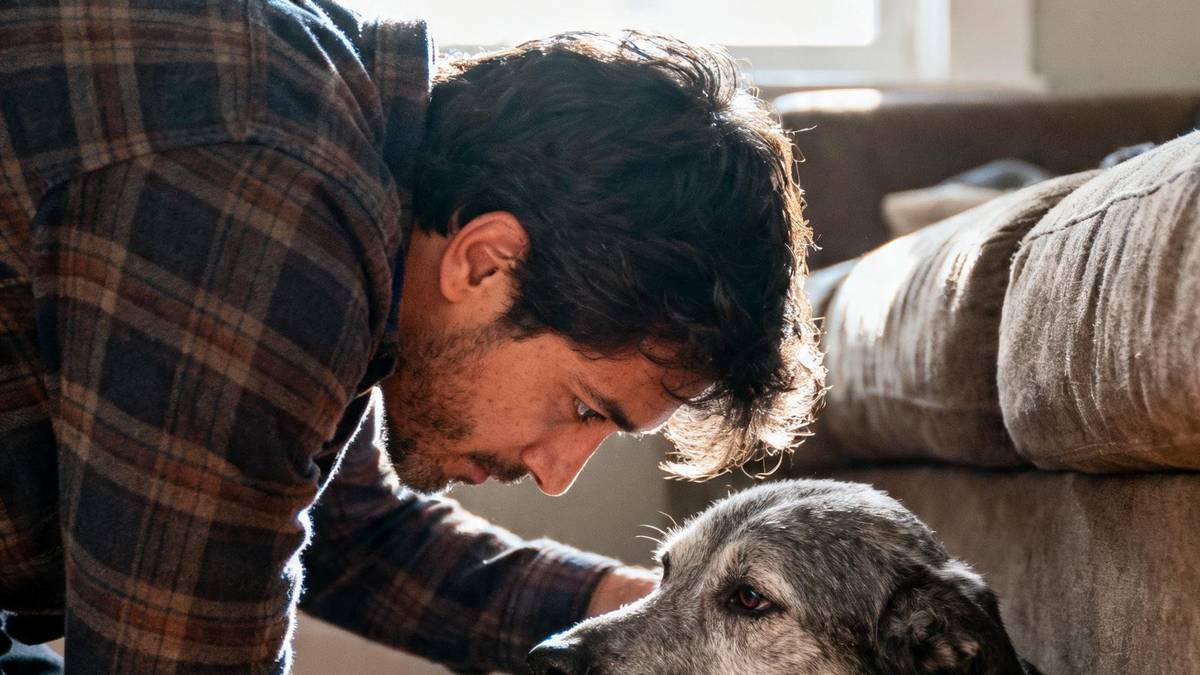
She sniffed every room. Not with the frantic energy of a puppy, but with a slow, patient thoroughness, like a building inspector taking notes. She bumped softly into a dining chair and adjusted around it. She found the water bowl Dan had filled and drank for a solid minute, slopping half of it onto the floor.
Dan sat on the floor next to her, back against the wall, and watched.
"Hungry?" he asked.
No response.
"Juno."
Still nothing.
He reached out and touched her side. She turned then, and looked at him — or at least toward him, with those fogged brown eyes. And Dan understood: she wasn't ignoring him. She hadn't heard him. Not the door. Not the water bowl. Not her name.
The shelter staff hadn't mentioned it. Maybe they hadn't noticed, or maybe they hadn't wanted to complicate the adoption. Dan didn't know which, and he found he didn't much care.
He spread the old canvas jacket on the floor beside the couch. Juno sniffed it, turned around three times — slow, deliberate circles — and lay down with her chin resting on the sleeve.
At 3 a.m., Dan woke to a sound he didn't recognize: a soft, rhythmic thump somewhere near the foot of the bed. He lay still, listening, then realized what it was.
A tail.
Juno was lying on the floor beside his bed, tail sweeping back and forth against the wood.
He laid his hand over the side of the mattress, and she pushed her nose into his palm. Her nose was cool, wet, alive.
*Okay,* he thought. *This might be the start of something.*
The next morning he called the vet.
The clinic was a squat brick building on Hawley Road — West Side Veterinary Care — with a waiting room that smelled like disinfectant and anxious cats. A tech in blue scrubs led Dan and Juno into an exam room, weighed the dog (sixty-four pounds, down from a probable eighty-five), and scribbled something on a chart.
Dr. Alvarez came in a few minutes later, a woman in her forties with gray-streaked hair and a way of moving that was quicker than it needed to be, like she was already thinking about her next patient.
But when she saw Juno, she stopped. She ran her hands over the dog's spine, felt the joints in her hips, checked her ears, peered into her cloudy eyes with a penlight.
"How long have you had her?"
"Since yesterday."
Dr. Alvarez looked up. "You adopted a twelve-year-old dog with arthritis, cataracts, and hearing loss. Yesterday."
"That's right."
The vet was quiet a moment. Then she pulled up a stool and sat across from Dan.
"Okay. Here's the truth. Her arthritis is advanced but manageable — gabapentin's a good start, I'm adding a joint supplement too. The cataracts are significant in both eyes. There's no glaucoma, which is good, because glaucoma's the kind of thing that actually hurts. The cataracts themselves don't hurt her, but they're not going away, and nothing in a bottle is going to reverse them. Surgery's an option in theory — realistically, at her age, with her joints, I wouldn't put her under for it. She's not going to get her sight back. I'm sorry."
Dan's jaw tightened. He looked down at the folder in his hands instead of at her. "What about the weight loss?"
"She's been underfed. Not starved, but inconsistent. The prescription diet's a good start." She glanced at the folder. "Have you looked at the records yet?"
"Not all of them."
Dr. Alvarez held out her hand, and Dan gave her the folder. She flipped through it, frowning.
"They had her twelve years. Brought her in for annuals until she was about nine, and then…" She paused. "Last visit was two years ago. Nothing since."
Dan said nothing. He picked at a loose thread on his jeans.
"I want to run bloodwork. Kidneys, liver, thyroid, red count. It won't be cheap — probably three-fifty, four hundred with everything."
"Fine."
She studied him a minute, like she was trying to figure out if he was for real. Then she pulled a pad from her coat pocket and started writing.
"Bloodwork today. She's mostly deaf, so you're going to have to learn to talk to her with your hands and your feet — stomp when you walk up behind her, don't startle her. I want to see her back in three weeks." She tore the sheet off and handed it over. "She's tough, Dan. You can see it in the way she holds herself. She's not done yet."
Dan looked at the smudged blue ink. "Neither am I," he said.
The next few weeks fell into a rhythm he learned without trying. Breakfast with the special pâté, mixed with a spoon of plain rice because she'd stopped finishing the bowl otherwise. A short walk around the block — not really a walk, more of a slow amble — while he drank coffee from a dented thermos he'd had since college. Gabapentin at eight and eight. The sound of her tail against the floor when she heard him get up in the night, though she never once heard him come in the front door.
He talked to her anyway. Not because he thought she could hear him, but because he needed to say the words out loud, and she was there.
"I think I made a mistake," he told her one Tuesday night, sitting on the floor next to the couch. "When I got the call about Ma, I was at work. I didn't pick up. Saw the number, knew something was wrong, figured I had more time."
Juno's tail thumped once.
"By the time I called back, she was gone." His voice stayed level. "Never got to say goodbye. Funeral's mostly a blur — I remember standing there watching them lower her down and thinking I never once told her thank you. All those years. Never said it out loud."
The dog shifted, pushed her nose against his knee. Dan let out a long breath through his nose and put his hand on her head, rubbing the loose skin behind her ear.
Three weeks later, he sat in the vet's waiting room with a plastic bag of medication in his lap and Juno dozing at his feet. The receptionist, a young woman with a nose ring, leaned over the counter.
"Your dog's name is Juno, right?"
"That's right."
"Good name. She's a sweetheart." She glanced at the door to the back. "Dr. Alvarez will be out in a minute with the results."
When the vet came in, Dan stood. She looked at him, then at Juno, then back.
"Bloodwork's normal. Liver and kidneys are better than I expected for a dog her age. Weight's up two pounds." She paused. "I've been doing this fifteen years. Most people who walk in here with a dog like Juno ask about euthanasia. Not because they're cruel — because they don't know what else to do. They see an old dog and figure the kindest thing is to let her go."
Dan waited.
"You didn't," the vet said. "That matters. For whatever it's worth."
Dan looked down at Juno. He didn't trust his voice, so he nodded once.
It was a warm Saturday in October when Dan took Juno to the dog park for the first time.
He'd been putting it off — wasn't sure how she'd handle the noise, the chaos, other dogs crowding her from a blind side. But the physical therapist he'd been seeing for his shoulder, an old ladder-fall injury, had told him it'd be good for both of them.
So here they were, Dan on a bench near the entrance, Juno lying in the grass a few feet off, a pair of golden retrievers chasing a tennis ball nearby. She didn't react to the ball, but her tail was up, wagging in a slow, contented rhythm.
A man sat down on the bench next to him. Mid-fifties, gray beard, coffee in a paper cup, a small terrier on a leash.
"Nice day," the man said.
"Sure is."
The man nodded toward Juno. "Yours?"
"Got her about six weeks back. From the shelter."
He sipped his coffee. "She looks settled. Like she's been with you a while."
Dan almost laughed. The dog who'd come to him matted and underweight, who used to flinch at sudden movement and sleep with her back against the wall — she was lying in the sun now, eyes closed, a dozen dogs barking around her.
"She's getting there," Dan said.
The terrier trotted over to sniff Juno's tail. Dan tensed, ready to step in, but Juno just lifted her head and huffed out a breath. The terrier lost interest and wandered off.
"She's used to other dogs," the man observed.
"Maybe. She was with a family a long time. Kids, other pets, I don't know. Then they gave her up."
The man was quiet a moment. "Had a dog like that once. Shepherd mix, got her at eight, old for a big dog. Family before me moved overseas, didn't want to deal with quarantine. I took her because I felt sorry for her." He paused. "Best dog I ever had. Lived to sixteen. Cost me a fortune in vet bills. I'd pay it again tomorrow."
Dan looked at Juno, who'd rolled onto her side, legs splayed, belly to the sun.
"Worth it, then," he said.
"Every cent." The man finished his coffee and stood. "Keep doing what you're doing. She knows."
The first time Juno heard him was in November.
Tuesday morning, cold enough that Dan could see his breath in the kitchen before the furnace kicked on. He was pouring oatmeal into a pot when he knocked a fork off the counter. It hit the tile with a sharp clatter.
Juno lifted her head. Her ears — those old, drooping ears — twitched. She turned toward the sound, toward the spot where the fork had landed, head tilting the way dogs do when they're working something out.
Dan went still.
"Juno." Not loud. Just his normal voice.
She turned. Her ears twitched again. Slowly she got to her feet and walked toward him, tail going in a loose, easy arc.
Dan dropped to his knees, wrapped his arms around her, pressed his face into the warm fur of her neck. Her heart beat against his chest. Her nose was wet against his ear.
She'd heard him. Not perfectly, maybe not even clearly. But she'd heard her name.
He pulled back and looked at her, at eyes that had once seemed so empty. Her tail kept going, slow and steady.
"Good girl," he said, and his voice came apart on the second word. "Good girl, Juno."
That night, Dan called his sister.
Rachel lived in Denver, worked in insurance, had two kids, a husband, and a golden retriever named Waffles. They talked twice a month, usually about nothing — the weather, the kids, gas prices. Tonight he just wanted to hear her voice.
She picked up on the third ring. "Dan? You okay?"
"Yeah. I'm okay." He paused. "Wanted to tell you something."
"Okay…"
"I got a dog."
A beat. "You? A dog? Since when?"
"About three months ago. She's older. From a shelter." He leaned back against the couch. Juno lay on the floor beside him, chin on his foot. "Named her Juno."
"Juno," Rachel repeated. "That's pretty. What made you—"
"She was the one nobody wanted," Dan said. "Twelve years old. Deaf, mostly blind, arthritis. She'd been at the shelter two months." He stopped. "I don't know, Rach. I saw her and I just knew."
His sister was quiet a long moment. "That sounds like something Mom would've done."
Dan looked at the ceiling. His throat was tight, and he waited it out before he answered.
"Yeah," he finally said. "I think that's maybe why I did it."
Winter came hard that year, the kind of cold that gets into your bones and stays. Dan bought Juno a coat from the feed store, a red one with velcro straps that took him three tries to figure out. She hated it for a week and then stopped noticing it. He learned to stomp when he walked up behind her, learned to let her sniff his hand before he touched her shoulder, learned that she startled less if the porch light was on when he got home from work.
She never got her hearing back beyond the occasional loud, close sound. Her eyes stayed clouded — Dr. Alvarez checked again in January and found nothing new, no miracle, just the same milky white she'd walked in with. What changed was Juno. She learned the house by feel: eleven steps from the water bowl to the couch, a left turn around the coffee table, the particular give of the rug by the back door. She learned Dan's footsteps through the floorboards before she learned almost anything else, the weight of him different from anyone else who ever came through that door — the mail carrier, his sister visiting once at Christmas, the kid from next door who fed her when Dan worked late. She never mistook any of them for him.
In March, on the first warm day of the year, Dan took her back to the park.
The maple trees were budding. The path was mud. A woman jogged past with a labradoodle. Dan found the same bench he'd sat on in October and Juno settled beside him, close enough to touch.
A little girl in a pink jacket and yellow boots ran up, then stopped short. "Is that a dog?"
"She is," Dan said. "Her name's Juno."
The mother caught up, apologetic. "Sorry — she's in a 'dogs are everything' phase."
"No need. Juno likes kids." This wasn't strictly true — Juno had always been wary of quick movement, kept her distance at playgrounds — but the girl crouched low, out of reach, palm up.
"Hi, Juno," she said. "I'm Amelia."
Juno lifted her head, ears forward, and did something Dan had never seen her do with a stranger: stood, took two careful steps, and sniffed the offered hand.
Amelia giggled. "Her nose is cold."
She licked the girl's fingers once, then sat and leaned her shoulder into Amelia's knee. The mother crouched too. "She's really sweet. How old?"
"Thirteen. Maybe fourteen."
"You're good with her," the mother said. "It shows."
After they left, Dan sat a while, watching Juno track the geese by sound and smell, her head turning toward the honking before her nose ever caught the scent.
He pulled out his phone and scrolled to the photo from the day he'd brought her home — thin, huddled in the corner of a kennel, refusing to meet the camera. Then a photo from the week before: Juno stretched in a patch of sun on the living room floor, coat filled back in, tail mid-wag, caught blurry because she never held still for it anymore.
He put the phone away and clipped on her leash.
She stood, turned her head toward the sound of the clip, and pressed her nose against his knuckles once, the way she always did before a walk — checking, the way she checked everything now, by nose and by weight and by the particular way his hand moved.
"Come on, old girl," he said. "Let's go home."
She fell in beside him, shoulder against his leg, and they walked out of the park together, not fast, mud sucking at his boots, her leash creaking a little where the clip had started to rust.