Marcus had driven twenty-two miles to get to the shelter because it was the only place in Indianapolis with beagle mixes. Six weeks old. Already weaned. Ready to go. He'd printed the directions, which took him out past the White River and through a part of town where the streetlights flickered even at noon.
The sign above the door said "Paws & Hearts Rescue" in peeling blue letters. The parking lot was mostly empty. A bus from the depot down the block rumbled past, shaking the ground.
Inside, a volunteer named Renee led him past rows of crates. Dogs barked—some from excitement, some from a deeper, sadder place. He kept his hands in his jacket pockets and didn't look at them. If he looked, he'd want to take all of them home. That's how his brain worked.
"The puppies are this way." Renee pointed to a pen where three brown things climbed over each other. "Somebody left them in a cardboard box behind the gas station."
Marcus crouched. The chubbiest one wobbled toward him, pressed its nose against the wire, left a smudge. He reached out a finger to touch it.
And then he saw her.
She was in a crate at the far end, an old pit bull mix with a gray muzzle and cloudy eyes. She hadn't barked. She hadn't stood. Her head rested on her paws, and the only sign she'd noticed him was a twitch of one ear.
"Who's that?"
Renee's voice changed. "That's Hazel. Eleven years old. Her owners brought her in two months ago."
"Why?"
"She's blind. Almost deaf. The husband said: 'We want a dog we can enjoy.'" Renee's jaw tightened. "She didn't hear them say it. She was sitting on the floor between them, and she didn't hear a word."
Marcus stood up. Walked to the crate. When he got closer, the old dog lifted her head—not because she saw him, but because she felt the vibration of his footsteps.
"Can I open it?"
"You came for a puppy."
"I didn't ask that."
Renee unlatched the crate door. The dog stood the way Marcus's father had stood after his stroke—front paws first, then the back, careful and deliberate. Same dignity. Same patience.
Marcus put his hand out, palm up. Hazel sniffed his fingers. She didn't wag. She didn't lick. She just breathed against his skin, as if deciding whether he was safe.
His father had done the same thing in the hospital. After the stroke, when words were hard, he'd reach out and touch Marcus's hand. Not to communicate anything specific. Just to check that he was still there.
"I want her," Marcus said.
Renee opened her mouth, closed it, tried again. "She needs eye medication twice a day. Joint supplements. Special food. She has to be carried up stairs. I need to tell you—"
"I know what it's like to care for someone who can't care for themselves anymore. I did it for six years."
Renee looked at his face. Whatever she saw there made her say, "Let's do the paperwork."
The paperwork took an hour. Marcus signed his name in fourteen places. Renee gave him a folder: adoption contract, a list of veterinarians, a discount card for a pet store on College Avenue. She also gave him a collar and a leash—the ones Hazel's owners had left behind.
"She came in with these," Renee said. "The collar was too tight. I had to loosen it two notches."
Marcus loosened it another notch before putting it on. The leather was frayed at the edges. The metal buckle had a dent in it.
He walked Hazel out to the parking lot. She moved carefully, mapping the pavement with her paws. When they reached the car, she stopped and sniffed the rear tire.
"It's a Honda," Marcus told her. "Two thousand eleven. The gas cap sticks in the winter."
He helped her into the back seat. She settled onto a folded blanket he'd brought from home, turned in a circle once, and lay down with a sound like an old man sighing.
The drive home took thirty-five minutes. Hazel slept for most of it. Marcus caught himself checking the rearview mirror more than he needed to—making sure she was still breathing, still there.
His apartment was on the second floor of a brick building in Fountain Square. No elevator. He carried her up the stairs—all forty-two pounds of her—her ribs against his forearm, her breath hot on his neck, and he thought about carrying his father from the wheelchair to the recliner, the same shift of weight, the same care not to bang a bad hip against a doorframe.
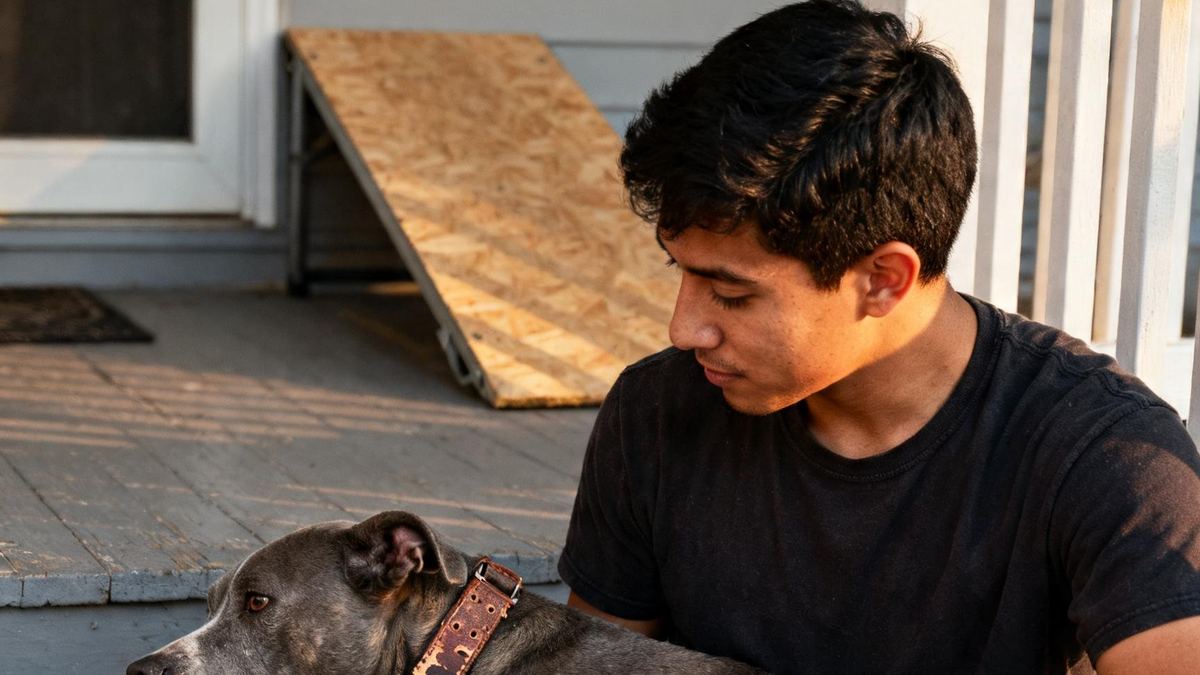
The first week ran on a schedule Marcus wrote on an index card and taped to the fridge. Eye drops, seven a.m. and seven p.m. Joint supplement crushed into the wet food, because Hazel wouldn't touch a pill wrapped in cheese. A ramp he built out of scrap plywood so she wouldn't have to take the porch steps. He learned to stomp twice on the floor before entering a room, so the vibration would wake her gently instead of startling her into a snap.
The vet bills came fast. Bloodwork, $210. A dental cleaning she needed badly, $640, paid in two installments because that's what fit in his checking account. Prescription food, $58 a bag, gone in three weeks. He picked up a Saturday shift at the hardware store on Virginia Avenue to cover it and didn't tell anyone why.
At night Hazel slept against his shin, and when he shifted in bed she'd startle awake, disoriented, turning her head toward sounds she couldn't place. He learned to lay his hand flat on her side before he moved, so she'd feel him first.
Three weeks in, his sister Danielle called. "You adopted a blind, deaf dog. With everything you went through with Dad—why would you do that to yourself again?"
"She's not Dad."
"I know that. I'm asking why you'd choose it again."
Marcus didn't have an answer that night. He gave her one two weeks later, though he didn't know it yet.
It happened on a Tuesday. Hazel wouldn't eat her breakfast. She lay by the ramp, breathing fast and shallow, and when Marcus knelt beside her she flinched from his hand—something she hadn't done since the first day. He carried her to the car in his arms, the way he used to carry his father down the hospital corridor when the wheelchair wouldn't fit through a doorway, and drove to the emergency vet on East 10th Street with his hazards on the whole way, running two yellow lights that turned red before he cleared the intersection.
The vet, a woman named Dr. Okafor, kept Hazel in the back for forty minutes while Marcus sat in a plastic chair reading the same paragraph of a pamphlet about heartworm prevention six times without understanding a word.
"Her heart's enlarged," Dr. Okafor said when she came out. "Common at her age, worse because of the deafness—her body's been compensating for lost senses for years, and the strain adds up. We can manage it with medication. It won't reverse it. I want to be honest with you: with dogs like Hazel, we're not talking about years. We're talking about good months, if we're careful."
"How many?"
"I can't tell you that. Nobody can."
Marcus sat with that the way he'd sat with a different doctor, four years earlier, in a different plastic chair, hearing a different version of the same sentence about his father. He remembered exactly what he'd wanted then, which was for somebody to just tell him the number so he could stop flinching every time the phone rang.
He drove Hazel home with a new bottle of pills in the cupholder and her head resting against his thigh the entire way, because she'd climbed into the front seat and he hadn't had the heart to move her.
That night he didn't write anything on the index card. He just sat on the kitchen floor with his back against the cabinet and Hazel's head in his lap, running his thumb along the dent in her old collar, and let himself think about the six years he hadn't let himself think about all at once—the pureed food, the physical therapy appointments he drove his father to on his lunch breaks, the last morning, when his father's hand had found his on the blanket and held on, not to say anything, just to confirm he was there.
He'd told himself back then that loving someone who was leaving was a kind of foolishness. He'd told himself that again in the shelter parking lot, loading a nearly blind, nearly deaf dog into the back of a 2011 Honda. He didn't believe it either time.
The medication helped. Hazel's breathing evened out over the following weeks. She started eating her breakfast again, started sniffing the rear tire every morning like it was a ritual she needed. Marcus kept the Saturday shift. He kept the index card on the fridge, though he stopped needing to check it—the schedule had moved into his hands the way his father's schedule once had, into muscle and habit rather than paper.
Six months later, on a Sunday afternoon in early spring, Marcus sat on the porch steps with Hazel stretched out beside him in a patch of sun, her gray muzzle resting on his knee. He stomped twice on the wood before he reached for her, out of habit now more than necessity, and rested his palm flat against her ribs to feel them rise and fall.
"You're still here," he said, not because she could hear him, but because he needed to say it out loud.
Hazel exhaled, long and slow, and pressed her head harder into his knee—the same weight, the same trust, his father used to lean into his hand at the end, when words had stopped being the point.