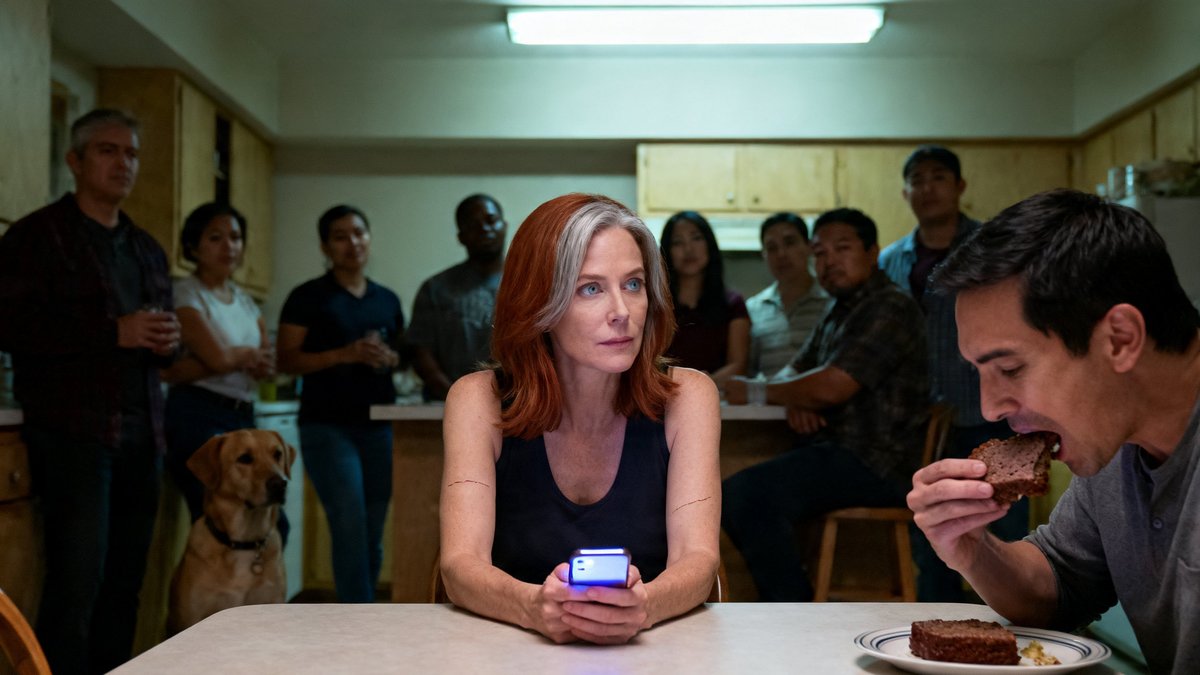
Marianne Cole was still holding her phone when Doug walked past her into the kitchen and opened the fridge like nothing had happened.
"Twenty years," she said. "Twenty years, Doug."
"I heard you the first time." He grabbed a beer, cracked it against the counter edge. "Mom already told the Hendersons we're coming Saturday. They're bringing their tiller."
The confirmation email was still glowing on her screen: *Cedar Hollow Inn looks forward to hosting your anniversary celebration.* She'd booked it in February. Six months of quietly moving fifty, sometimes seventy-five dollars a week from her paycheck into a separate savings account labeled "Us" so Doug wouldn't ask questions. She'd found their old wedding photographer's daughter, who now shot weddings out of Asheville, and paid her to drive two hours just to catch candids of two middle-aged people dancing badly in a barn.
"It's not a tiller weekend," Marianne said. "It's our anniversary."
Doug sat at the table, pulled his plate toward him — meatloaf going cold, the ketchup bottle sweating a ring onto the placemat. "Mom's seventy-three, Mari. The potatoes don't wait for anniversaries."
She sat down across from him and made herself keep her voice level, though her hands weren't cooperating. "Do you remember our tenth? We had train tickets to Savannah. Your mother called about a leak in the porch roof and we cancelled."
"The roof was leaking."
"Fifteenth. I'd booked the private room at Marchetti's. Forty people. We cancelled because the tomatoes were 'about to split on the vine.'"
He didn't answer that one. He just chewed.
This was the pattern, and it had taken Marianne the better part of two decades to see it as a pattern instead of just bad luck stacking up. Every celebration that belonged to their marriage got quietly rerouted toward Ruth Cole's five acres outside Hendersonville — the garden, the canning, the gutters, the driveway that needed regraveling every spring. Marianne had spent her twenties trying to earn a place in that family, showing up every other Saturday to weed bean rows, cooking Thanksgiving for fourteen people while Ruth supervised from a lawn chair with sweet tea. She used to tell herself it was what good wives did.
"I already told the Hendersons we're in," Doug said. "Told Mom too. It's decided."
"You told them. Not me."
"What's there to discuss? She needs help. We help. That's how it's always worked."
Marianne looked at him — this man who used to drive four hours round trip in college just to bring her soup when she had strep throat — and felt something in her chest go very still and very clear.
"Not this time," she said.
"Mari, don't be—"
"I'm not cancelling the inn."
That night, after Doug fell asleep in front of a Braves game, Marianne pulled the wedding album down from the closet shelf, dust furring the spine. She sat on the edge of the bed and paged through it slowly — twenty-three-year-old Doug in a rented tux that didn't quite fit the shoulders, her own veil catching the light from the church's side window. Their daughter Paige wasn't born yet in a single one of these pictures. Ruth Cole was in exactly four of them, and in every single one she was looking at the camera like she wasn't sure she approved of the bride.
Marianne closed the album. Somewhere down the hall a floorboard creaked — just the house settling, the way it always did around eleven — and for a second she thought it was a sign, then decided it was just the house.
In the morning she called her friend Denise before her coffee finished brewing.
"It's happening," she said. "Saturday. As planned."
"And Doug's going to the farm anyway?"
"Doug can do what Doug wants. I'm done building my life around his mother's harvest schedule."
She called the inn to reconfirm. She texted Paige, who was living in Charlotte now and working at a pediatric clinic, and told her the plan hadn't changed. She texted their old best man, Frank, and his wife Carol, who'd moved to Greenville years back but still sent a Christmas card every year with a photo of their beagle in a Santa hat.
Doug found out at dinner. His fork stopped halfway to his mouth.
"You're actually going through with this."
"I am."
"Alone?"
"Paige is coming. Frank and Carol. Denise and her husband. A full room, Doug. You're the one who scheduled a potato harvest instead."
The phone rang forty minutes later. RUTH COLE, the screen said. Marianne put it on speaker and set it on the counter like it was nothing more than a weather report.
"Marianne, what exactly do you think you're doing?" Ruth's voice had that particular pitch it got when she was cornered and trying to sound offended instead. "Doug says you won't come Saturday. I already told the Hendersons, told the whole church prayer group we'd have three families out there working—"
"I'm sure they'll manage without me, Ruth."
"Do you have any idea how much work this is? For who do you think I'm doing all this? For you two!"
"Twenty years of marriage happens once," Marianne said, and she was surprised by how calm it came out. "The potato harvest happens every year, rain or shine, with or without me."
"You ungrateful—"
She ended the call before Ruth got to finish the sentence. Outside her kitchen window, a mockingbird was working through its whole repertoire on the power line, the same one that had been driving their neighbor's cat crazy for two weeks straight.
Saturday came in clear and warm, the kind of late-September morning that made the Blue Ridge look like it had been repainted overnight. Doug packed a bag in silence — boots, gloves, an old Panthers cap he only wore for yard work. He didn't look at her on his way out.
"Change your mind, you know where we'll be," he said through the truck window. "Mom wants everyone there by noon."
Marianne watched the truck back down the driveway and felt something inside her go quiet instead of hollow — a difference she hadn't expected.
Cedar Hollow Inn sat at the end of a gravel road lined with dogwoods just starting to turn. Paige was waiting on the porch steps, having driven up that morning with an overnight bag and a garment bag holding a dress Marianne had never seen.
"Mom. You look incredible." Paige hugged her hard enough to lift her half off her feet. "Where's Dad?"
"Your father picked potatoes."
"Of course he did." Paige pulled back, studying her mother's face. "You okay?"
"Better than okay. I picked us."
Inside, the private dining room filled up through the afternoon — Denise and her husband Mark, Marianne's brother Tom with his wife and two teenagers, three coworkers from the accounting firm where Marianne had put in eleven years, and finally Frank and Carol, who'd driven in from Greenville with a bottle of the same Riesling they'd served at the wedding reception.
"You didn't cave," Frank said, lifting his glass. "To Marianne. Twenty years and she finally threw herself a party."
They watched an old VHS transfer of the wedding reception on a laptop somebody had hooked up to the TV — younger versions of all of them dancing off-beat to a song none of the teenagers recognized. Marianne laughed until her eyes watered at the sight of Doug attempting the electric slide.
Later, she and Paige walked the gravel path around the inn's small pond, string lights just starting to come on in the trees. Marianne stopped to look at the water, at the ring the porch lights threw across it, and didn't say anything for a while. Paige didn't either. They just stood there until the mosquitoes got bad enough to send them back inside.
Back at the Cole farm, the day was not going the way Ruth had planned. Doug's brother called at ten — his son had a fever, they weren't coming. His sister backed out an hour later because her husband refused to drive up alone. The two Henderson boys who'd promised to help showed up, took one look at the size of the job with half the crew missing, and said they'd need to be paid for their time.
"See what your wife did," Ruth muttered, handing Doug another crate. "Ruined everything. Ruined the whole day."
Doug kept digging. Dirt worked itself under his nails, sweat soaked through the back of his shirt, and every few minutes he found himself doing the math on his fingers without meaning to — ten years, Savannah; fifteen, Marchetti's; every birthday dinner that turned into a Saturday out here instead. He set his shovel down twice without noticing he'd stopped.
By the time he pulled into the Cedar Hollow parking lot it was almost ten, dinner long since cleared, but a handful of guests were still out on the terrace with the last of the wine. Marianne was laughing at something Carol said, candlelight catching the edge of a dress the color of dark plum. He stood at the edge of the lawn for a second before she noticed him.
"Can we talk?" His voice came out rougher than he meant it to.
They walked to the gazebo at the far end of the property, string lights swaying slightly in a breeze that smelled like cut grass and somebody's cigarette from two tables over.
"I dug potatoes all day and thought about you the whole time," Doug said. "Mom kept complaining and all I could hear was every year I let this happen. The trip to Savannah. Marchetti's. All of it."
Marianne didn't say anything. She let him keep going.
"I chose easy. It was easier to agree with Mom than to stand up for you, and somewhere along the way I stopped even noticing I was doing it. Twenty years, and I let our life get scheduled around her garden instead of around us."
"You didn't ruin today," Marianne said finally. "Today I got to sit at a table full of people who came because they wanted to be here. Nobody had a crate to fill."
He reached for her hand, and this time she let him hold it.
The following spring, Ruth called with her usual list — the greenhouse needed expanding, the fence needed mending, could they come Memorial Day weekend.
"We'll come one Saturday if we're free," Doug told her. "But we've got our own plans for the holiday."
"What plans?"
"Ours, Mom. Marianne and I decide our weekends now."
Ruth didn't call for eleven days. Eventually she hired two teenagers from town to help with the fence instead.
That September, on their twenty-first anniversary, Doug and Marianne drove to Hilton Head — six nights, no garden, no crates to fill. They walked the beach at low tide and ate dinner at a place with paper tablecloths and a cup of crayons on the table, and on the last night they sat out on the porch long after the sun had dropped behind the marsh grass, past when the mosquitoes usually chased them in. Marianne picked up a crayon and drew a crooked little house on the corner of the tablecloth, and under it, in the shaky print of someone who hadn't used a crayon in years, she wrote both their names and the number twenty-one. Doug added the date next to it, and neither one of them made a move to go anywhere.





