The night I lost everything, the ER smelled like burnt coffee and wet wool. I stood at the ambulance bay doors, watching the sleet come down sideways, a cardboard box of my desk stuff getting soggy in my arms. Dr. Gregory Hayes, DVM — that’s me — formerly of Willow Creek Veterinary Hospital, now just Greg. Fired. Not for malpractice. Not for negligence. For telling a city councilman his prize Labrador needed a diet, not a repeat prescription for painkillers the dog didn’t need. The councilman didn’t like that. The clinic’s board liked the councilman’s donations even less.
I drove home in my old Subaru, heater barely coughing out warmth. Somewhere on Arapahoe Road, a homeless woman and her kid were trying to cross six lanes of traffic in the dark. I almost didn’t see them. No cardboard sign this time, just a mother towing a little girl by the hand, the kid clutching a rain-soaked stuffed lion in a flimsy king costume. I swerved, heart punching my ribs, and pulled into a Walgreens parking lot to breathe. When I came out with a bag of granola bars and two Gatorades, they were huddled under the awning of a closed dry cleaner.
The girl couldn’t have been more than eight. Her lips were the wrong color. She had a cough that rattled in her chest like loose change, and her mother — tall, bone-thin, wearing a jean jacket way too light for thirty degrees — kept saying, “She’s fine. She just needs to sleep it off.”
“I’m a vet,” I said, and then immediately wanted to swallow my own tongue. “I mean. Not a people doctor. But I know a respiratory infection when I hear one. That kid needs a warm room and antibiotics.”
The mother’s face went hard, a door slamming shut. I knew that look. I’d seen it on strays and rescues — the flinch before the bite. “We’re not a charity case.”
“I’m not offering charity,” I said. “My guest room has clean sheets and I’ve got a pot of chili on the stove I can’t finish alone. Name’s Greg. I can show you my license if it helps.”
Her name was Lorraine. The girl was Maya. They’d been sleeping in a Nissan Sentra for six weeks, ever since Lorraine’s husband decided the way to fix an overcooked pot roast was to slam her head into the refrigerator door. He was an IT guy with a LinkedIn profile full of endorsements and a temper that showed up only behind locked doors. She had fresh bruises under that jacket. I didn’t see them until she hung it on a kitchen chair and her sleeve rode up, exposing arms mottled deep purple and greenish yellow, the kind left by a hard grip that didn’t let go.
Maya fell asleep on my couch before she finished her second bowl of chili, the stuffed lion tucked under her chin. Lorraine sat rigid on the edge of an armchair, watching me like I might sprout extra heads. I told her about the councilman, about the board, about the box of my stuff that was now drying out on the passenger seat of my car.
“Seems like a lot of people get screwed by a few assholes with checkbooks,” she said.
“Seems like,” I agreed.
She started talking. I didn’t prompt. Sometimes a person just has a story that’s been stoppered up so long it bursts the moment someone offers an ear that isn’t looking to judge. The husband — Derek — had isolated her from friends, tracked her phone, drained the joint account after she mentioned wanting to visit her sister in Boise. When she filed a report, his mother stepped in. Patricia, a woman with a Title at the county assessor’s office and a Rolodex full of favors, had told Lorraine in a voice as smooth as car oil that if she pursued this, the family would ensure Maya ended up in a “more stable environment.” The implication was a knife wrapped in a silk napkin: *You’ll lose your kid.*
I listened. I didn’t sleep that night. I sat in my recliner and watched Maya’s chest rise and fall under a Denver Broncos throw blanket and thought about all the broken things in this world that can’t be fixed with a prescription or a splint.
By morning, Maya’s fever hit 102. Lorraine panicked, started gathering their things with shaking hands, apologizing for being a burden. I was already on the phone with Dr. Kessler, the only MD I knew who still made house calls in the twenty-first century — a semi-retired pediatrician who owed me a favor from the time I’d saved his golden retriever from a porcupine. He came over with a stethoscope and a surprisingly gentle manner for a man who looked like a grumpy walrus.
“Bronchitis,” he said. “Keep her warm. Antibiotics. She’ll be fine in a week.”
I drove to the pharmacy while Lorraine sat with Maya, refusing to leave the couch. When I got back, my mother was parked in the driveway.
Ida Hayes is seventy-one, built like a sparrow, and carries enough authority to make generals stand at attention. She’d let herself in with her spare key and was already in the kitchen, unpacking a Tupperware of beef stew and a loaf of homemade sourdough. She’d heard about the firing through the grapevine — Boulder is a small town dressed up in a medium-sized city’s clothes.
“I come to check on you, and I find a sick child and a woman who looks like she’s been through a spin cycle,” she said, eyeing Lorraine with the same expression she uses on undercooked poultry.
“Ma, this is Lorraine and Maya. They needed a place.”
Ida assessed Lorraine for a long moment. Then Maya, who was awake now, coughing weakly. Then me. “Did you make them breakfast?”
“I was getting the antibiotics—”
“Useless, all of you.” She tied on my spare apron. “Lorraine, can you eat eggs? Good. Sit down. Greg, you—go change the sheets in the guest room. I can smell the bachelor from here.”
Lorraine’s lips curved upward. The first real one I’d seen. It was like watching a patch of sun break through a cloudy window.
That evening, I came downstairs to find Ida and Maya at the kitchen table, bent over a puzzle — a five-hundred-piece thing with a covered bridge in Vermont. Maya was humming to herself, her cough already loosening. Lorraine was watching them from the doorway, a strange expression on her face. A mix of wonder and grief.
“You’re lucky,” she said, keeping her voice low. “Your mom. She’s something.”
“Half the time I want to throttle her,” I said. “The other half, I’d be dead without her.”
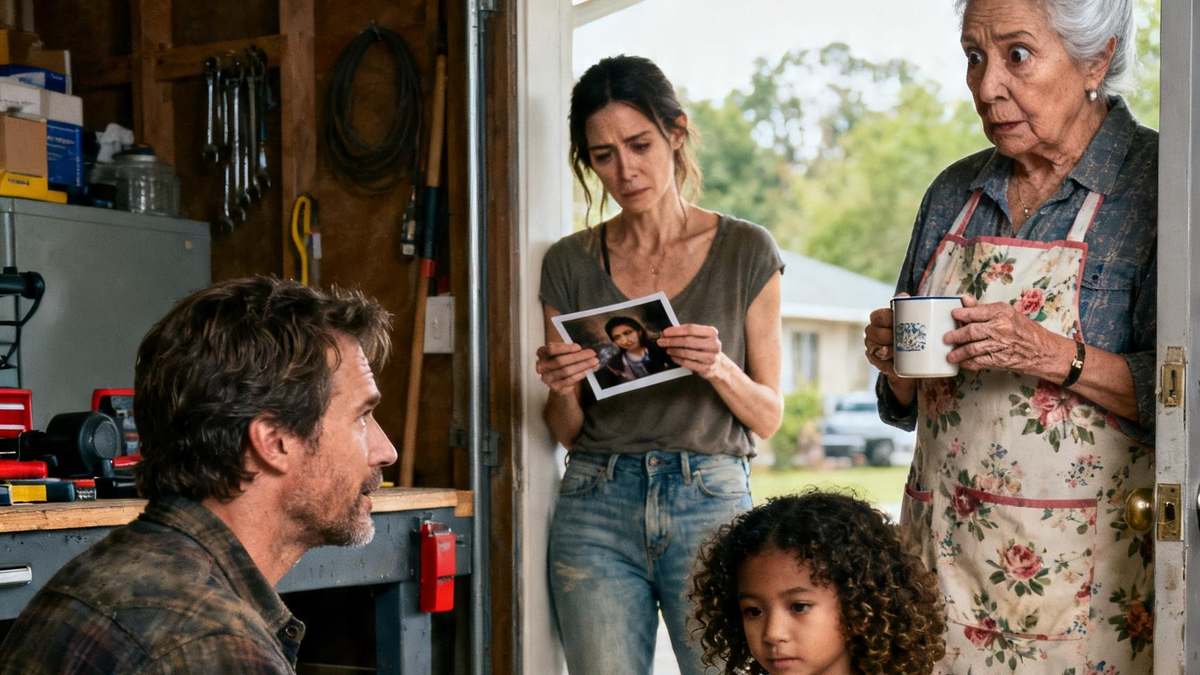
On the fourth day, Maya, feeling better, decided to “help” me in my garage. I was organizing tools I hadn’t touched in years — unemployment does that to a man, makes him alphabetize screwdrivers. While I was under the workbench, Maya dragged a dusty cardboard box away from the wall and dug through it. She lifted a photograph, faded and cracked inside a cheap frame.
“Who’s this guy?” she asked.
I looked at it and my blood stopped.
The man in the photo was Martin Hayes. My father. Except he wasn’t standing with my mother or me. He was older, gray, standing in front of a redwood tree in California, his arm around a woman I’d never seen. Between them, a little girl in a yellow sundress clutched a stuffed lion — a cheap plush in a gold-paper crown, the kind you might win at a county fair.
Lorraine came out to the garage to see what the noise was about. She saw the photo, and all the life left her face.
“That’s my mom. Ellen.” Her voice had no air in it. “And that lion… my mom gave me one exactly like it when I was little. I still have it, in a box of her things. I bought Maya one a few years ago, the same style, because it felt like… protection. A family thing.”
I flipped the frame over. On the back, in my father’s tight engineer’s handwriting: *Martin, Ellen, and little Lorraine. Muir Woods, 1992.*
Ellen. Not Ida. *Ellen.*
Lorraine was thirty-six, I was forty-two. The math made me furious. My father left when I was ten. That would be 1992 — the same year as this photo. He’d already built another family while my mother was still wearing her wedding ring, before he finally walked out. Lorraine had to have been born around 1988, when I was eight, before the leaving. A second daughter, hidden from us both.
“What do you know about your father?” I asked, and the words felt like pieces of broken glass in my mouth.
“He… my mom said he died. Before I was born. That’s what she always told me. She died when I was nineteen — pancreatic cancer, fast — and I never… I never questioned it.”
I pointed at Martin’s face. “This man was an engineer. Built bridges. He walked out on my mother and me when I was a kid. He’s my father.”
Lorraine’s expression went through several stages — confusion, disbelief, a slow, dawning understanding. “Are you saying we’re—”
“I’m saying Martin Hayes had two families. And you, Lorraine, are my half-sister.”
Maya tugged on my sleeve. “Does that mean you’re my uncle Greg? For real?”
Before I could answer, Ida appeared in the garage doorway. She’d come to bring Maya a hot chocolate and saw us all sitting on the cold concrete, the photo in Lorraine’s trembling hands. She looked at it. She looked at me. Her mouth pressed into a thin line.
“I suppose,” she said, her voice uncharacteristically fragile, “there’s no point in pretending anymore.”
She’d known about Ellen. She’d found the letters, years after he left, when she was cleaning out his office. Love letters. Plans. A confession. She’d buried them in a box in the attic alongside her wedding ring. “I didn’t want you hating him,” she told me. “Hating someone takes so much energy, and you were already angry enough at the world. I thought I was protecting you.” She turned to Lorraine. “I didn’t know your name. I didn’t know there was a daughter. I only knew there was a woman, and that he’d been living a second life long before he walked out. I’m sorry. I never imagined…”
Lorraine didn’t cry right away. She just sat there, holding the photo, staring at a man she’d never meet. Then Maya climbed into her lap, and the tears came, the kind that are too worn out to make much sound.
That night, Ida made pot roast. We ate at the table, all four of us, and nobody said much, but something had shifted. A door had opened that couldn’t be closed again.
A week later, Derek pulled into my driveway in a polished Audi A6, wearing a North Face vest and a smile calibrated for witnesses. He’d found us through a tip from some “concerned” parent at Maya’s school. He stood on my front porch holding a bouquet of lilies and a gift bag, looking for all the world like a devoted husband on a reconciliation mission. His mother, Patricia, idled in the passenger seat with the window rolled down, radiating the smug certainty of someone who’d never lost a game because she owned the board.
Lorraine was inside, in the kitchen, shaking so hard she nearly dropped the coffee pot.
I walked out onto the porch. I didn’t raise my voice. I didn’t need to.
“Derek. Patricia. You’re trespassing.”
“Greg, be reasonable.” That smile, wide and empty. “I just want to see my daughter. A father has rights.”
“You had the right to not slam your wife’s head into a refrigerator. You waived the rest.”
His smile vanished. “You don’t know the story. She’s unstable. I’ve got lawyers—”
I lifted my phone, screen toward him. “This has been recording since I opened the door. I’ve also got Dr. Kessler’s notes from Maya’s exam, photos of Lorraine’s injuries, and a police report she filed three days ago with a very interested detective. Your mother’s connections might make a parking ticket disappear, but they can’t bury an assault charge. You want to do this on the front lawn? Go ahead. But every word you say is being preserved for a courtroom.”
Patricia’s face, already pinched, grew tighter. She leaned toward Derek, murmured something sharp. Derek’s knuckles went white around the bouquet, snapping several stems.
“This isn’t over,” he ground out.
“It is for tonight. And every night after this. You come near my sister or my niece again, and the next conversation will be with a bailiff.”
The Audi peeled out of the driveway, leaving a smear of rubber on the asphalt. I stood there until the taillights disappeared, then went back inside and locked the door. My hands were steady, but my pulse was pounding against my ribs.
Two days later, a woman from Child Protective Services showed up at the door with a clipboard and a face that had practiced neutrality. Patricia, it turned out, had made an anonymous call claiming an “unfit mother and a strange man” were keeping a child in unsafe conditions. The caseworker interviewed all of us, walked through the house, spoke to Maya alone. I watched Lorraine’s face gray as she answered question after question, the old terror of losing her daughter seeping back into her eyes. When the caseworker finally left, saying it “appeared unfounded,” Lorraine collapsed into a kitchen chair and didn’t speak for an hour. The shadow of that visit hung over us until the restraining order hearing finally gave us something solid.
The hearing was brief. Patricia tried to back-channel, but the judge — recently reelected after a primary challenge — had no patience for insiders. The restraining order became permanent. Derek was granted supervised visitation: one hour, every other Sunday, in a beige room at a county facility. He has yet to show up for a single one. Patricia’s quiet replacement at the assessor’s office came later, after an unrelated audit turned up suspicious property assessments. None of it felt like a victory. It felt like a long, bureaucratic flinch that somehow missed us.
The councilman with the Labrador didn’t vanish, either. When my termination appeal came before the board, Kessler testified, former clients sent letters, and my old vet tech Aaron presented records showing the dog’s joint inflammation had been managed beautifully with a diet and glucosamine. The board reinstated my license. But the news didn’t travel clean. The *Daily Camera* ran a tiny item about a local vet “censured for treatment philosophy,” and the councilman’s admin assistant made sure certain phrases — “difficult,” “unprofessional commentary” — bobbed around the community. Willow Creek Veterinary offered me my old job back, but with a probationary period and a docked salary, making it clear they were doing me a favor. I turned it down.
I took out a small business loan instead. The first bank declined me outright, citing the board’s “letter of concern” that still sat in my file. It took my mother co-signing — a thing that chafed both of us — and a second application at a credit union to get approval. Aaron quit the old clinic and came with me. Lorraine, who’d been job hunting for weeks, offered to work the front desk. We leased a run-down pet clinic in Longmont that had most recently been a tax preparer’s office and still carried the ghost of stale coffee and despair. While Aaron and I scrubbed exam rooms, Lorraine organized files, painted the waiting room a shade called “sea glass” that dried an underwhelming beige, and started a corkboard for patient photos.
Maya drew the sign for the door herself. “Uncle Greg’s Animal Hospital,” it read, featuring a stick-figure me in a white coat beside a dog with enormous wings. “So the sick ones can fly when they feel better,” she explained.
Ida hauled over her sewing machine and stitched curtains for the exam-room windows. She never said she was proud — she’s not the type — but she appeared every day for a month with homemade lunch, which is an Ida Hayes declaration of approval more potent than any framed certificate.
Last Thanksgiving, we all gathered at my mother’s tiny house in Niwot. Rain pattered the windows, the turkey was slightly dry, and Maya had made place cards with hand-drawn portraits of each guest. Mine showed me in the white coat. Ida’s portrait gave her the fire poker she’d kept close during the Derek confrontation. Maya’s own self-portrait had her clutching the stuffed lion, which she still slept with every night.
Lorraine stood to make a toast, her glass of Martinelli’s steady in a hand that used to tremble for other reasons. “To the brother I never knew I had,” she said, “who didn’t walk past.”
Nobody looked at the empty chair at the head of the table, but we all knew it was there, holding the ghost of a bridge builder who’d spanned rivers and created chasms in equal measure. The old photograph from Muir Woods now occupied the mantelpiece, placed by Ida herself weeks after we unearthed it.
Later, after the pie, Maya climbed into my lap with her sketchbook. “I’m drawing the bridge,” she announced. “The one Grandpa built. But I’m putting all of us on it, from my other pictures.”
She showed me the rough lines: a suspension bridge spanning a blue-crayon river, with a clinic on one side, a house on the other, and five small figures — a girl, a woman, a man, a grandmother, and a faded shape set slightly apart.
I tapped the faded shape. “Is that your grandpa?”
She dipped her chin, solemn. “He’s not in the clinic. He’s not allowed yet. But he’s on the bridge, in case he wants to walk back someday.”
Ida, who had been clearing plates, stopped and looked at the drawing. Then she took a thumbtack from the corkboard and pinned it right beside the grocery list, where it could be seen from every seat at the table.





