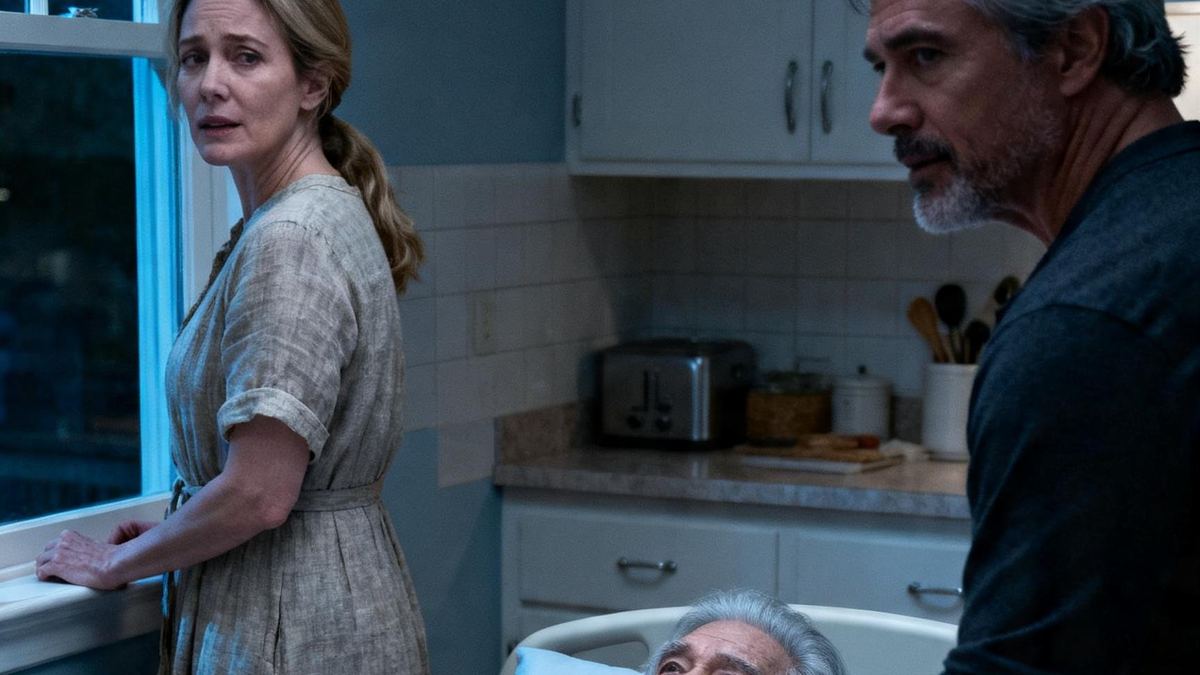
Claire was thirty-nine and still turned heads at the grocery store. She knew it, catalogued it the way other women tracked their 401(k) balances. That beauty had once felt like a ticket to somewhere. Now, on a Tuesday morning in late September, she stood at the kitchen window of their ranch house in Sacramento, watching the sprinkler sputter across a patch of brown grass, and felt like she’d already been to wherever the ticket was for and come back empty-handed.
Fifteen years with Michael. He was a structural engineer—steady, methodical, a man who read the manual before assembling furniture. He’d never once raised his voice at her or the girls. He remembered to replace the HVAC filters. He folded laundry while watching PBS documentaries about the Roman aqueducts. By every available metric, the marriage was a success, which was exactly the problem. Claire had started craving a disaster just to feel something that wasn’t this low-grade numbness, this sense that the rest of her life was a hallway she’d already walked down.
The girls were fourteen and twelve now—Mia and Chloe. Mia had recently perfected the art of communicating exclusively in single syllables and slammed doors. Chloe lived inside her phone, surfacing only to complain about dinner. Claire would sit at the table, pushing roasted chicken around her plate, and realize nobody had spoken for six full minutes. The silence wasn’t hostile. It was worse. It was comfortable.
So she made a plan. A meticulous, color-coded, hyperlink-filled plan buried in a folder on her laptop labeled “Tax Docs.” Rental listings in Midtown, walking distance from the coffee shop where she could work remotely. A budget with line items for utilities, a parking permit, health insurance. She’d even priced out studio furniture on IKEA’s website. Not a dramatic exit—no slammed doors, no affair. Just a quiet, grown-up extraction. A life of her own, small but real, with nobody else’s dishes in the sink.
She set the date for a Saturday. Told herself she’d sit Michael down after breakfast, when the morning light made everything feel less catastrophic. All week she was almost tender with him, guilty in advance.
Friday night, she got the call from her mother’s neighbor in Elk Grove. Jean had fallen in the bathroom. Stroke. They’d taken her to Mercy San Juan.
Claire stood in the entryway with the phone still pressed to her ear, wearing a linen dress she’d bought for the new life. Michael was already at the coat closet, pulling on his jacket.
“I’ll get the car,” he said. “Pack her a bag. Socks, slip-on shoes, a robe. She’ll need a robe.”
And just like that, the plan collapsed. Not gently. Not slowly. All at once, like a retaining wall giving way.
—
The ICU waiting room smelled like hand sanitizer and burnt coffee from the vending machine. Claire sat in a plastic chair with a rip in the upholstery, staring at a muted TV showing a home renovation show. A couple in Nashville was arguing about backsplash tile. She wanted to throw something at the screen.
Jean had been an English teacher for thirty-two years at McClatchy High. She could silence a room by lowering her voice half a decibel. She’d raised Claire alone after Claire’s father took off for Phoenix in ’92, and she’d done it with a kind of ferocious competence that left no room for doubt—or warmth. Claire had spent her twenties trying to become the opposite of her mother. She’d married Michael partly because he was so unlike Jean: soft-spoken, undemanding, easy to please.
Now Jean lay in a hospital bed, her left side slack, her speech reduced to a slurred smear of syllables. A neurologist with kind, tired eyes talked about the extent of the infarct, about aspiration risk and the window for meaningful recovery. The first ninety days are critical. After that, whatever function hasn’t returned probably won’t. He said the word “probably” seven times.
Claire’s mind was already calculating. She could use the escape money—the $17,000 she’d been feeding into a separate savings account for eighteen months. Hire a home health aide through an agency, then move Jean to a skilled nursing facility. There was a place in Folsom with a memory care wing and a courtyard with roses. Her friend Kate’s father-in-law had been there. It cost $9,400 a month but it didn’t smell like bedpans and the CNAs actually showed up. She could swing it if she rented out Jean’s condo.
On the drive home, she laid it all out for Michael, talking fast, her hands moving. “I’ve got some savings set aside. We bring in Visiting Angels for the first few weeks, then transition her to a facility. Kate swears by this place—it’s got a therapy pool and a speech pathologist on staff. I know it’s expensive, but I can cover it. And her condo, if we list it for rent, the market’s strong right now. We’re probably looking at, what, six months? A year, tops, and then she’ll be back on her—”
“Claire.”
He said it quietly, but she stopped midsentence like a car hitting a curb. He only used that tone when something was final.
“We’re bringing her home. To our house.”
She turned in the passenger seat. “Michael. It’s not a broken ankle. She can’t walk to the bathroom by herself. She can’t say her own name.”
“I know what a stroke is.”
“Then you know we’re not equipped—”
“We’ll put her in Mia’s room. Mia can take the den. We’ll get a hospital bed, one of those rails, whatever. The den’s got that big window. She’ll like the light.”
“Mia will lose her mind.”
“Mia will survive.” He signaled, changed lanes, merged onto the freeway. Smooth. Unhurried. “I’m not sending your mother to some facility where she’ll sit in a hallway all day watching people drool. I don’t care how nice the roses are.”
Claire wanted to scream. Wanted to say: *I was leaving you. I had a plan. I was going to be free.* Instead she said, “You don’t owe her this.”
He glanced at her, then back at the road. “It’s not about what I owe.”
—
They brought Jean home on a Wednesday. The Sacramento heat had finally broken, and the air had that first edge of autumn, dry and faintly electric. Michael had spent the weekend clearing out Mia’s room—posters down, books boxed, the IKEA daybed replaced by a hospital bed that came from a medical supply company in Rancho Cordova.
Mia had cried for two nights, then gone silent in a way that worried Claire more than the crying. Chloe retreated further into her phone, posting memes about parental betrayal. The den now held a twin mattress, a floor lamp from Target, and the acrid smell of adolescent resentment.
Michael carried Jean from the car to the front door. One arm under her knees, one behind her back. She weighed maybe a hundred and twenty pounds now—she’d always been thin, but the stroke had hollowed her out. She buried her face against his shoulder, and Claire watched from the doorway, gripping the doorframe so hard her knuckles whitened.
“Here we are, Jean,” Michael said, lowering her onto the bed. “Room service is a little slow, but the management’s friendly.”
Jean’s face tried to smile. The right side cooperated. The left side didn’t. The result was something crooked and terrible and brave.
The first two weeks broke Claire open. Jean was incontinent, humiliated, prone to weeping rages that surfaced without warning and receded just as fast. She would lie in bed and struggle to form words, her good hand clutching the blanket, her eyes wild with frustration. Claire would spoon applesauce into her mouth and think about the woman who’d once made her rewrite a fourth-grade book report three times because “adequate isn’t the same as good.”
She stopped checking her laptop. The folder was still there—“Tax Docs,” the dry joke of it. She didn’t delete it. She just stopped looking.
At 2 a.m. on a Thursday, she found herself on the kitchen floor, back against the dishwasher, crying so hard her ribs hurt. She’d been up since five. She’d changed three sets of sheets. She’d wrestled her own mother onto a commode while Jean called her a name she hadn’t heard since high school. She’d smiled at Michael when he came home from work and said everything was fine, and now, in the dark kitchen, the lie felt like a swallowed bone.
She didn’t hear him come in. Just became aware, gradually, of him sitting on the floor beside her, his back against the cabinets, a mug of tea cooling in his hands.
“I was going to leave you,” she said. The words came out raw and quiet, aimed at the linoleum. “I had it all planned. I was going to tell you that Saturday.”
Silence. The refrigerator hummed. Outside, a neighbor’s sprinkler clicked on.
“I know,” Michael said.
She looked up. His face in the dim light was calm. Not surprised. Not angry. Just calm, like a man who’d already done the math.
“How?”
“You kept the laptop open once. I saw the rental listings.” He shrugged, a small movement. “You’re not as subtle as you think you are.”
“Why didn’t you say anything?”
“Gave you time. Figured you’d either do it or you wouldn’t. Either way, I wasn’t going to argue with a decision you’d already made.”
“That’s insane.”
He took a sip of the tea, made a face. Let it get cold. “Maybe.”
“You would have just let me go.”
“I would have let you do what you needed to do.” He set the mug down and looked at her. “I still will. If that’s what you want. But right now, you need to sleep. You’re running on fumes, and you’re no good to anyone like this.”
She didn’t answer. She let him pull her up, lead her to the bedroom, close the blinds against the streetlight. She fell asleep in her clothes and dreamed of nothing at all.
—
She woke late the next morning to the sound of voices. Jean’s voice—muffled, halting, but trying. And Michael’s, low and steady in response.
She found them in what used to be Mia’s room. Michael was sitting on the edge of the hospital bed, a basin of warm water on the nightstand, carefully washing Jean’s left hand—the bad one—with a washcloth. He was talking about something, a story, his voice unhurried.
“—and then the inspector tells me the rebar spacing is off by three inches, and I’m standing there thinking, I’ve got a crew of twelve guys waiting and a concrete pour scheduled for seven a.m., and this guy wants to debate three inches. So I said, ‘Sir, with all due respect, this is a retaining wall in Elk Grove, not the Hoover Dam.’ And you know what he did? He laughed. Actually laughed. Bought me a coffee at the gas station across the street.”
Jean made a sound that might have been a laugh or a cough. Her good eye was fixed on Michael’s face with something Claire couldn’t quite name.
“I didn’t know you did that,” Claire said from the doorway.
Michael looked up, not startled. “Did what?”
“Talked to her. Like this.”
“We talk all the time.” He rinsed the washcloth, wrung it out. “She can’t say much back yet, but she listens. Better than you, honestly.”
Jean made that almost-laugh sound again.
Claire leaned against the doorframe. Something was shifting inside her—not an earthquake, but a readjustment, furniture sliding back into place after years of sitting crooked. She thought about her plan, her careful arithmetic, the studio apartment with the north-facing window. She’d imagined herself in that apartment a hundred times. She’d never once imagined Michael there with her mother, washing her hands, telling her stories.
That evening, she opened the laptop. The folder sat there among spreadsheets and old tax forms, innocuous and patient. She stared at it for a long time.
Then she dragged it to the trash, emptied it, and closed the screen.
In the other room, Michael was helping Jean with her speech exercises, reading words from a laminated card the therapist had left. “Bird,” he said. “Buh-ird.” And Jean, after a long pause: “Buh… buh…”
Claire stood in the hallway between the two rooms, not going anywhere, just listening. The word hung in the air, unfinished, waiting.